
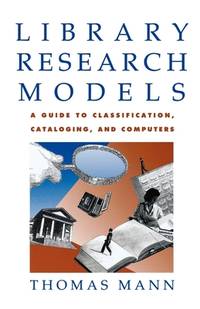
Stock photo: cover may vary
Library Research Models: A Guide to Classification, Cataloging, and Computers Paperback - 1994 - 1st Edition
by Mann, Thomas
- Used
to Libra ry Research Methods shows the full range of search options possible and illuminates the inevitable tradeoffs and losses of access that occur when researchers limit themselves to a specific method. 11 halftone illustrations.
A$13.30
A$5.78
Delivery within USA
Standard delivery: 5 to 9 days
More delivery options
Standard delivery: 5 to 9 days
Ships from Wonder Book (Maryland, United States)
Details
- Title Library Research Models: A Guide to Classification, Cataloging, and Computers
- Author Mann, Thomas
- Binding Paperback
- Edition number 1st
- Edition 1
- Condition Used - Very good
- Pages 268
- Volumes 1
- Language ENG
- Publisher Oxford University Press
- Publication date 1994-12-15
- Features Bibliography
- Bookseller's Inventory # B09B-00691
- ISBN 9780195093957 / 019509395X
- Weight 0.68 lbs (0.31 kg)
- Dimensions 8.02 x 5.13 x 0.77 in (20.37 x 13.03 x 1.96 cm)
- Category Reference
- Dewey Decimal Code 025.524
About Wonder Book Maryland, United States
Biblio member since 2003


With 3 stores less than 1 hour outside the DC/Metropolitan area (1 in Gaithersburg, 1 in Frederick and 1 in Hagerstown, MD), we have the largest selection of books in the tri-state area. Wonder Book and Video has been in business since 1980 and online since 1997. We have over 1 Million books for sale on our website and another 1 Million books for sale in our 3 locations. We have a very active online inventory and as such, we can receive multiple orders for the same item. We fill those orders on a first come first serve basis, but will refund promptly any items that are out of stock. Since 1980 it has always been about the books. ALL kinds of books from 95 cent children\'s paperbacks to five figure rare and collectibles. A merging of the old and new is where we started, and it is where we are today. Our retail stores have always been places where a reader can rush in looking for a title needed for a term paper that is due the next day, or where bibliophiles can get lost \"in the stacks\" for as long as they wish. In 2002 USAToday recognized us as \"1 of 10 Great Old Bookstores\", and we have been featured in numerous other newspaper and TV stories including Washington Post and CSpan.
RETURNS are cheerfully accepted up to 30 days. We ship out within 1-2 business days and U.S. Standard Shipments usually arrive within 6-9 business days, Priority 3-6.
Reader reviews for Library Research Models: A Guide to Classification, Cataloging, and Computers
Write a review for this book
Important Terms and Guidelines
- Please focus on the book’s content and context. Also, add any personal comments as to how you enjoyed the book. Substantiate your likes and dislikes. You may make comparisons to other books.
- Reviews must be at least 140 characters in length.
- Please do not reveal critical plot elements.
- This is not a help line. Contact customer support if you need help.
Your review must not include:
- Obscenities, discriminatory language, or other insulting language not suitable for public domain
- Advertisements, “spam” content, or references to other products, offers or websites.
- Email addresses, URLs, phone numbers, physical addresses or other contact information.
- Overly critical comments about other reviews or reviewers
- Time-sensitive material (i.e. promotional tours, seminars, lectures, etc.)
- Availability, price, or alternative ordering/shipping information
From the publisher
First line
Successful library research is to a large extent a function of the mental set that a researcher brings to the task.

