
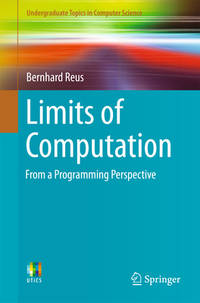
Stock photo: cover may vary
Limits of Computation From a Programming Perspective Papeback -
by Bernhard Reus
- New
A$87.93
A$5.77
Delivery within USA
Standard delivery: 9 to 14 days
More delivery options
Standard delivery: 9 to 14 days
Ships from Cold Books (New York, United States)
Details
- Title Limits of Computation From a Programming Perspective
- Author Bernhard Reus
- Binding Papeback
- Condition New
- Pages 348
- Volumes 1
- Language ENG
- Publisher Springer
- Publication date pp. 348
- Bookseller's Inventory # 6375620260
- ISBN 9783319278872 / 3319278878
- Weight 13.74 lbs (6.23 kg)
- Dimensions 9.25 x 6.1 x 0.76 in (23.50 x 15.49 x 1.93 cm)
- Category Computers - Languages / Programming
- Dewey Decimal Code 005.1
- Quantity available 4
About Cold Books New York, United States
Reader reviews for Limits of Computation From a Programming Perspective
Write a review for this book
Important Terms and Guidelines
- Please focus on the book’s content and context. Also, add any personal comments as to how you enjoyed the book. Substantiate your likes and dislikes. You may make comparisons to other books.
- Reviews must be at least 140 characters in length.
- Please do not reveal critical plot elements.
- This is not a help line. Contact customer support if you need help.
Your review must not include:
- Obscenities, discriminatory language, or other insulting language not suitable for public domain
- Advertisements, “spam” content, or references to other products, offers or websites.
- Email addresses, URLs, phone numbers, physical addresses or other contact information.
- Overly critical comments about other reviews or reviewers
- Time-sensitive material (i.e. promotional tours, seminars, lectures, etc.)
- Availability, price, or alternative ordering/shipping information
From the publisher
From the rear cover
This textbook discusses the most fundamental and puzzling questions about the foundations of computing. In 23 lecture-sized chapters it provides an exciting tour through the most important results in the field of computability and time complexity, including the Halting Problem, Rice's Theorem, Kleene's Recursion Theorem, the Church-Turing Thesis, Hierarchy Theorems, and Cook-Levin's Theorem. Each chapter contains classroom-tested material, including examples and exercises. Links between adjacent chapters provide a coherent narrative.
Fundamental results are explained lucidly by means of programs written in a simple, high-level imperative programming language, which only requires basic mathematical knowledge. Throughout the book, the impact of the presented results on the entire field of computer science is emphasised. Examples range from program analysis to networking, from database programming to popular games and puzzles. Numerous biographical footnotes about the famous scientists who developed the subject are also included.
"Limits of Computation" offers a thorough, yet accessible, introduction to computability and complexity for the computer science student of the 21st century.

