
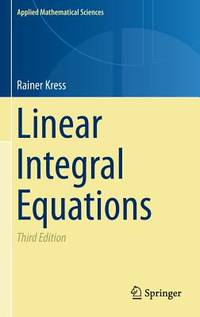
Stock photo: cover may vary
Linear Integral Equations (Applied Mathematical Sciences, 82) Hardback - 2013 - 3rd Edition
by Kress, Rainer
- New
- Hardback
A$170.95
Free Delivery within USA
Standard delivery: 5 to 10 days
More delivery options
Standard delivery: 5 to 10 days
Dropship order
Ships from Ergodebooks (Texas, United States)
Details
- Title Linear Integral Equations (Applied Mathematical Sciences, 82)
- Author Kress, Rainer
- Binding Hardback
- Edition number 3rd
- Edition 3rd ed. 2014
- Condition New
- Pages 412
- Volumes 1
- Language ENG
- Publisher Springer
- Publication date 2013-12-06
- Illustrated Yes
- Features Bibliography, Illustrated, Index
- Bookseller's Inventory # DADAX146149592X
- ISBN 9781461495925 / 146149592X
- Weight 1.71 lbs (0.78 kg)
- Dimensions 9.21 x 6.14 x 0.94 in (23.39 x 15.60 x 2.39 cm)
- Size 6.14x0.94x9.21
-
Themes
- Aspects (Academic): Science/Technology Aspects
- Category Mathematics
- Library of Congress subjects Integral equations
- Library of Congress Catalogue Number 2013954393
- Dewey Decimal Code 515
- Quantity available 1
About Ergodebooks Texas, United States
Biblio member since 2005
Our goal is to provide best customer service and good condition books for the lowest possible price. We are always honest about condition of book. We list book only by ISBN # and hence exact book is guaranteed.
We have 30 day return policy.
Reader reviews for Linear Integral Equations (Applied Mathematical Sciences, 82)
Write a review for this book
Important Terms and Guidelines
- Please focus on the book’s content and context. Also, add any personal comments as to how you enjoyed the book. Substantiate your likes and dislikes. You may make comparisons to other books.
- Reviews must be at least 140 characters in length.
- Please do not reveal critical plot elements.
- This is not a help line. Contact customer support if you need help.
Your review must not include:
- Obscenities, discriminatory language, or other insulting language not suitable for public domain
- Advertisements, “spam” content, or references to other products, offers or websites.
- Email addresses, URLs, phone numbers, physical addresses or other contact information.
- Overly critical comments about other reviews or reviewers
- Time-sensitive material (i.e. promotional tours, seminars, lectures, etc.)
- Availability, price, or alternative ordering/shipping information
From the publisher
From the rear cover
This book combines theory, applications, and numerical methods, and covers each of these fields with the same weight. In order to make the book accessible to mathematicians, physicists, and engineers alike, the author has made it as self-contained as possible, requiring only a solid foundation in differential and integral calculus. The functional analysis which is necessary for an adequate treatment of the theory and the numerical solution of integral equations is developed within the book itself. Problems are included at the end of each chapter.
For this third edition in order to make the introduction to the basic functional analytic tools more complete the Hahn-Banach extension theorem and the Banach open mapping theorem are now included in the text.The treatment of boundary value problems in potential theory has been extended by a more complete discussion of integral equations of the first kind in the classical Holder space setting and of both integral equations of the first and second kind in the contemporary Sobolev space setting. In the numerical solution part of the book, the author included a new collocation method for two-dimensional hypersingular boundary integral equations and a collocation method for the three-dimensional Lippmann-Schwinger equation. The final chapter of the book on inverse boundary value problems for the Laplace equation has been largely rewritten with special attention to the trilogy of decomposition, iterative and sampling methods
Reviews of earlier editions:
"This book is an excellent introductory text for students, scientists, and engineers who want to learn the basic theory of linear integral equations and their numerical solution."
(Math. Reviews, 2000)
"This is a good introductory text book on linear integral equations. It contains almost all the topics necessary for a student. The presentation of the subject matter is lucid, clear and in the proper modernframework without being too abstract." (ZbMath, 1999)

