BIBLIO is the largest independent book marketplace in the world, with over 100 million books.

Skip to content

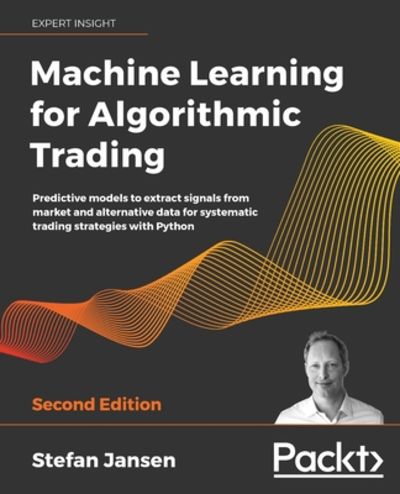
Machine Learning for Algorithmic Trading: Predictive models to extract signals from market and alternative data for systematic trading strategies with Python

Machine Learning for Algorithmic Trading: Predictive models to extract signals from market and alternative data for systematic trading strategies with Python

Machine Learning for Algorithmic Trading: Predictive models to extract signals
Stock photo: cover may vary

Machine Learning for Algorithmic Trading: Predictive models to extract signals from market and alternative data for systematic trading strategies with Python Paperback - 2020

by Stefan Jansen

Add to wish list
  • Used
Used - Very good

Description

Packt Publishing. Used - Very Good.
Ask the seller a question Add to wish list
A$42.74
A$7.08 Delivery within USA
Standard delivery: 5 to 8 days
More delivery options
Ships from The Book Forest (California, United States)

Details

  • Title Machine Learning for Algorithmic Trading: Predictive models to extract signals from market and alternative data for systematic trading strategies with Python
  • Author Stefan Jansen
  • Binding Paperback
  • Condition Used - Very good
  • Pages 822
  • Volumes 1
  • Language ENG
  • Publisher Packt Publishing
  • Publication date 2020-07-31
  • Features Bibliography, Index
  • Bookseller's Inventory # BAY0-00267
  • ISBN 9781839217715 / 1839217715
  • Weight 3.05 lbs (1.38 kg)
  • Dimensions 9.25 x 7.5 x 1.63 in (23.50 x 19.05 x 4.14 cm)
  • Category Computers - General Information
  • Library of Congress subjects Python (Computer program language), Machine learning
  • Dewey Decimal Code 006.31
  • Quantity available 1

About The Book Forest California, United States

Biblio member since 2006

The Book Forest has been selling books on the internet since 2004, with a 98% customer approval rating on other internet book selling venues. At The Book Forest we never mislead customers on the condition of a book so that we might make a sale, and we ship all our orders within 24 hours of receiving them. We also have a 100% money back guarantee, and we handle questions and concerns within a few hours of receiving them.

Terms of Sale: The Book Forest offers a 100% money back guarantee on all items. If you are all dissatisfied with the timeliness or condition of your order you can return it for a full refund (we submit refund upon receipt of the book). Partial refunds are also given if the customer so chooses. Please note that standard/media mail takes 4-14 business days, while priority takes 2-4.

Browse books from The Book Forest

Reader reviews for Machine Learning for Algorithmic Trading: Predictive models to extract signals from market and alternative data for systematic trading strategies with Python

From the publisher

Leverage machine learning to design and back-test automated trading strategies for real-world markets using pandas, TA-Lib, scikit-learn, LightGBM, SpaCy, Gensim, TensorFlow 2, Zipline, backtrader, Alphalens, and pyfolio.

Purchase of the print or Kindle book includes a free eBook in the PDF format.

Key Features:

- Design, train, and evaluate machine learning algorithms that underpin automated trading strategies

- Create a research and strategy development process to apply predictive modeling to trading decisions

- Leverage NLP and deep learning to extract tradeable signals from market and alternative data

Book Description:

The explosive growth of digital data has boosted the demand for expertise in trading strategies that use machine learning (ML). This revised and expanded second edition enables you to build and evaluate sophisticated supervised, unsupervised, and reinforcement learning models.

This book introduces end-to-end machine learning for the trading workflow, from the idea and feature engineering to model optimization, strategy design, and backtesting. It illustrates this by using examples ranging from linear models and tree-based ensembles to deep-learning techniques from cutting edge research.

This edition shows how to work with market, fundamental, and alternative data, such as tick data, minute and daily bars, SEC filings, earnings call transcripts, financial news, or satellite images to generate tradeable signals. It illustrates how to engineer financial features or alpha factors that enable an ML model to predict returns from price data for US and international stocks and ETFs. It also shows how to assess the signal content of new features using Alphalens and SHAP values and includes a new appendix with over one hundred alpha factor examples.

By the end, you will be proficient in translating ML model predictions into a trading strategy that operates at daily or intraday horizons, and in evaluating its performance.

What You Will Learn:

- Leverage market, fundamental, and alternative text and image data

- Research and evaluate alpha factors using statistics, Alphalens, and SHAP values

- Implement machine learning techniques to solve investment and trading problems

- Backtest and evaluate trading strategies based on machine learning using Zipline and Backtrader

- Optimize portfolio risk and performance analysis using pandas, NumPy, and pyfolio

- Create a pairs trading strategy based on cointegration for US equities and ETFs

- Train a gradient boosting model to predict intraday returns using AlgoSeek s high-quality trades and quotes data

Who this book is for:

If you are a data analyst, data scientist, Python developer, investment analyst, or portfolio manager interested in getting hands-on machine learning knowledge for trading, this book is for you. This book is for you if you want to learn how to extract value from a diverse set of data sources using machine learning to design your own systematic trading strategies.

Some understanding of Python and machine learning techniques is required.

Table of Contents

- Machine Learning for Trading

- Market and Fundamental Data

- Alternative Data for Finance

- Financial Feature Engineering

- Portfolio Optimization and Performance Evaluation

- The Machine Learning Process

- Linear Models

- The ML4T Workflow

(N.B. Please use the Read Sample option to see further chapters)

tracking-