BIBLIO is the largest independent book marketplace in the world, with over 100 million books.

Skip to content

Machine Learning Techniques for Gait Biometric Recognition: Using the Ground Reaction Force

Machine Learning Techniques for Gait Biometric Recognition: Using the Ground Reaction Force

Machine Learning Techniques for Gait Biometric Recognition: Using the Ground
Stock photo: cover may vary

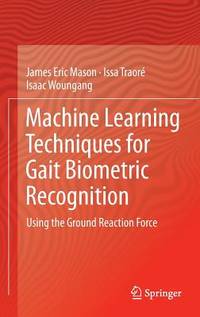
Machine Learning Techniques for Gait Biometric Recognition: Using the Ground Reaction Force Hardback - 2016

by Mason, James Eric/ Traore, Issa/ Woungang, Isaac

Add to wish list
  • New
  • Hardback
New

Description

Springer Verlag, 2016. Hardcover. New. 260 pages. 9.25x6.25x0.75 inches.
Ask the seller a question Add to wish list
A$131.61
A$29.23 Delivery to USA
Standard delivery: 7 to 14 days
More delivery options
Ships from Revaluation Books (Devon, United Kingdom)

Details

  • Title Machine Learning Techniques for Gait Biometric Recognition: Using the Ground Reaction Force
  • Author Mason, James Eric/ Traore, Issa/ Woungang, Isaac
  • Binding Hardback
  • Condition New
  • Language ENG
  • Publisher Springer Verlag
  • Publication date 2016
  • Features Illustrated
  • Bookseller's Inventory # x-331929086X
  • ISBN 9783319290867
  • Quantity available 2

About Revaluation Books Devon, United Kingdom

Biblio member since 2020

General bookseller of both fiction and non-fiction.

Terms of Sale: 30 day return guarantee, with full refund including original shipping costs for up to 30 days after delivery if an item arrives misdescribed or damaged.

Browse books from Revaluation Books

Reader reviews for Machine Learning Techniques for Gait Biometric Recognition: Using the Ground Reaction Force

From the publisher

This book focuses on how machine learning techniques can be used to analyze and make use of one particular category of behavioral biometrics known as the gait biometric. A comprehensive Ground Reaction Force (GRF)-based Gait Biometrics Recognition framework is proposed and validated by experiments. In addition, an in-depth analysis of existing recognition techniques that are best suited for performing footstep GRF-based person recognition is also proposed, as well as a comparison of feature extractors, normalizers, and classifiers configurations that were never directly compared with one another in any previous GRF recognition research. Finally, a detailed theoretical overview of many existing machine learning techniques is presented, leading to a proposal of two novel data processing techniques developed specifically for the purpose of gait biometric recognition using GRF.

This book

- introduces novel machine-learning-based temporal normalization techniques

- bridges research gaps concerning the effect of footwear and stepping speed on footstep GRF-based person recognition

- provides detailed discussions of key research challenges and open research issues in gait biometrics recognition

- compares biometrics systems trained and tested with the same footwear against those trained and tested with different footwear

From the rear cover

This book focuses on how machine learning techniques can be used to analyze and make use of one particular category of behavioral biometrics known as the gait biometric. A comprehensive Ground Reaction Force (GRF)-based Gait Biometrics Recognition framework is proposed and validated by experiments. In addition, an in-depth analysis of existing recognition techniques that are best suited for performing footstep GRF-based person recognition is also proposed, as well as a comparison of feature extractors, normalizers, and classifiers configurations that were never directly compared with one another in any previous GRF recognition research. Finally, a detailed theoretical overview of many existing machine learning techniques is presented, leading to a proposal of two novel data processing techniques developed specifically for the purpose of gait biometric recognition using GRF.

This book

- introduces novel machine-learning-based temporal normalization techniques

- bridges research gaps concerning the effect of footwear and stepping speed on footstep GRF-based person recognition

- provides detailed discussions of key research challenges and open research issues in gait biometrics recognition

- compares biometrics systems trained and tested with the same footwear against those trained and tested with different footwear

About the author

James Eric Mason obtained his BSEng and MASc from the University of Victoria, Canada, in 2009 and 2014, respectively. During his Master's program, under the supervision of Dr. Issa Traore, his research focused primarily on biometric security solutions with a particular emphasis on the gait biometric. In 2014 he completed his thesis titled Examining the impact of Normalization and Footwear on Gait Biometrics Recognition using the Ground Reaction Force, which served as an inspiration for the work presented in this book. His research interests include biometric security, machine learning, software engineering, web development, and weather/climate sciences. Since 2011, he has been working with the software startup Referral SaaSquatch as a full stack software developer.

Issa Traore obtained a PhD in Software Engineering in 1998 from Institute Nationale Polytechnique (INPT)-LAAS/CNRS, Toulouse, France. He has been with the faculty of the Department of Electrical and Computer Engineering of the University of Victoria since 1999. He is currently a Full Professor and the Coordinator of the Information Security and object Technology (ISOT) Lab at the University of Victoria. His research interests include biometrics technologies, computer intrusion detection, network forensics, software security, and software quality engineering. He is currently serving as Associate Editor for the International Journal of Communication Systems (IJCS) and the International Journal of Communication Networks and Distributed Systems (IJCNDS). Dr. Traore is also a co-founder and Chief Scientist of Plurilock Security Solutions Inc., a network security company which provides innovative authentication technologies, and is one of the pioneers in bringing behavioral biometric authentication products to the market.

Isaac Woungang received his M.Sc. & Ph.D degrees, all in Mathematics, from the University of Aix Marseille II, France, and University of South, Toulon and Var, France, in 1990 and 1994 respectively. In 1999, he received a MSc degree from the INRS-Materials and Telecommunications, University of Quebec, Montreal, QC, Canada. From 1999 to 2002, he worked as a software engineer at Nortel Networks, Ottawa, Canada, in the Photonic Line Systems Group. Since 2002, he has been with Ryerson University, where he is now a full professor of Computer Science and Director of the Distributed Applications and Broadband (DABNEL) Lab. His current research interests include radio resource management in next generation wireless networks, biometrics technologies, network security. Dr. Woungang has published 8 books and over 89 refereed technical articles in scholarly international journals and proceedings of international conferences. He has served as Associate Editor of the Computers and Electrical Engineering (Elsevier), and the International Journal of Communication Systems (Wiley). He has Guest Edited several Special Issues withvarious reputed journals such as IET Information Security, Mathematical and Computer Modeling (Elsevier), Computer Communications (Elsevier), Computers and Electrical Engineering (Elsevier), and Telecommunication Systems (Springer). Since January 2012, He serves as Chair of Computer Chapter, IEEE Toronto Section.

tracking-