BIBLIO is the largest independent book marketplace in the world, with over 100 million books.

Skip to content

Making the Most of Small Groups: Differentiation for All

Making the Most of Small Groups: Differentiation for All

Making the Most of Small Groups: Differentiation for All
Stock photo: cover may vary

Making the Most of Small Groups: Differentiation for All Paperback - 2007

by Diller, Debbie

Add to wish list
  • Used
  • Good
  • Paperback
Used - Good

Description

Stenhouse Publishers, 2007-03-01. Paperback. Good. 9x8x0.
Ask the seller a question Add to wish list
A$8.35
Free Delivery within USA
Standard delivery: 4 to 8 days
More delivery options
Ships from Your Online Bookstore (Texas, United States)

Details

  • Title Making the Most of Small Groups: Differentiation for All
  • Author Diller, Debbie
  • Binding Paperback
  • Condition Used - Good
  • Pages 232
  • Volumes 1
  • Language ENG
  • Publisher Stenhouse Publishers, Portland ME
  • Publication date 2007-03-01
  • Features Bibliography, Table of Contents
  • Bookseller's Inventory # 1571104313-3-19619412
  • ISBN 9781571104311 / 1571104313
  • Weight 1.25 lbs (0.57 kg)
  • Dimensions 9.8 x 7.9 x 0.6 in (24.89 x 20.07 x 1.52 cm)
  • Size 9x8x0
  • Category Education / Teaching
  • Library of Congress subjects Education, Primary - United States, Small groups - Study and teaching (Primary)
  • Library of Congress Catalogue Number 2006031884
  • Dewey Decimal Code 372.416
  • Quantity available 3

About Your Online Bookstore Texas, United States

Biblio member since 2012

Terms of Sale:

We provide a 30 day return guarantee, with full refund including shipping costs for up to 30 days after delivery if an item arrives damaged or not as it was described in the listing.

Browse books from Your Online Bookstore

Reader reviews for Making the Most of Small Groups: Differentiation for All

From the publisher

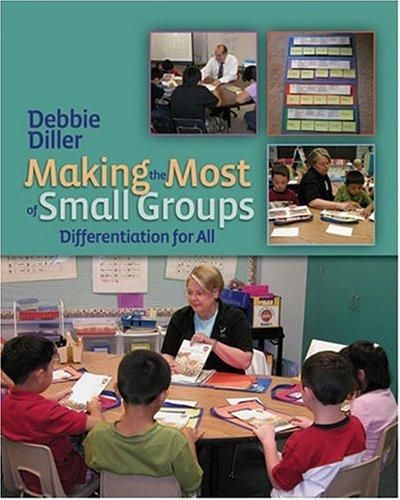
Author Debbie Diller turns her attention to small reading groups and the teacher's role in small-group instruction. Making the Most of Small Groups: Differentiation for All grapples with difficult questions regarding small-group instruction in elementary classrooms such as:

  • How do I find the time?
  • How can I be more organized?
  • How do I form groups?
  • How can I differentiate to meet the needs of all of my students?

Structured around the five essential reading elements - comprehension, fluency, phonemic awareness, phonics, and vocabulary - the book provides practical tips, sample lessons, lesson plans and templates, suggestions for related literacy work stations, and connections to whole-group instruction. In addition to ideas to use immediately in the classroom, Diller provides an overview of relevant research and reflection questions for professional conversations.

About the author

Debbie has been a national consultant since 2000, but still has those back to school dreams in the fall. After playing school in the basement of her childhood home in Lititz, Pennsylvania, she earned her bachelor's and master's degrees in education from Millersville University and Temple University and spent the next four decades as an educator. She's worked as a classroom teacher, migrant education teacher, Title I reading teacher, and literacy coach in Pre-K through grade 10 in diverse public school settings. Her love of teaching stems from her love of learning. I have always loved learning. Becoming a teacher was a way I could share that love of learning with children and eventually, with adults. A big part of her learning is listening to teachers and their professional development needs. When I work with teachers, I try to understand their needs by finding out what they know and listening to their questions. Then I begin where they are and work with them to help them take the next steps toward where they (and/or their school systems) want (them) to be. I believe in professional reading and professional learning communities, and support teachers in their quest to best meet the needs of all students in their classrooms. Debbie's ideas for her books also come from her work with teachers. She listens for frequently asked questions, patterns, teachers' needs, and keeps a writer's notebook to collect ideas, thoughts, and notes. Often, the old joke comes to mind: how do you eat an elephant? One bite at a time. That's how I write: Bit by bit, on planes, in hotel rooms, in my office on a rare day. Teachers' questions and comments spur me on through my daily, ongoing work in classrooms, which sustains my craft. Debbie's family has changed and grown in recent years. Her son, Jon, and daughter, Jessica, are both married, and she now has a granddaughter, Chloe, with another on the way. Debbie's husband, Tom, passed away in 2012.
tracking-