
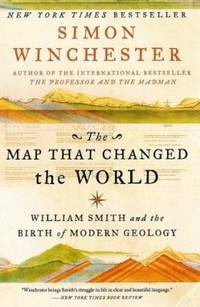
The Map That Changed the World : William Smith and the Birth of Modern Geology Paperback - 2002
by Simon Winchester
- Used
- very good
- Paperback
A$9.98
Free Delivery within USA
Standard delivery: 4 to 8 days
More delivery options
Standard delivery: 4 to 8 days
Details
- Title The Map That Changed the World : William Smith and the Birth of Modern Geology
- Author Simon Winchester
- Binding Paperback
- Edition Reprint
- Condition Used - Very good
- Pages 352
- Volumes 1
- Language ENG
- Publisher HarperCollins Publishers, New York
- Publication date 2002
- Illustrated Yes
- Bookseller's Inventory # G0060931809I4N00
- ISBN 9780060931803 / 0060931809
- Weight 0.59 lbs (0.27 kg)
- Dimensions 8.04 x 5.3 x 0.88 in (20.42 x 13.46 x 2.24 cm)
- Category Science
- Library of Congress subjects Smith, William, Geology, Stratigraphic - History
- Dewey Decimal Code 550.92
- Quantity available 2
About ThriftBooks Washington, United States
Biblio member since 2018
From the largest selection of used titles, we put quality, affordable books into the hands of readers
Summary
Following the hugely successful hardback, this extraordinary tale of the father of modern geology looks set to be the non fiction paperback for 2002. Hidden behind velvet curtains above a stairway in a house in London's Piccadilly is an enormous and beautiful hand-coloured map - the first geological map of anywhere in the world. Its maker was a farmer's son named William Smith. Born in 1769 his life was beset by troubles: he was imprisoned for debt, turned out of his home, his work was plagiarised, his wife went insane and the scientific establishment shunned him. It was not until 1829, when a Yorkshire aristocrat recognised his genius, that he was returned to London in triumph: The Map That Changed the World is his story.
Reader reviews for The Map That Changed the World : William Smith and the Birth of Modern Geology
Write a review for this book
Important Terms and Guidelines
- Please focus on the book’s content and context. Also, add any personal comments as to how you enjoyed the book. Substantiate your likes and dislikes. You may make comparisons to other books.
- Reviews must be at least 140 characters in length.
- Please do not reveal critical plot elements.
- This is not a help line. Contact customer support if you need help.
Your review must not include:
- Obscenities, discriminatory language, or other insulting language not suitable for public domain
- Advertisements, “spam” content, or references to other products, offers or websites.
- Email addresses, URLs, phone numbers, physical addresses or other contact information.
- Overly critical comments about other reviews or reviewers
- Time-sensitive material (i.e. promotional tours, seminars, lectures, etc.)
- Availability, price, or alternative ordering/shipping information
From the publisher
First line
Above one of the many grand mar staircases within the east wing of Burlington House, the great Palladian mansion on the north side of London' Piccadilly, hangs a pair of huge sky blue velvet curtains, twisted and tasseled silk ropes beside them.

