
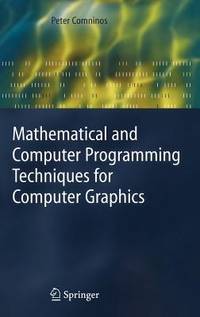
Stock photo: cover may vary
Mathematical and Computer Programming Techniques For Computer Graphics Hardback - 2005
by Comninos, Peter,
- Used
A$271.17
A$5.76
Delivery within USA
Standard delivery: 2 to 14 days
More delivery options
Standard delivery: 2 to 14 days
Ships from GreatBookPrices (Maryland, United States)
Details
- Title Mathematical and Computer Programming Techniques For Computer Graphics
- Author Comninos, Peter,
- Binding Hardback
- Edition 1st
- Condition New
- Pages 548
- Volumes 1
- Language ENG
- Publisher Springer
- Publication date 2005-11-22
- Illustrated Yes
- Features Illustrated, Index, Table of Contents
- Bookseller's Inventory # 3416223
- ISBN 9781852339029 / 1852339020
- Weight 1.99 lbs (0.90 kg)
- Dimensions 9.52 x 6.32 x 1.17 in (24.18 x 16.05 x 2.97 cm)
- Category Computers - Other Applications
- Dewey Decimal Code 006.601
- Quantity available 5
About GreatBookPrices Maryland, United States
Biblio member since 2024
Since 1991, we have worked every day to serve our customers with state-of-the-art technology and world class service. We are dedicated to providing customers around the world with the widest selection of books, DVDs, and CDs at the absolute lowest price.
Reader reviews for Mathematical and Computer Programming Techniques For Computer Graphics
Write a review for this book
Important Terms and Guidelines
- Please focus on the book’s content and context. Also, add any personal comments as to how you enjoyed the book. Substantiate your likes and dislikes. You may make comparisons to other books.
- Reviews must be at least 140 characters in length.
- Please do not reveal critical plot elements.
- This is not a help line. Contact customer support if you need help.
Your review must not include:
- Obscenities, discriminatory language, or other insulting language not suitable for public domain
- Advertisements, “spam” content, or references to other products, offers or websites.
- Email addresses, URLs, phone numbers, physical addresses or other contact information.
- Overly critical comments about other reviews or reviewers
- Time-sensitive material (i.e. promotional tours, seminars, lectures, etc.)
- Availability, price, or alternative ordering/shipping information
From the publisher
From the rear cover
Mathematical and Computer Programming Techniques for Computer Graphics introduces the mathematics and related computer programming techniques used in Computer Graphics. Starting with the underlying mathematical ideas, it gradually leads the reader to a sufficient understanding of the detail to be able to implement libraries and programs for 2D and 3D graphics. Using lots of code examples, the reader is encouraged to explore and experiment with data and computer programs (in the C programming language) and to master the related mathematical techniques.
Written for students with a minimum prerequisite knowledge of mathematics, the reader should have had some basic exposure to topics such as functions, trigonometric functions, elementary geometry and number theory, and also to have some familiarity with computer programming languages such as C. The material presented in this book has been used successfully with final year undergraduate and masters students studying Computer Graphics and Computer Animation. A simple but effective set of routines are included, organised as a library, covering both 2D and 3D graphics - taking a parallel approach to mathematical theory, and showing the reader how to incorporate it into example programs. This approach both demystifies the mathematics and demonstrates its relevance to 2D and 3D computer graphics.

