
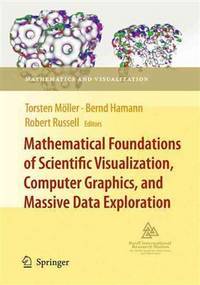
Stock photo: cover may vary
Mathematical Foundations of Scientific Visualization, Computer Graphics, and Massive Data Exploration Hardback - 2009 - 2009th Edition
by M÷ller, Torsten (Editor)/ Hamann, Bernd (Editor)/ Russell, Robert (Editor)
- New
- Hardback
A$258.20
A$29.09
Delivery to USA
Standard delivery: 7 to 14 days
More delivery options
Standard delivery: 7 to 14 days
Ships from Revaluation Books (Devon, United Kingdom)
Details
- Title Mathematical Foundations of Scientific Visualization, Computer Graphics, and Massive Data Exploration
- Author M÷ller, Torsten (Editor)/ Hamann, Bernd (Editor)/ Russell, Robert (Editor)
- Binding Hardback
- Edition number 2009th
- Edition 2009
- Condition New
- Pages 350
- Language ENG
- Publisher Springer Verlag, Berlin, Germany
- Publication date 2009
- Features Bibliography, Illustrated, Table of Contents
- Bookseller's Inventory # x-354025076X
- ISBN 9783540250760
- Quantity available 2
About Revaluation Books Devon, United Kingdom
Biblio member since 2020
General bookseller of both fiction and non-fiction.
Reader reviews for Mathematical Foundations of Scientific Visualization, Computer Graphics, and Massive Data Exploration
Write a review for this book
Important Terms and Guidelines
- Please focus on the book’s content and context. Also, add any personal comments as to how you enjoyed the book. Substantiate your likes and dislikes. You may make comparisons to other books.
- Reviews must be at least 140 characters in length.
- Please do not reveal critical plot elements.
- This is not a help line. Contact customer support if you need help.
Your review must not include:
- Obscenities, discriminatory language, or other insulting language not suitable for public domain
- Advertisements, “spam” content, or references to other products, offers or websites.
- Email addresses, URLs, phone numbers, physical addresses or other contact information.
- Overly critical comments about other reviews or reviewers
- Time-sensitive material (i.e. promotional tours, seminars, lectures, etc.)
- Availability, price, or alternative ordering/shipping information
From the publisher
From the rear cover
Visualization is one of the most active and exciting areas of Mathematics and Computing Science, and indeed one which is only beginning to mature. Current visualization algorithms break down for very large data sets. While present approaches use multi-resolution ideas, future data sizes will not be handled that way. New algorithms based on sophisticated mathematical modeling techniques must be devised which will permit the extraction of high-level topological structures that can be visualized.
For these reasons a workshop was organized at the Banff International Research Station, focused specifically on mathematical issues. A primary objective of the workshop was to gather together a diverse set of researchers in the mathematical areas relevant to the recent advances in order to discuss the research challenges facing this field in the next several years. The workshop was organized into five different thrusts:
- Topology and Discrete Methods
- Signal and Geometry Processing
- Partial Differential Equations
- Data Approximation Techniques
- Massive Data Applications
This book presents a summary of the research ideas presented at this workshop.

