
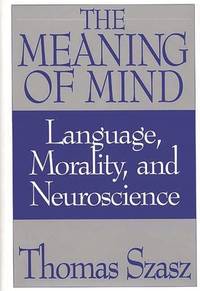
Stock photo: cover may vary
The Meaning Of Mind Hardback - 1996
by Thomas Szasz
- New
Classically controversial Szasz here challenges "modern" science's attempts to define the human mind as merely a collection of brain functions. Thomas Sazsz is Professor of Psychiatry Emeritus at the State University of New York Health Science Center. He is the author of 23 books, among them the classic, The Myth of Mental Illness.
A$80.95
A$21.27
Delivery to USA
Standard delivery: 7 to 14 days
More delivery options
Standard delivery: 7 to 14 days
Details
- Title The Meaning Of Mind
- Author Thomas Szasz
- Binding Hardback
- Edition 1st
- Condition New
- Pages 200
- Volumes 1
- Language ENG
- Publisher Praeger, Westport, Connecticut, U.S.A.
- Publication date 1996-09-30
- Features Bibliography, Dust Cover
- Bookseller's Inventory # BIBNNA-92934
- ISBN 9780275956035 / 0275956032
- Weight 1.18 lbs (0.54 kg)
- Dimensions 9.48 x 6.39 x 0.86 in (24.08 x 16.23 x 2.18 cm)
- Reading level 1410
- Category Psychology
- Library of Congress subjects Neuropsychology, Philosophy of mind
- Library of Congress Catalogue Number 96002207
- Dewey Decimal Code 128.2
- Quantity available 1
About Students Textbooks India
Specialising in: International Edition., Textbooks
Biblio member since 2009
Selling textbooks, International editions and reference books online from last 5 Years.
30 day return guarantee, with full refund including shipping costs for up to 30 days after delivery if an item arrives misdescribed or damaged. Return address: Students_Textbooks 12 phankha road Jankpuri New Delhi 110036 India
Reader reviews for The Meaning Of Mind
Write a review for this book
Important Terms and Guidelines
- Please focus on the book’s content and context. Also, add any personal comments as to how you enjoyed the book. Substantiate your likes and dislikes. You may make comparisons to other books.
- Reviews must be at least 140 characters in length.
- Please do not reveal critical plot elements.
- This is not a help line. Contact customer support if you need help.
Your review must not include:
- Obscenities, discriminatory language, or other insulting language not suitable for public domain
- Advertisements, “spam” content, or references to other products, offers or websites.
- Email addresses, URLs, phone numbers, physical addresses or other contact information.
- Overly critical comments about other reviews or reviewers
- Time-sensitive material (i.e. promotional tours, seminars, lectures, etc.)
- Availability, price, or alternative ordering/shipping information
From the publisher
From the rear cover
In The Meaning of Mind, Thomas Szasz argues that only as a verb does the word "mind" name something in the real world, namely, attending or heeding. Minding is the ability to pay attention and adapt to one's environment by using language to communicate with others and oneself. Viewing the "mind" as a potentially infinite variety of self-conversations is the key that unlocks many of the mysteries we associate with this concept. Modern neuroscience is a misdirected effort to explain "mind" in terms of brain functions. The claims and conclusions of the diverse academics and scientists who engage in this enterprise undermine the concepts of moral agency and personal responsibility. Szasz shows that the cognitive function of speech is to enable us to talk not only to others but to ourselves (in short, to be our own interlocutor) and that the view that mind is brain - embraced by both the scientific community and the popular press - is not an empirical finding but a rhetorical ruse concealing humanity's unceasing struggle to control persons by controlling their vocabulary. The discourse of brain-mind, unlike the discourse of man as moral agent, protects people from the dilemmas intrinsic to holding themselves responsible for their own actions and holding others responsible for theirs. Because we live in an age blessed by the fruits of materialist science, reductionist explanations of the relationship between brain and mind are more popular than ever, making this book an indispensable addition to the seemingly recondite debate about, simply, who we are.
Media reviews
Citations
- Library Journal, 12/01/1996, Page 126
- Publishers Weekly, 09/30/1996, Page 73

