
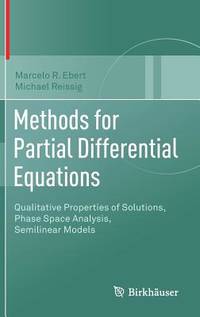
Stock photo: cover may vary
Methods for Partial Differential Equations.: Qualitative Properties of Solutions, Phase Space Analysis, Semilinear Models. Hardback - 2018
by Ebert, M, R. et al (Eds.)
- Used
- Hardback
A$69.35
A$33.03
Delivery to USA
Standard delivery: 7 to 21 days
More delivery options
Standard delivery: 7 to 21 days
Ships from Lange & Springer Antiquariat (Germany)
Details
- Title Methods for Partial Differential Equations.
- Author Ebert, M, R. et al (Eds.)
- Binding Hardback
- Pages xix, 479 p.
- Volumes 1
- Language ENG
- Publisher Birkhauser
- Publication date 2018
- Illustrated Yes
- Features Illustrated
- Bookseller's Inventory # 6123FB
- ISBN 9783319664552 / 3319664557
- Weight 1.92 lbs (0.87 kg)
- Dimensions 9.21 x 6.14 x 1.06 in (23.39 x 15.60 x 2.69 cm)
- Category Mathematics
- Dewey Decimal Code 515.353
About Lange & Springer Antiquariat Germany
Specialising in: Astrology, Chemistry, Engineering, Humanities, Mathematics, Medicine, Natural Science, Old and rare scientific books
Biblio member since 2025
Lange & Springer Antiquariat (est. 1816) is a long-established scientific antiquarian bookstore based in Berlin. We specialize in rare and scholarly books spanning the sciences, medicine, mathematics, engineering, and the humanities — from historically significant early works to modern academic literature. Our curated selection includes antiquarian treasures as well as contemporary academic titles for researchers, collectors, and institutions worldwide.
Reader reviews for Methods for Partial Differential Equations.
Write a review for this book
Important Terms and Guidelines
- Please focus on the book’s content and context. Also, add any personal comments as to how you enjoyed the book. Substantiate your likes and dislikes. You may make comparisons to other books.
- Reviews must be at least 140 characters in length.
- Please do not reveal critical plot elements.
- This is not a help line. Contact customer support if you need help.
Your review must not include:
- Obscenities, discriminatory language, or other insulting language not suitable for public domain
- Advertisements, “spam” content, or references to other products, offers or websites.
- Email addresses, URLs, phone numbers, physical addresses or other contact information.
- Overly critical comments about other reviews or reviewers
- Time-sensitive material (i.e. promotional tours, seminars, lectures, etc.)
- Availability, price, or alternative ordering/shipping information
From the publisher
From the rear cover
This book provides an overview of different topics related to the theory of partial differential equations. Selected exercises are included at the end of each chapter to prepare readers for the "research project for beginners" proposed at the end of the book. It is a valuable resource for advanced graduates and undergraduate students who are interested in specializing in this area.
The book is organized in five parts:
In Part 1 the authors review the basics and the mathematical prerequisites, presenting two of the most fundamental results in the theory of partial differential equations: the Cauchy-Kovalevskaja theorem and Holmgren's uniqueness theorem in its classical and abstract form. It also introduces the method of characteristics in detail and applies this method to the study of Burger's equation.
Part 2 focuses on qualitative properties of solutions to basic partial differential equations, explaining the usual properties of solutions to elliptic, parabolic and hyperbolic equations for the archetypes Laplace equation, heat equation and wave equation as well as the different features of each theory. It also discusses the notion of energy of solutions, a highly effective tool for the treatment of non-stationary or evolution models and shows how to define energies for different models.
Part 3 demonstrates how phase space analysis and interpolation techniques are used to prove decay estimates for solutions on and away from the conjugate line. It also examines how terms of lower order (mass or dissipation) or additional regularity of the data may influence expected results.
Part 4 addresses semilinear models with power type non-linearity of source and absorbing type in order to determine critical exponents: two well-known critical exponents, the Fujita exponent and the Strauss exponent come into play. Depending on concrete models these critical exponents divide the range of admissible powers in classes which make it possible to prove quite different qualitative properties of solutions, for example, the stability of the zero solution or blow-up behavior of local (in time) solutions.
The last part features selected research projects and general background material.

