
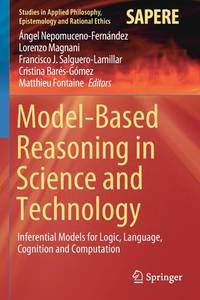
Stock photo: cover may vary
Model-Based Reasoning in Science and Technology: Inferential Models for Logic, Language, Cognition and Computation: 49 (Studies in Applied Philosophy, Epistemology and Rational Ethics) Papeback -
- New
A$453.88
A$5.82
Delivery within USA
Standard delivery: 9 to 14 days
More delivery options
Standard delivery: 9 to 14 days
Ships from Cold Books (New York, United States)
Details
- Title Model-Based Reasoning in Science and Technology: Inferential Models for Logic, Language, Cognition and Computation: 49 (Studies in Applied Philosophy, Epistemology and Rational Ethics)
- Binding Papeback
- Condition New
- Publisher Springer
- Publication date pp. XIII, 502 78 illus., 14 ill
- Features Illustrated
- Bookseller's Inventory # 6384555298
- ISBN 9783030327248
- Quantity available 4
About Cold Books New York, United States
Reader reviews for Model-Based Reasoning in Science and Technology: Inferential Models for Logic, Language, Cognition and Computation: 49 (Studies in Applied Philosophy, Epistemology and Rational Ethics)
Write a review for this book
Important Terms and Guidelines
- Please focus on the book’s content and context. Also, add any personal comments as to how you enjoyed the book. Substantiate your likes and dislikes. You may make comparisons to other books.
- Reviews must be at least 140 characters in length.
- Please do not reveal critical plot elements.
- This is not a help line. Contact customer support if you need help.
Your review must not include:
- Obscenities, discriminatory language, or other insulting language not suitable for public domain
- Advertisements, “spam” content, or references to other products, offers or websites.
- Email addresses, URLs, phone numbers, physical addresses or other contact information.
- Overly critical comments about other reviews or reviewers
- Time-sensitive material (i.e. promotional tours, seminars, lectures, etc.)
- Availability, price, or alternative ordering/shipping information
From the publisher
From the rear cover
This book discusses how scientific and other types of cognition make use of models, abduction, and explanatory reasoning in order to produce important and innovative changes in theories and concepts. Gathering revised contributions presented at the international conference on Model-Based Reasoning (MBR18), held on October 24-26 2018 in Seville, Spain, the book is divided into three main parts. The first focuses on models, reasoning, and representation. It highlights key theoretical concepts from an applied perspective, and addresses issues concerning information visualization, experimental methods, and design. The second part goes a step further, examining abduction, problem solving, and reasoning. The respective papers assess different types of reasoning, and discuss various concepts of inference and creativity and their relationship with experimental data. In turn, the third part reports on a number of epistemological and technological issues. By analyzing possible contradictionsin modern research and describing representative case studies, this part is intended to foster new discussions and stimulate new ideas. All in all, the book provides researchers and graduate students in the fields of applied philosophy, epistemology, cognitive science, and artificial intelligence alike with an authoritative snapshot of the latest theories and applications of model-based reasoning.

