BIBLIO is the largest independent book marketplace in the world, with over 100 million books.

Skip to content

Model and Design of Improved Current Mode Logic Gates: Differential and Single-ended

Model and Design of Improved Current Mode Logic Gates: Differential and Single-ended

Model and Design of Improved Current Mode Logic Gates: Differential and
Stock photo: cover may vary

Model and Design of Improved Current Mode Logic Gates: Differential and Single-ended Paperback - 2020

by Gupta, Maneesha

Add to wish list
  • Used
  • Good
  • Paperback
Used - Good

Description

paperback. Good. Access codes and supplements are not guaranteed with used items. May be an ex-library book.
Ask the seller a question Add to wish list
A$123.40
Free Delivery within USA
Standard delivery: 7 to 14 days
More delivery options
Dropship order
Ships from Bonita (California, United States)

Details

  • Title Model and Design of Improved Current Mode Logic Gates: Differential and Single-ended
  • Author Gupta, Maneesha
  • Binding Paperback
  • Condition Used - Good
  • Pages 171
  • Volumes 1
  • Language ENG
  • Publisher Springer
  • Publication date 2020-12-02
  • Illustrated Yes
  • Features Illustrated
  • Bookseller's Inventory # 9811509840.G
  • ISBN 9789811509841 / 9811509840
  • Weight 0.6 lbs (0.27 kg)
  • Dimensions 9.21 x 6.14 x 0.4 in (23.39 x 15.60 x 1.02 cm)
  • Category Computers - General Information
  • Dewey Decimal Code 004.6
  • Quantity available 1

About Bonita California, United States

Biblio member since 2020

Terms of Sale: 30 day return guarantee, with full refund including original shipping costs for up to 30 days after delivery if an item arrives misdescribed or damaged.

Browse books from Bonita

Reader reviews for Model and Design of Improved Current Mode Logic Gates: Differential and Single-ended

From the publisher

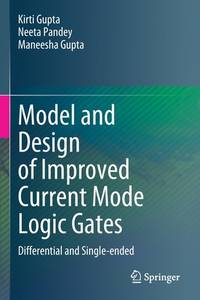
This book presents MOSFET-based current mode logic (CML) topologies, which increase the speed, and lower the transistor count, supply voltage and power consumption. The improved topologies modify the conventional PDN, load, and the current source sections of the basic CML gates.

Electronic system implementation involves embedding digital and analog circuits on a single die shifting towards mixed-mode circuit design. The high-resolution, low-power and low-voltage analog circuits are combined with high-frequency complex digital circuits, and the conventional static CMOS logic generates large current spikes during the switching (also referred to as digital switching noise), which degrade the resolution of the sensitive analog circuits via supply line and substrate coupling. This problem is exacerbated further with scaling down of CMOS technology due to higher integration levels and operating frequencies. In the literature, several methods are described to reduce the propagation of the digital switching noise. However, in high-resolution applications, these methods are not sufficient. The conventional CMOS static logic is no longer an effective solution, and therefore an alternative with reduced current spikes or that draws a constant supply current must be selected. The current mode logic (CML) topology, with its unique property of requiring constant supply current, is a promising alternative to the conventional CMOS static logic.

From the rear cover

This book presents MOSFET-based current mode logic (CML) topologies, which increase the speed, and lower the transistor count, supply voltage and power consumption. The improved topologies modify the conventional PDN, load, and the current source sections of the basic CML gates.

Electronic system implementation involves embedding digital and analog circuits on a single die shifting towards mixed-mode circuit design. The high-resolution, low-power and low-voltage analog circuits are combined with high-frequency complex digital circuits, and the conventional static CMOS logic generates large current spikes during the switching (also referred to as digital switching noise), which degrade the resolution of the sensitive analog circuits via supply line and substrate coupling. This problem is exacerbated further with scaling down of CMOS technology due to higher integration levels and operating frequencies. In the literature, several methods are described to reduce the propagation of the digital switching noise. However, in high-resolution applications, these methods are not sufficient. The conventional CMOS static logic is no longer an effective solution, and therefore an alternative with reduced current spikes or that draws a constant supply current must be selected. The current mode logic (CML) topology, with its unique property of requiring constant supply current, is a promising alternative to the conventional CMOS static logic.

About the author

Dr. Kirti Gupta received B.Tech. in Electronics and Communication Engineering from Indira Gandhi Institute of Technology, Delhi in 2002, M. Tech. in Information Technology from School of Information Technology in 2006. She received her Ph.D. in Electronics and Communication Engineering from Delhi Technological University, in 2016. Since 2002, she is with Bharati Vidyapeeth's College of Engineering, New Delhi and is presently serving as Professor in the same institute. A life member of ISTE, and senior member of IEEE, she has published more than 100 research papers in international, national journals and conferences. Her teaching and research interest is in digital VLSI design.

Dr. Neeta Pandey received her M.E. in Microelectronics from Birla Institute of Technology and Sciences, Pilani in 1991 and Ph.D. from Guru Gobind Singh Indraprastha University, Delhi in 2009. She has served in Central Electronics Engineering Research Institute, Pilani, Indian Instituteof Technology, Delhi, Priyadarshini College of Computer Science, Noida and Bharati Vidyapeeth's College of Engineering, Delhi in various capacities. At present, she is a professor in the ECE department, Delhi Technological University. Her teaching and research interests include analog and digital VLSI design.

A life member of ISTE, and senior member of IEEE, USA, she has coauthored over 100 papers in international, national journals of repute and conferences.

Dr. Maneesha Gupta is currently a Professor at the Electronics & Communication Engineering Department of the Netaji Subhas University of Technology, India. She received her B.E. in Electronics & Communication Engineering from the Government Engineering College, Jabalpur in 1981, M.E. in Electronics & Communication Engineering from the same university in 1983, and her PhD. in Electronics Engineering (Analysis, Synthesis & Applications of Switched Capacitor Circuits) from the Indian Institute of Technology, Delhi in 1990.

Her teaching and research interests include switched capacitor circuits and analog signal processing. Dr. Gupta has co-authored over 150 research papers in the above areas in various international/national journals and conferences.

tracking-