
Stock photo: cover may vary
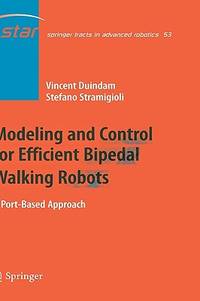
Modeling and Control for Efficient Bipedal Walking Robots: A Port-Based Approach (Springer Tracts in Advanced Robotics, 53) Hardback - 2009 - 2009th Edition
by Duindam, Vincent
- Used
- Hardback
A$341.93
A$21.78
Delivery within USA
Standard delivery: 12 to 14 days
More delivery options
Standard delivery: 12 to 14 days
Dropship order
Ships from Ergodebooks (Texas, United States)
Details
- Title Modeling and Control for Efficient Bipedal Walking Robots: A Port-Based Approach (Springer Tracts in Advanced Robotics, 53)
- Author Duindam, Vincent
- Binding Hardback
- Edition number 2009th
- Edition 2009
- Condition Used: Good
- Pages 214
- Volumes 1
- Language ENG
- Publisher Springer
- Publication date 2009-01-17
- Illustrated Yes
- Features Bibliography, Illustrated, Index, Table of Contents
- Bookseller's Inventory # SONG3540899170
- ISBN 9783540899174 / 3540899170
- Weight 1.15 lbs (0.52 kg)
- Dimensions 9.4 x 6.3 x 0.7 in (23.88 x 16.00 x 1.78 cm)
- Size 6.25x0.50x9.50
- Category Computers - General Information
- Library of Congress Catalogue Number 2008941014
- Dewey Decimal Code 629.892
- Quantity available 1
About Ergodebooks Texas, United States
Biblio member since 2005
Our goal is to provide best customer service and good condition books for the lowest possible price. We are always honest about condition of book. We list book only by ISBN # and hence exact book is guaranteed.
We have 30 day return policy.
Reader reviews for Modeling and Control for Efficient Bipedal Walking Robots: A Port-Based Approach (Springer Tracts in Advanced Robotics, 53)
Write a review for this book
Important Terms and Guidelines
- Please focus on the book’s content and context. Also, add any personal comments as to how you enjoyed the book. Substantiate your likes and dislikes. You may make comparisons to other books.
- Reviews must be at least 140 characters in length.
- Please do not reveal critical plot elements.
- This is not a help line. Contact customer support if you need help.
Your review must not include:
- Obscenities, discriminatory language, or other insulting language not suitable for public domain
- Advertisements, “spam” content, or references to other products, offers or websites.
- Email addresses, URLs, phone numbers, physical addresses or other contact information.
- Overly critical comments about other reviews or reviewers
- Time-sensitive material (i.e. promotional tours, seminars, lectures, etc.)
- Availability, price, or alternative ordering/shipping information
From the publisher
From the rear cover
Walking robots are complex machines with many degrees of freedom. Designing efficient controllers for such robots can be a daunting task, and the differential equations by themselves usually do not help much when trying to understand the dynamics. Still, research on passive dynamic walking robots has shown that it is possible to make robotic mechanisms walk very naturally and efficiently without using any control! The gap between theoretically well-understood position-controlled walking robots and experimentally-designed uncontrolled passive-dynamic walkers is nevertheless large, and extending a passive-dynamic walker to be more robust and versatile is non-trivial.
The purpose of this work is to present a set of mathematical tools that can simplify studying robotic walking motions and designing energy-efficient controllers. The authors extend classical dynamic modeling methods and view robots and controllers as energy-exchanging physical systems, which forms the basisof the so-called port-based approach. They show how such methods can be used to analyze walking mechanisms, find efficient walking trajectories, and design controllers that increase robustness and stability with minimal energy cost. Extensive examples and illustrations are used with the objective to make the mathematics intuitive and accessible to everyone with an engineering background.

