
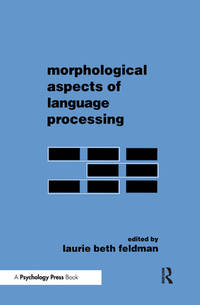
Stock photo: cover may vary
Morphological Aspects of Language Processing Hardback - 1994
by Laurie Beth Feldman
- Used
- Hardback
A$61.97
A$6.57
Delivery within USA
Standard delivery: 7 to 14 days
More delivery options
Standard delivery: 7 to 14 days
Ships from Magus Books (Washington, United States)
Details
- Title Morphological Aspects of Language Processing
- Author Laurie Beth Feldman
- Binding Hardback
- Condition Used - VG-
- Pages 430
- Volumes 1
- Language ENG
- Publisher Psychology Press, Hillsdale, NJ
- Publication date December 1994
- Features Bibliography, Index
- Bookseller's Inventory # 1267438
- ISBN 9780805813586 / 0805813586
- Weight 1.88 lbs (0.85 kg)
- Dimensions 9.48 x 6.12 x 1.33 in (24.08 x 15.54 x 3.38 cm)
- Reading level 1450
- Category Language Arts / Linguistics / Literacy
- Library of Congress subjects Psycholinguistics, Grammar, Comparative and general -
- Library of Congress Catalogue Number 94028968
- Dewey Decimal Code 155.9
- Quantity available 1
About Magus Books Washington, United States
Biblio member since 2005
Located in Seattle's University District since 1978, Magus is one of the oldest and largest independent used bookstores in the Seattle. With more than 70,000 titles in all fields and hundreds of carefully selected new arrivals every day, Magus is a vibrant and always interesting book shopping experience.
Please search or browse our inventory of hard to find, out of print, used and rare books. If you can't find what you like please email us at magus@seanet.com or call us at 206-633-1800 and we will search our off-line inventory for you. We have more than 70,000 books in-store and only 12,000 online so our shelf inventory is significant.
Please call 206-633-1800 or email magus@seanet.com with questions regarding any item or order. We accept payment by Visa, Mastercard, Discover, and check. All items may be returned within one week of receipt if not as described for full refund of purchase price with prior notification. All items will be shipped within 3 business days of receipt of order via USPS media mail. Shipping costs are based on items weighing 1 kg (2.2 US lbs.) or less. International orders and expedited shipping may be charged extra for larger items. Orders shipped within the state of WA will be charged local sales tax. No dealer discounts for online sales.
Reader reviews for Morphological Aspects of Language Processing
Write a review for this book
Important Terms and Guidelines
- Please focus on the book’s content and context. Also, add any personal comments as to how you enjoyed the book. Substantiate your likes and dislikes. You may make comparisons to other books.
- Reviews must be at least 140 characters in length.
- Please do not reveal critical plot elements.
- This is not a help line. Contact customer support if you need help.
Your review must not include:
- Obscenities, discriminatory language, or other insulting language not suitable for public domain
- Advertisements, “spam” content, or references to other products, offers or websites.
- Email addresses, URLs, phone numbers, physical addresses or other contact information.
- Overly critical comments about other reviews or reviewers
- Time-sensitive material (i.e. promotional tours, seminars, lectures, etc.)
- Availability, price, or alternative ordering/shipping information

