BIBLIO is the largest independent book marketplace in the world, with over 100 million books.

Skip to content

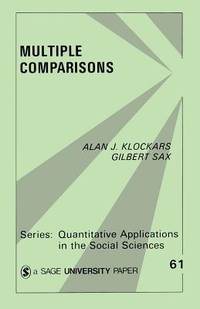
Multiple Comparisons (Quantitative Applications in the Social Sciences)

Multiple Comparisons (Quantitative Applications in the Social Sciences)

Multiple Comparisons (Quantitative Applications in the Social Sciences)
Stock photo: cover may vary

Multiple Comparisons (Quantitative Applications in the Social Sciences) Paperback - 1986

by Klockars, Alan J.; Sax, Gilbert

Add to wish list
  • New
  • Paperback
New

Description

SAGE Publications, Inc, 1986-11-24. paperback. New. 5x0x8.
Ask the seller a question Add to wish list
A$50.57
Free Delivery within USA
Standard delivery: 4 to 8 days
More delivery options
Ships from Your Online Bookstore (Texas, United States)

Details

  • Title Multiple Comparisons (Quantitative Applications in the Social Sciences)
  • Author Klockars, Alan J.; Sax, Gilbert
  • Binding Paperback
  • Edition illustrated edit
  • Condition New
  • Pages 88
  • Volumes 1
  • Language ENG
  • Publisher SAGE Publications, Inc, Beverly Hills, CA
  • Publication date 1986-11-24
  • Illustrated Yes
  • Features Bibliography, Illustrated, Table of Contents
  • Bookseller's Inventory # 0803920512-11-27700989
  • ISBN 9780803920514 / 0803920512
  • Weight 0.24 lbs (0.11 kg)
  • Dimensions 5.76 x 8.86 x 0.23 in (14.63 x 22.50 x 0.58 cm)
  • Size 5x0x8
  • Category Mathematics
  • Library of Congress subjects Multiple comparisons (Statistics)
  • Library of Congress Catalogue Number 86061611
  • Dewey Decimal Code 519.5
  • Quantity available 1

About Your Online Bookstore Texas, United States

Biblio member since 2012

Terms of Sale:

We provide a 30 day return guarantee, with full refund including shipping costs for up to 30 days after delivery if an item arrives damaged or not as it was described in the listing.

Browse books from Your Online Bookstore

Reader reviews for Multiple Comparisons (Quantitative Applications in the Social Sciences)

From the publisher

Describes the most important methods used to investigate differences between levels of an independent variable within an experimental design. Readers will learn not only how to conduct multiple comparisons in experimental designs but also how to better understand and evaluate published research. "A highly readable introduction to multiple comparison methods, which demands little from its reader in the way of background other than some familiarity with analysis of variance." --The Statistician


About the author

Many people do not automatically think of experimental design and statistics when they think of Education. In fact, major departments of Educational Psychology throughout the country have strong commitments to teaching and systematically exploring these topics and have consistently been leaders in the development of knowledge on how behavioral scientists can use the best possible practices when doing their research. It is in this spirit that I spend almost all of my teaching and research efforts on issues related to statistics and experimental design.

All of the classes that I (and others in the Measurement, Research Design and Statistics area) teach draw students from a wide variety of academic departments and colleges. This makes the course a lot more interesting for me and exposes our students to an array of issues not found in more narrowly defined programs. Our students learn about the issues in Nursing, Speech, Social Welfare, and many other disciplines making them more knowledgeable statistical consultants as they progress through the program.

Research that I do usually consists of asking what is the best way for researchers in the behavioral sciences to conduct their statistical analysis. I devote most of my time to finding best practices in answering specific questions within an analysis of variance. Using monte carlo simulation techniques, I will construct a simulated world in which I introduce differences between treatment groups. I then use each of the competing strategies to analyze the scores I have generated and record which methods correctly detect the difference. This is repeated a half million times to determine which strategy works best in the long run. A secondary research interest involves rating scales. Numerous factors influence how we attach meaning to potential responses on a rating scale. These include how many points there are and what anchors are attached to the positions. I am interested in how these characteristics can be manipulated to increase the information captured by the scale.

When I am not teaching or working on research I greatly enjoy writing musicals for my church's youth groups. Music has a wonderful structure and intricacy to it that in many ways is like the structure and intricacies of statistics.

tracking-