BIBLIO is the largest independent book marketplace in the world, with over 100 million books.

Skip to content

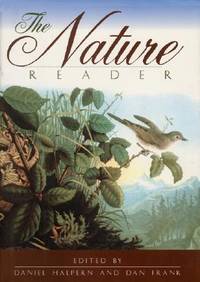
Nature Reader

Nature Reader

Nature Reader
Stock photo: cover may vary

Nature Reader Paperback - 1996

by Halpern, Daniel

Add to wish list
  • Used
  • very good
  • Paperback
Used - Very good

Description

Ecco, 1996. Very Good. Halpern, Daniel. Nature Reader. Hopewell, NJ: Ecco, 1996. 16.00pp. 8vo. Paperback. Book condition: Very good. Edges lightly rubbed and light crease on spine.
Ask the seller a question Add to wish list
A$10.16
A$8.71 Delivery within USA
Standard delivery: 5 to 14 days
More delivery options
Ships from Weller Book Works ABAA/ILAB (Utah, United States)

Details

  • Title Nature Reader
  • Author Halpern, Daniel
  • Binding Paperback
  • Edition Edition Unstated
  • Condition Used - Very good
  • Pages 368
  • Volumes 1
  • Language ENG
  • Publisher Ecco, New York
  • Publication date 1996
  • Bookseller's Inventory # UHALNAT01fp
  • ISBN 9780880015547 / 0880015543
  • Weight 1.22 lbs (0.55 kg)
  • Dimensions 9 x 6.12 x 0.92 in (22.86 x 15.54 x 2.34 cm)
  • Category Nature
  • Library of Congress Catalogue Number 00000000
  • Dewey Decimal Code 508
  • Quantity available 1

About Weller Book Works ABAA/ILAB Utah, United States

Biblio member since 2011

Weller Book Works was founded as Zion Bookstore in 1929. Over the years we’ve been known as Sam Weller’s Books and Sam Weller’s Zion Bookstore. We are in our third generation of operations, owned and managed by Catherine and Tony Weller. Our bookstore sells new, used and rare books in a space built to surprise and delight you in historic Trolley Square. You can find Weller Book Works at our store at Trolley Square in Salt Lake City or you can search our inventory online. Either way, we’re delighted to answer your questions and help you select just the right book.

Terms of Sale:

30 day return guarantee, with full refund including original shipping costs for up to 30 days after delivery if an item arrives misdescribed or damaged.

Browse books from Weller Book Works ABAA/ILAB

Reader reviews for Nature Reader

From the publisher

The Nature Writer's Dilemma John Hay

You might think, after many years of teaching a class called "Nature Writers," that I would know what nature meant, but I do not. Perhaps this is of little importance. The word comes from the Latin, to be born, which is fundamental enough, and puts it under the heading of abiding mystery. Then we have the essential character of something, like a rock, or a child; plus physical power, according to the dictionary, causing the phenomena of the material world; or for one grand definition, the sum of the surrounding universe. When I hear it said in caustic tones that "Everyone knows man is a part of nature," I have only the vaguest idea of wh at at means either. The last time I heard such a remark, it came from a teacher of philosophy who did not seem to be particularly interested in what is often referred to as "the lower forms of life." There is reason to suspect the assumptions of the human brain when it becomes too elevated from the earth that nurtured it.

The dictionary also includes "the state of nature," which was long considered to be unregenerate, the opposite of grace, with the heathen and the wolves. The Judeo-Christian ethic has been blamed for putting man above nature in Gods name. In this view, technology, ravaging industrialism, the will to exploit are an extension of overweening Christian arrogance. It is certainly true that most people still believe in their superiority to nonhuman life, though this may now be tempered by the idea that both of us share in an equality of inheritance, and that consciousness may not be man's exclusive property.

Are we unique? The ethologist Niko Tinbergen says it is difficult to provescientifically. The question of why we need to feel unique might be more useful. How does the human spirit stand and survive in relation to the surrounding universe? For all our human claiming of the right to possess and dominate the earth, we have lost a great deal of our sense of it. A relationship which was once as direct as the food we put into our mouths has become abstract. We seldom know where the food comes from. If you approach certain publishers with writing which deals with nature, in other words, the world of life, the water we could not live without, the air we breathe, you might very well be advised to "put more people into it." But if you can't find nature, where will the people live? The subject is only au courant if backpacking, canoeing, sailing, and other acceptable activities make it so, added, of course, to writings with the authority of science, the accepted interpreter of all natural phenomena. We could identify very little without it. At the same time, the priesthood that can take us beyond Jupiter to black holes and quarks seems to alter common nature into a detached state most people can't take in.

So the contemporary nature writer can be forgiven if he is not quite sure on whichshelf he is to end up. It may give him some confidence that his subject derives from the Latin nasci, "to be born," and so is the most important one he could possibly have, but he is subject, like all the race, to confusion. It may be better to hang loose and respect your capacity to receive unknown surprises than to wait on terms and categories, from whatever important direction they come.

John Muir, who was a religious man in spite of his rejection of his Scots Calvinist upbringing, said that he took a walk and decided to stay out past sundown, to conclude that going out is really going in. His wilderness has now become the cause for a more translated religion, so that those who want it saved but have never entered it, and might not like it if they did, talk about it as if it were some paradisal refuge at the end of the mind. Things are getting pretty desperate when you can no longer move out into the substance of where you ought to be.

A practical culture wants to know what things are, how they work, even, for almost anything under the sun, "What good is it?" Existence for its own sake -life forms that flow in the beauty of the wind, like a flock of sanderlings- becomes subordinated to labels. The facts may help us to feel sure about our control of circumstances, but they are a poor substitute for the deeper equations of earth and human life.

The American Indian saw the Word behind all manifested things, the primal, creative power ...

tracking-