
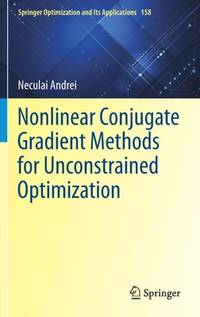
Stock photo: cover may vary
Nonlinear Conjugate Gradient Methods for Unconstrained Optimization Hardback - 2020
by Andrei, Neculai
- New
- Hardback
A$366.53
A$28.66
Delivery to USA
Standard delivery: 7 to 14 days
More delivery options
Standard delivery: 7 to 14 days
Ships from Revaluation Books (Devon, United Kingdom)
Details
- Title Nonlinear Conjugate Gradient Methods for Unconstrained Optimization
- Author Andrei, Neculai
- Binding Hardback
- Condition New
- Pages 498
- Volumes 1
- Language ENG
- Publisher Springer Nature
- Publication date 2020
- Illustrated Yes
- Features Illustrated
- Bookseller's Inventory # x-3030429490
- ISBN 9783030429492 / 3030429490
- Weight 2.01 lbs (0.91 kg)
- Dimensions 9.21 x 6.14 x 1.13 in (23.39 x 15.60 x 2.87 cm)
- Category Mathematics
- Quantity available 2
About Revaluation Books Devon, United Kingdom
Biblio member since 2020
General bookseller of both fiction and non-fiction.
Reader reviews for Nonlinear Conjugate Gradient Methods for Unconstrained Optimization
Write a review for this book
Important Terms and Guidelines
- Please focus on the book’s content and context. Also, add any personal comments as to how you enjoyed the book. Substantiate your likes and dislikes. You may make comparisons to other books.
- Reviews must be at least 140 characters in length.
- Please do not reveal critical plot elements.
- This is not a help line. Contact customer support if you need help.
Your review must not include:
- Obscenities, discriminatory language, or other insulting language not suitable for public domain
- Advertisements, “spam” content, or references to other products, offers or websites.
- Email addresses, URLs, phone numbers, physical addresses or other contact information.
- Overly critical comments about other reviews or reviewers
- Time-sensitive material (i.e. promotional tours, seminars, lectures, etc.)
- Availability, price, or alternative ordering/shipping information
From the publisher
From the rear cover
Two approaches are known for solving large-scale unconstrained optimization problems--the limited-memory quasi-Newton method (truncated Newton method) and the conjugate gradient method. This is the first book to detail conjugate gradient methods, showing their properties and convergence characteristics as well as their performance in solving large-scale unconstrained optimization problems and applications. Comparisons to the limited-memory and truncated Newton methods are also discussed. Topics studied in detail include: linear conjugate gradient methods, standard conjugate gradient methods, acceleration of conjugate gradient methods, hybrid, modifications of the standard scheme, memoryless BFGS preconditioned, and three-term. Other conjugate gradient methods with clustering the eigenvalues or with the minimization of the condition number of the iteration matrix, are also treated. For each method, the convergence analysis, the computational performances and the comparisons versus other conjugate gradient methods are given.
The theory behind the conjugate gradient algorithms presented as a methodology is developed with a clear, rigorous, and friendly exposition; the reader will gain an understanding of their properties and their convergence and will learn to develop and prove the convergence of his/her own methods. Numerous numerical studies are supplied with comparisons and comments on the behavior of conjugate gradient algorithms for solving a collection of 800 unconstrained optimization problems of different structures and complexities with the number of variables in the range [1000,10000]. The book is addressed to all those interested in developing and using new advanced techniques for solving unconstrained optimization complex problems. Mathematical programming researchers, theoreticians and practitioners in operations research, practitioners in engineering and industry researchers, as well as graduate students in mathematics, Ph.D. and master students in mathematical programming, will find plenty of information and practical applications for solving large-scale unconstrained optimization problems and applications by conjugate gradient methods.

