
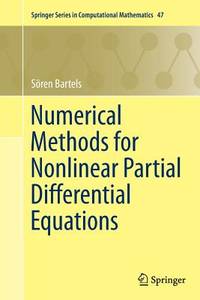
Stock photo: cover may vary
Numerical Methods for Nonlinear Partial Differential Equations (Springer Se ries in Computational Mathematics, 47) Paperback - 2016
by Bartels, Sören
- Used
- very good
- Paperback
A$135.72
A$173.26
Delivery to USA
Standard delivery: 30 to 60 days
More delivery options
Standard delivery: 30 to 60 days
Details
- Title Numerical Methods for Nonlinear Partial Differential Equations (Springer Se ries in Computational Mathematics, 47)
- Author Bartels, Sören
- Binding Paperback
- Condition Used - Very good
- Publisher Springer, US
- Publication date 2016
- Features Illustrated, Maps
- Bookseller's Inventory # RWARE0000062232
- ISBN 9783319356808
- Quantity available 1
- Bookseller catalogues Sciences / Mathematics
About Infinity Books Japan Japan
Specialising in: Live Music / Book Readings, Clubs, Poetry / Art / Workshops / Ne
Biblio member since 2006
Infinity Books Japan,was founded in the year 2002, we pride ourselves in being there for our customers, we deal in, used, rare, out of print and first editions.
Reader reviews for Numerical Methods for Nonlinear Partial Differential Equations (Springer Se ries in Computational Mathematics, 47)
Write a review for this book
Important Terms and Guidelines
- Please focus on the book’s content and context. Also, add any personal comments as to how you enjoyed the book. Substantiate your likes and dislikes. You may make comparisons to other books.
- Reviews must be at least 140 characters in length.
- Please do not reveal critical plot elements.
- This is not a help line. Contact customer support if you need help.
Your review must not include:
- Obscenities, discriminatory language, or other insulting language not suitable for public domain
- Advertisements, “spam” content, or references to other products, offers or websites.
- Email addresses, URLs, phone numbers, physical addresses or other contact information.
- Overly critical comments about other reviews or reviewers
- Time-sensitive material (i.e. promotional tours, seminars, lectures, etc.)
- Availability, price, or alternative ordering/shipping information
From the rear cover
The description of many interesting phenomena in science and engineering leads to infinite-dimensional minimization or evolution problems that define nonlinear partial differential equations. While the development and analysis of numerical methods for linear partial differential equations is nearly complete, only few results are available in the case of nonlinear equations. This monograph devises numerical methods for nonlinear model problems arising in the mathematical description of phase transitions, large bending problems, image processing, and inelastic material behavior. For each of these problems the underlying mathematical model is discussed, the essential analytical properties are explained, and the proposed numerical method is rigorously analyzed. The practicality of the algorithms is illustrated by means of short implementations.

