
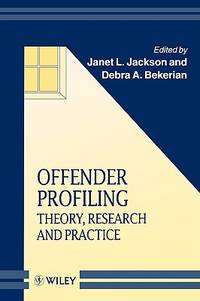
Stock photo: cover may vary
Offender Profiling: Theory, Research and Practice (Wiley Series in Psychology of Crime, Policing and Law) Paperback - 1997 - 1st Edition
by Janet L. Jackson (Editor); Debra Anne Bekerian (Editor)
- Used
- Paperback
A$7.14
A$32.84
Delivery to USA
Standard delivery: 7 to 10 days
More delivery options
Standard delivery: 7 to 10 days
Ships from Brit Books Ltd (Buckinghamshire, United Kingdom)
Details
- Title Offender Profiling: Theory, Research and Practice (Wiley Series in Psychology of Crime, Policing and Law)
- Author Janet L. Jackson (Editor); Debra Anne Bekerian (Editor)
- Binding Paperback
- Edition number 1st
- Edition 1
- Condition Used; Good
- Pages 256
- Volumes 1
- Language ENG
- Publisher Wiley-Blackwell, Chichester, Sussex, UK
- Publication date 1997-12-29
- Bookseller's Inventory # 1468403
- ISBN 9780471975656 / 0471975656
- Weight 0.86 lbs (0.39 kg)
- Dimensions 9.01 x 6.01 x 0.65 in (22.89 x 15.27 x 1.65 cm)
- Category Sociology
- Library of Congress subjects Criminal investigation - Psychological, Criminal behavior, Prediction of
- Library of Congress Catalogue Number 97017402
- Dewey Decimal Code 364.3
- Quantity available 1
About Brit Books Ltd Buckinghamshire, United Kingdom
Biblio member since 2010
Brit Books endeavours to provide each and every customer with an excellent shopping experience, backed by our customer satisfaction guarantee.
30 day return guarantee, with full refund including shipping costs for up to 30 days after delivery if an item arrives misdescribed or damaged. Please contact us on customercare@britbooks.co.uk if you have queries regarding your order.
Reader reviews for Offender Profiling: Theory, Research and Practice (Wiley Series in Psychology of Crime, Policing and Law)
Write a review for this book
Important Terms and Guidelines
- Please focus on the book’s content and context. Also, add any personal comments as to how you enjoyed the book. Substantiate your likes and dislikes. You may make comparisons to other books.
- Reviews must be at least 140 characters in length.
- Please do not reveal critical plot elements.
- This is not a help line. Contact customer support if you need help.
Your review must not include:
- Obscenities, discriminatory language, or other insulting language not suitable for public domain
- Advertisements, “spam” content, or references to other products, offers or websites.
- Email addresses, URLs, phone numbers, physical addresses or other contact information.
- Overly critical comments about other reviews or reviewers
- Time-sensitive material (i.e. promotional tours, seminars, lectures, etc.)
- Availability, price, or alternative ordering/shipping information
First line
HASH(0x110d31f0)
From the rear cover
Most incidents of violent crime occur between people who know each other, but in other cases (fortunately much less frequent) there are no obvious ties between the victim and the criminal, and these cases cause a great deal of social fear and uncertainty. They also result in large-scale, costly investigations and, increasingly, police are collaborating with other professionals in a process of offender profiling which might help their investigation. This book is a substantial, unique and critical account of the scope and practice of offender profiling, and its limitations. Professionals worldwide, from psychiatry, psychology, criminology and policing, have contributed accounts of their experience and knowledge across a range of approaches to offender profiling. Some use a clinical approach, based on the application of established theories of personality and psychopathy. Others argue for the effectiveness of the objective analysis of offence records to predict future offending. Some of the police contributions provide a frank description of their methods, others address the difficult issues relating to the use of offender profiling. This is a controversial subject, full of potent myth, and the object of this book is to provide a cool overview of the related scientific knowledge, now spread over many journals and reports, as well as accounts of the process and difficulties of offender profiling. It will be useful and interesting to most scientists and professionals in the field of criminal justice. This book is in the Wiley Series in the Psychology of Crime, Policing and Law.

