
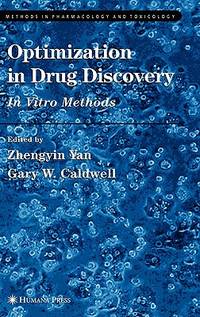
Stock photo: cover may vary
Optimization in Drug Discovery Hardback -
by Zhengyin Yan (Editor); Gary W. Caldwell (Editor)
- Used
- Hardback
A$242.14
A$5.77
Delivery within USA
Standard delivery: 9 to 14 days
More delivery options
Standard delivery: 9 to 14 days
Ships from Cold Books (New York, United States)
Details
- Title Optimization in Drug Discovery
- Author Zhengyin Yan (Editor); Gary W. Caldwell (Editor)
- Binding Hardback
- Edition 1st
- Condition Used
- Pages 420
- Volumes 1
- Language ENG
- Publisher Humana Press
- Publication date pp. 436
- Illustrated Yes
- Features Bibliography, Illustrated, Index
- Bookseller's Inventory # 6279211
- ISBN 9781588293329 / 1588293327
- Weight 1.8 lbs (0.82 kg)
- Dimensions 9.38 x 6.18 x 1.25 in (23.83 x 15.70 x 3.18 cm)
- Category Medical / Nursing
- Library of Congress subjects Pharmaceutical chemistry, Drugs - Testing
- Library of Congress Catalogue Number 2004008395
- Dewey Decimal Code 615.190
- Quantity available 1
About Cold Books New York, United States
Reader reviews for Optimization in Drug Discovery
Write a review for this book
Important Terms and Guidelines
- Please focus on the book’s content and context. Also, add any personal comments as to how you enjoyed the book. Substantiate your likes and dislikes. You may make comparisons to other books.
- Reviews must be at least 140 characters in length.
- Please do not reveal critical plot elements.
- This is not a help line. Contact customer support if you need help.
Your review must not include:
- Obscenities, discriminatory language, or other insulting language not suitable for public domain
- Advertisements, “spam” content, or references to other products, offers or websites.
- Email addresses, URLs, phone numbers, physical addresses or other contact information.
- Overly critical comments about other reviews or reviewers
- Time-sensitive material (i.e. promotional tours, seminars, lectures, etc.)
- Availability, price, or alternative ordering/shipping information
From the publisher
First line
In the drug discovery process, the lead candidates must have proper physicochemical properties, in addition to affinity and potency, in order to have a better chance of success in development.
From the rear cover
Although parallel synthesis combined with high-throughput screening has made it easier to generate highly potent drug candidates, many of these compounds never make the grade because they either prove to be unsafe or lack the necessary physicochemical and pharmacokinetic properties. In Optimization in Drug Discovery: In Vitro Methods, a panel of researchers and experts from leading universities and major pharmaceutical companies from all over the world provide proven solutions to this expensive problem with a collection of cutting-edge experimental protocols for early in vitro evaluation of new chemical entities (NCE). These readily reproducible assays measure such critical parameters as physicochemical properties, adsorption, plasma binding, metabolism, drug interactions, and toxicity. All protocols follow the successful Methods in Molecular Biology(TM) series format, each one offering step-by-step laboratory instructions, an introduction outlining the principle behind the technique, lists of equipment and reagents, and tips on troubleshooting and avoiding known pitfalls.
Comprehensive and highly practical, Optimization in Drug Discovery: In Vitro Methods systematically collects and describes the key methods for uncovering-as early in the discovery stage as possible-those defects that can eliminate candidate drugs from preclinical and clinical development.
Comprehensive and highly practical, Optimization in Drug Discovery: In Vitro Methods systematically collects and describes the key methods for uncovering-as early in the discovery stage as possible-those defects that can eliminate candidate drugs from preclinical and clinical development.
Media reviews
Citations
- Scitech Book News, 12/01/2004, Page 119

