BIBLIO is the largest independent book marketplace in the world, with over 100 million books.

Skip to content

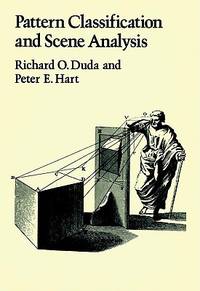
Pattern Classification and Scene Analysis

Pattern Classification and Scene Analysis

Pattern Classification and Scene Analysis
Stock photo: cover may vary

Pattern Classification and Scene Analysis Hardback - 1973 - 1st Edition

by Duda, Richard O.; Hart, Peter E

Add to wish list
  • New
  • Hardback
New

Description

Wiley, 1973-02-09. Hardcover. New. New. In shrink wrap. Looks like an interesting title!
Ask the seller a question Add to wish list
A$187.18
A$8.74 Delivery within USA
Standard delivery: 2 to 21 days
More delivery options
Ships from GridFreed LLC (California, United States)

Details

  • Title Pattern Classification and Scene Analysis
  • Author Duda, Richard O.; Hart, Peter E
  • Binding Hardback
  • Edition number 1st
  • Edition 1
  • Condition New
  • Pages 512
  • Volumes 1
  • Language ENG
  • Publisher Wiley, New York
  • Publication date 1973-02-09
  • Bookseller's Inventory # Q-0471223611
  • ISBN 9780471223610 / 0471223611
  • Weight 1.8 lbs (0.82 kg)
  • Dimensions 9.31 x 6.3 x 1.15 in (23.65 x 16.00 x 2.92 cm)
  • Category Language Arts / Linguistics / Literacy
  • Library of Congress subjects Statistical decision, Pattern recognition systems
  • Library of Congress Catalogue Number 72007008
  • Dewey Decimal Code 001.533
  • Quantity available 1

About GridFreed LLC California, United States

Biblio member since 2021

We sell primarily non-fiction, many new books, some collectible first editions and signed books. We operate 100% online and have been in business since 2005.

Terms of Sale: 30 day return guarantee, with full refund including original shipping costs for up to 30 days after delivery if an item arrives misdescribed or damaged.

Browse books from GridFreed LLC

Reader reviews for Pattern Classification and Scene Analysis

From the publisher

Introduction to Mathematical Techniques in Pattern Recognition by Harry C. Andrews This volume is one of the first cohesive treatments of the use of mathematics for studying interactions between various recognition environments. It brings together techniques previously scattered throughout the literature and provides a concise common notation that will facilitate the understanding and comparison of the many aspects of mathematical pattern recognition. The contents of this volume are divided into five interrelated subject areas: Feature Selection, Distribution Free Classification, Statistical Classification, Nonsupervised Learning, and Sequential Learning. Appendices describing specific aspects of feature selection and extensive reference and bibliographies are included. 1972 253 pp. Threshold Logic and its Applications by Saburo Muroga This is the first in-depth exposition of threshold logic and its applications using linear programming and integer programming as optimization tools. It presents threshold logic as a unified theory of conventional simple gates, threshold gates and their networks. This unified viewpoint explicitly reveals many important properties that were formerly concealed in the framework of conventional switching theory (based essentially on and, or and not gates). 1971 478 pp. Knowing and Guessing A Quantitative Study of Inference and Information By Satosi Watanabe This volume presents a coherent theoretical view of a field now split into different disciplines: philosophy, information science, cybernetics, psychology, electrical engineering, and physics. The target of investigation is the cognitive process of knowing and guessing. In contrast to traditional philosophy, the approach is quantitative rather than qualitative. The study is formal in the sense that the author is not interested in the contents of knowledge or the physiological mechanism of the process of knowing. "The author's style is lucid, his comments are illuminating. The result is a fascinating book, which will be of interest to scientists in many different fields." -- Nature 1969 592 pp.

About the author

About the Authors RICHARD O. DUDA is a Senior Research Engineer at Stanford Research Institute. He received a Ph. D. degree in Electrical Engineering from the Massachusetts Institute of Technology in 1962. Dr. Duda was the Associate Editor for "Pattern Recognition: IEEE Transactions on Computers" from 1969 to 1971. He has lectured on pattern classification at the University of California, Berkeley, and has written numerous technical articles for journals and books. PETER E. HART is Assistant Director of the Artificial Intelligence Center at Stanford Research Institute. He received a Ph. D. degree in Electrical Engineering from Stanford University in 1966. Dr. Hart has lectured on scene analysis at Stanford University, and has actively contributed to the literature of pattern recognition and artificial intelligence.
tracking-