
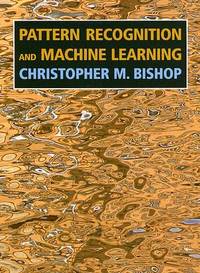
Stock photo: cover may vary
Pattern Recognition and Machine Learning (Information Science and Statistics) Hardback - 2006
by ?BISHOP, Christopher M
- Used
- Good
- Hardback
A$80.14
A$8.73
Delivery within USA
Standard delivery: 6 to 11 days
More delivery options
Standard delivery: 6 to 11 days
Ships from TextbookSavvy, Inc (Tennessee, United States)
Details
- Title Pattern Recognition and Machine Learning (Information Science and Statistics)
- Author ?BISHOP, Christopher M
- Binding Hardback
- Edition INTERNATIONAL ED
- Condition Used - Good
- Pages 778
- Volumes 1
- Language ENG
- Publisher Springer, New York
- Publication date 2006-08-17
- Illustrated Yes
- Features Bibliography, Illustrated, Index, Table of Contents
- Bookseller's Inventory # 11093
- ISBN 9780387310732 / 0387310738
- Weight 3 lbs (1.36 kg)
- Dimensions 10.2 x 7.7 x 1.3 in (25.91 x 19.56 x 3.30 cm)
- Category Computers - General Information
- Library of Congress subjects Pattern perception, Machine learning
- Dewey Decimal Code 006.4
About TextbookSavvy, Inc Tennessee, United States
Biblio member since 2025
Founded in 2023 in U.S. East Coast, TextbookSavvy Inc is a national distributor of used (pre-owned) textbooks and relevant education materials serving clients in the United States, the UK, and Canada.
**Once order is placed, TextbookSavvy Inc may not accept returns for reasons such as "changed my mind", "school book requirement changes", "found a better price", "ordered the wrong book", etc. We only accept returns due to book quality issues, but return period / refund eligiblity will expire after 3 days from the day on which you acquire physical possession of the last good. As a used book seller, our books may contain light highlight or slight damages to its cover, but readability isn't impacted. Books may not contain access codes. **
Reader reviews for Pattern Recognition and Machine Learning (Information Science and Statistics)
Write a review for this book
Important Terms and Guidelines
- Please focus on the book’s content and context. Also, add any personal comments as to how you enjoyed the book. Substantiate your likes and dislikes. You may make comparisons to other books.
- Reviews must be at least 140 characters in length.
- Please do not reveal critical plot elements.
- This is not a help line. Contact customer support if you need help.
Your review must not include:
- Obscenities, discriminatory language, or other insulting language not suitable for public domain
- Advertisements, “spam” content, or references to other products, offers or websites.
- Email addresses, URLs, phone numbers, physical addresses or other contact information.
- Overly critical comments about other reviews or reviewers
- Time-sensitive material (i.e. promotional tours, seminars, lectures, etc.)
- Availability, price, or alternative ordering/shipping information
From the publisher
From the rear cover
The dramatic growth in practical applications for machine learning over the last ten years has been accompanied by many important developments in the underlying algorithms and techniques. For example, Bayesian methods have grown from a specialist niche to become mainstream, while graphical models have emerged as a general framework for describing and applying probabilistic techniques. The practical applicability of Bayesian methods has been greatly enhanced by the development of a range of approximate inference algorithms such as variational Bayes and expectation propagation, while new models based on kernels have had a significant impact on both algorithms and applications.
This completely new textbook reflects these recent developments while providing a comprehensive introduction to the fields of pattern recognition and machine learning. It is aimed at advanced undergraduates or first-year PhD students, as well as researchers and practitioners. No previous knowledge of pattern recognition or machine learning concepts is assumed. Familiarity with multivariate calculus and basic linear algebra is required, and some experience in the use of probabilities would be helpful though not essential as the book includes a self-contained introduction to basic probability theory.
The book is suitable for courses on machine learning, statistics, computer science, signal processing, computer vision, data mining, and bioinformatics. Extensive support is provided for course instructors, including more than 400 exercises, graded according to difficulty. Example solutions for a subset of the exercises are available from the book web site, while solutions for the remainder can be obtained by instructors from the publisher. The book is supported by a great deal of additional material, and the reader is encouraged to visit the book web site for the latest information.
Christopher M. Bishop is Deputy Director of Microsoft Research Cambridge, and holds a Chair inComputer Science at the University of Edinburgh. He is a Fellow of Darwin College Cambridge, a Fellow of the Royal Academy of Engineering, and a Fellow of the Royal Society of Edinburgh. His previous textbook "Neural Networks for Pattern Recognition" has been widely adopted.
Coming soon:
*For students, worked solutions to a subset of exercises available on a public web site (for exercises marked "www" in the text)
*For instructors, worked solutions to remaining exercises from the Springer web site
*Lecture slides to accompany each chapter
*Data sets available for download

