
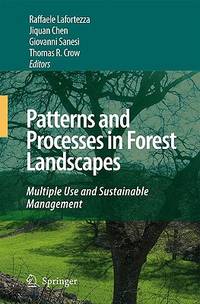
Patterns and Processes in Forest Landscapes: Multiple Use and Sustainable Management Hardback - 2008
by Raffaele Lafortezza (Editor); Foreword by Thomas A. Spies; Jiquan Chen (Editor)
Reader reviews for Patterns and Processes in Forest Landscapes: Multiple Use and Sustainable Management
Write a review for this book
Important Terms and Guidelines
- Please focus on the book’s content and context. Also, add any personal comments as to how you enjoyed the book. Substantiate your likes and dislikes. You may make comparisons to other books.
- Reviews must be at least 140 characters in length.
- Please do not reveal critical plot elements.
- This is not a help line. Contact customer support if you need help.
Your review must not include:
- Obscenities, discriminatory language, or other insulting language not suitable for public domain
- Advertisements, “spam” content, or references to other products, offers or websites.
- Email addresses, URLs, phone numbers, physical addresses or other contact information.
- Overly critical comments about other reviews or reviewers
- Time-sensitive material (i.e. promotional tours, seminars, lectures, etc.)
- Availability, price, or alternative ordering/shipping information
From the publisher
From the rear cover
Increasing evidence suggests that the composition and spatial configuration - the pattern - of forest landscapes affect many ecological processes, including the movement and persistence of particular species, the susceptibility and spread of disturbances such as fires or pest outbreaks, and the redistribution of matter and nutrients. Understanding these issues is key to the successful management of complex, multifunctional forest landscapes, and landscape ecology, based on a foundation of island bio-geography and meta-population dynamic theories, provides the rationale to deal with this pattern-to-process interaction at different spatial and temporal scales.
This carefully edited volume represents a stimulating addition to the international literature on landscape ecology and resource management. It provides key insights into some of the applicable landscape ecological theories that underlie forest management, with a specific focus on how forest management can benefit from landscape ecology, and how landscape ecology can be advanced by tackling challenging problems in forest (landscape) management. It also presents a series of case studies from Europe, Asia, North America, Africa and Australia exploring the issues of disturbance, diversity, management, and scale, and with a specific focus on how human intervention affects forest landscapes and, in turn, how landscapes influence humans and their culture.
An important reference for advanced students and researchers in landscape ecology, conservation biology, forest ecology, natural resource management and ecology across multiple scales, the book will also appeal to researchers and practitioners in reserve design, ecological restoration, forest management, landscape planning and landscape architecture.
Details
- Title Patterns and Processes in Forest Landscapes: Multiple Use and Sustainable Management
- Author Raffaele Lafortezza (Editor); Foreword by Thomas A. Spies; Jiquan Chen (Editor)
- Binding Hardback
- Edition 1st
- Pages 425
- Volumes 1
- Language ENG
- Publisher Springer
- Publication date 2008-09-09
- Illustrated Yes
- Features Bibliography, Illustrated, Index, Maps, Table of Contents
- ISBN 9781402085031 / 1402085036
- Weight 1.89 lbs (0.86 kg)
- Dimensions 9.3 x 6.1 x 0.9 in (23.62 x 15.49 x 2.29 cm)
-
Themes
- Topical: Ecology
- Category Technology & Industrial Arts
- Dewey Decimal Code 333.72
Media reviews
Citations
- Choice, 08/01/2009, Page 0
More Copies for Sale
PATTERNS AND PROCESSES IN FOREST LANDSCAPES
by T.A. SPIES,
- New
- Hardback
- first
- Condition
- New
- Edition
- 1st
- Binding
- Hardcover
- ISBN 10 / ISBN 13
- 9781402085031 / 1402085036
- Quantity available
- 5
- Seller
- Item price
-
A$176.50A$28.93 Delivery to USA
Show details
Patterns And Processes In Forest Landscapes
- New
- Condition
- New
- ISBN 10 / ISBN 13
- 9781402085031 / 1402085036
- Quantity available
- 1
- Seller
- Item price
-
A$198.89A$21.70 Delivery to USA
Show details
Patterns and Processes in Forest Landscapes Multiple Use and Sustainable Management
- New
- Condition
- New
- ISBN 10 / ISBN 13
- 9781402085031 / 1402085036
- Quantity available
- 5
- Seller
- Item price
-
A$206.37A$21.70 Delivery to USA
Show details
Patterns and Processes in Forest Landscapes
- New
- Hardback
- Condition
- New
- Binding
- Hardcover
- ISBN 10 / ISBN 13
- 9781402085031 / 1402085036
- Quantity available
- 4
- Seller
- Item price
-
A$211.02A$5.77 Delivery to USA
Show details
Patterns and Processes in Forest Landscapes: Multiple Use and Sustainable Management
by Lafortezza, Raffaele
- New
- Hardback
- Condition
- New
- Edition
- 2008
- Binding
- Hardcover
- ISBN 10 / ISBN 13
- 9781402085031 / 1402085036
- Quantity available
- 1
- Seller
- Item price
-
A$215.24A$21.70 Delivery to USA
Show details
Patterns and Processes in Forest Landscapes : Multiple Use and Sustainable Management
- New
- Hardback
- Condition
- New
- Binding
- Hardcover
- ISBN 10 / ISBN 13
- 9781402085031 / 1402085036
- Quantity available
- 89
- Seller
- Item price
-
A$386.94A$15.39 Delivery to USA
Show details
Patterns and Processes in Forest Landscapes: Multiple Use and Sustainable Management
by Lafortezza, Raffaele (Editor)/ Chen, Jiquan (Editor)/ Sanesi, Giovanni (Editor)/ Crow, Thomas R. (Editor)
- New
- Hardback
- Condition
- New
- Binding
- Hardcover
- ISBN 10 / ISBN 13
- 9781402085031 / 1402085036
- Quantity available
- 2
- Seller
- Item price
-
A$497.09A$28.90 Delivery to USA
Show details
Patterns And Processes In Forest Landscapes
by T.A. Spies,
- New
- first
- Condition
- New
- Edition
- 1st
- ISBN 10 / ISBN 13
- 9781402085031 / 1402085036
- Quantity available
- 10
- Seller
- Item price
-
A$646.78A$21.69 Delivery to USA
Show details
Patterns And Processes In Forest Landscapes
by T.A. Spies,
- New
- first
- Condition
- New
- Edition
- 1st
- ISBN 10 / ISBN 13
- 9781402085031 / 1402085036
- Quantity available
- 10
- Seller
- Item price
-
A$646.78A$21.69 Delivery to USA
Show details
Patterns And Processes In Forest Landscapes: Multiple Use and Sustainable Management
by Raffaele Lafortezza; Others
- New
- Hardback
- Condition
- New
- Binding
- Hardcover
- ISBN 10 / ISBN 13
- 9781402085031 / 1402085036
- Quantity available
- 500
- Seller
- Item price
-
A$1,057.05A$21.69 Delivery to USA
