BIBLIO is the largest independent book marketplace in the world, with over 100 million books.

Skip to content

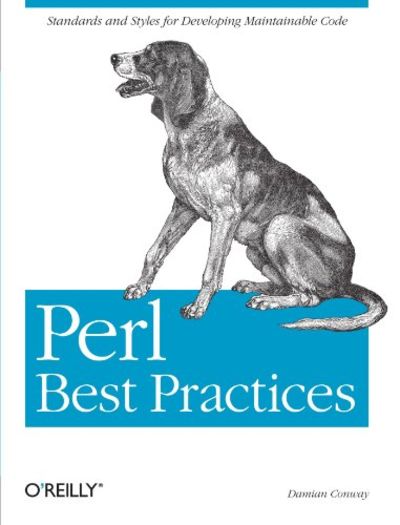
Perl Best Practices: Standards and Styles for Developing Maintainable Code

Perl Best Practices: Standards and Styles for Developing Maintainable Code

Perl Best Practices: Standards and Styles for Developing Maintainable Code Paperback - 2005 - 1st Edition

by Conway, Damian

Add to wish list
  • Used
  • Acceptable
  • Paperback
Used - Acceptable

Description

Paperback. Acceptable.
Ask the seller a question Add to wish list
A$2.06
A$16.35 Delivery to USA
Standard delivery: 7 to 40 days
More delivery options
Ships from World of Books Ltd (West Sussex, United Kingdom)

Details

  • Title Perl Best Practices: Standards and Styles for Developing Maintainable Code
  • Author Conway, Damian
  • Binding Paperback
  • Edition number 1st
  • Edition 1
  • Condition Used - Acceptable
  • Pages 542
  • Volumes 1
  • Language ENG
  • Publisher O'Reilly Media
  • Publication date 2005-08-16
  • Illustrated Yes
  • Features Bibliography, Illustrated, Index, Table of Contents
  • Bookseller's Inventory # GOR008641030
  • ISBN 9780596001735 / 0596001738
  • Weight 1.9 lbs (0.86 kg)
  • Dimensions 9.1 x 6.9 x 1.2 in (23.11 x 17.53 x 3.05 cm)
  • Category Computers - Languages / Programming
  • Library of Congress subjects Perl (Computer program language)
  • Library of Congress Catalogue Number 2005284585
  • Dewey Decimal Code 005.133
  • Quantity available 1

About World of Books Ltd West Sussex, United Kingdom

Biblio member since 2007

In 2002, World of Books was founded on an ethos to do good, protect the planet, and support charities by enabling more goods to be reused. Since then, we've grown into a global pioneer, dedicated to helping people read more and waste less. Through the World of Books brand, customers can now buy and sell with us! We provide affordable, preloved books to book lovers all around the world, while also giving people the opportunity to contribute to the circular economy, earn money and protect the planet by trading in their unwanted books and media for cash. Through the B2B side of our business we've developed technology to help charities sell in bulk, meaning they can clear much needed floor space and make money for great causes at the same time. A new book will be sold once but their stories can be enjoyed by more than one owner. After all, a story doesn't change because it's been read before!

Terms of Sale:

If you are not completely satisfied with your purchase for any reason, simply email customerservice@worldofbooks.com and we will quickly resolve any issues you may have. If you have any other queries about your order, please email customerservice@worldofbooks.com. Our goal is to deliver to our customers the best possible service and we hope your experience of dealing with us lives up to our promise. If for whatever reason we fail to meet your expectations then please let us know.

Browse books from World of Books Ltd

Reader reviews for Perl Best Practices: Standards and Styles for Developing Maintainable Code

From the publisher

Many programmers code by instinct, relying on convenient habits or a "style" they picked up early on. They aren't conscious of all the choices they make, like how they format their source, the names they use for variables, or the kinds of loops they use. They're focused entirely on problems they're solving, solutions they're creating, and algorithms they're implementing. So they write code in the way that seems natural, that happens intuitively, and that feels good.

But if you're serious about your profession, intuition isn't enough. Perl Best Practices author Damian Conway explains that rules, conventions, standards, and practices not only help programmers communicate and coordinate with one another, they also provide a reliable framework for thinking about problems, and a common language for expressing solutions. This is especially critical in Perl, because the language is designed to offer many ways to accomplish the same task, and consequently it supports many incompatible dialects.

With a good dose of Aussie humor, Dr. Conway (familiar to many in the Perl community) offers 256 guidelines on the art of coding to help you write better Perl code--in fact, the best Perl code you possibly can. The guidelines cover code layout, naming conventions, choice of data and control structures, program decomposition, interface design and implementation, modularity, object orientation, error handling, testing, and debugging.

They're designed to work together to produce code that is clear, robust, efficient, maintainable, and concise, but Dr. Conway doesn't pretend that this is the one true universal and unequivocal set of best practices. Instead, Perl Best Practices offers coherent and widely applicable suggestions based on real-world experience of how code is actually written, rather than on someone's ivory-tower theories on how software ought to be created.

Most of all, Perl Best Practices offers guidelines that actually work, and that many developers around the world are already using. Much like Perl itself, these guidelines are about helping you to get your job done, without getting in the way.

Praise for Perl Best Practices from Perl community members:

"As a manager of a large Perl project, I'd ensure that every member of my team has a copy of Perl Best Practices on their desk, and use it as the basis for an in-house style guide." -- Randal Schwartz

"There are no more excuses for writing bad Perl programs. All levels of Perl programmer will be more productive after reading this book." -- Peter Scott

"Perl Best Practices will be the next big important book in the evolution of Perl. The ideas and practices Damian lays down will help bring Perl out from under the embarrassing heading of "scripting languages". Many of us have known Perl is a real programming language, worthy of all the tasks normally delegated to Java and C++. With Perl Best Practices, Damian shows specifically how and why, so everyone else can see, too." -- Andy Lester

"Damian's done what many thought impossible: show how to build large, maintainable Perl applications, while still letting Perl be the powerful, expressive language that programmers have loved for years." -- Bill Odom

"Finally, a means to bring lasting order to the process and product of real Perl development teams." -- Andrew Sundstrom

"Perl Best Practices provides a valuable education in how to write robust, maintainable Perl, and is a definitive citation source when coaching other programmers." -- Bennett Todd "I've been teaching Perl for years, and find the same question keeps being asked: Where can I find a reference for writing reusable, maintainable Perl code? Finally I have a decent answer." -- Paul Fenwick "At last a well researched, well thought-out, comprehensive guide to Perl style. Instead of each of us developing our own, we can learn good practices from one of Perl's most prolific and experienced authors. I recommend this book to anyone who prefers getting on with the job rather than going back and fixing errors caused by syntax and poor style issues." -- Jacinta Richardson "If you care about programming in any language read this book. Even if you don't intend to follow all of the practices, thinking through your style will improve it." -- Steven Lembark "The Perl community's best author is back with another outstanding book. There has never been a comprehensive reference on high quality Perl coding and style until Perl Best Practices. This book fills a large gap in every Perl bookshelf." -- Uri Guttman

Media reviews

Citations

  • Scitech Book News, 06/01/2006, Page 13

About the author

Damian Conway holds a PhD in Computer Science and is an honorary Associate Professor with the School of Computer Science and Software Engineering at Monash University, Melbourne, Australia.Currently he runs an international IT training company--Thoughtstream--which provides programmer development from beginner to masterclass level throughout Europe, North America, and Australasia.Damian was the winner of the 1998, 1999, and 2000 Larry Wall Awards for Practical Utility. The best technical paper at the annual Perl Conference was subsequently named in his honour. He is a member of the technical committee for The Perl Conference, a keynote speaker at many Open Source conferences, a former columnist for The Perl Journal, and author of the book Object Oriented Perl. In 2001 Damian received the first "Perl Foundation Development Grant" and spent 20 months working on projects for the betterment of Perl.A popular speaker and trainer, he is also the author of numerous well-known Perl modules, including Parse:: RecDescent (a sophisticated parsing tool), Class:: Contract (design-by-contract programming in Perl), Lingua:: EN:: Inflect (rule-based English transformations for text generation), Class:: Multimethods (multiple dispatch polymorphism), Text:: Autoformat (intelligent automatic reformatting of plaintext), Switch (Perl's missing case statement), NEXT (resumptive method dispatch), Filter:: Simple (Perl-based source code manipulation), Quantum:: Superpositions (auto-parallelization of serial code using a quantum mechanical metaphor), and Lingua:: Romana:: Perligata (programming in Latin).Most of his time is now spent working with Larry Wall on the design of the new Perl 6 programming language.

tracking-