
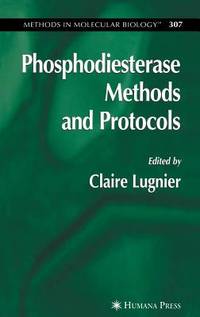
Stock photo: cover may vary
Phosphodiesterase Methods and Protocols Hardback -
by Claire Lugnier (Editor)
- New
- Hardback
A$109.81
A$5.81
Delivery within USA
Standard delivery: 9 to 14 days
More delivery options
Standard delivery: 9 to 14 days
Ships from Cold Books (New York, United States)
Details
- Title Phosphodiesterase Methods and Protocols
- Author Claire Lugnier (Editor)
- Binding Hardback
- Edition Us Edition
- Condition New
- Pages 336
- Volumes 1
- Language ENG
- Publisher Humana Press , Totowa, New Jersey, U.S.A.
- Publication date pp. xii + 324 1st Edition
- Illustrated Yes
- Features Bibliography, Illustrated, Index
- Bookseller's Inventory # 6279268
- ISBN 9781588293145 / 1588293149
- Weight 1.35 lbs (0.61 kg)
- Dimensions 9.2 x 6.3 x 1 in (23.37 x 16.00 x 2.54 cm)
- Category Medical / Nursing
- Library of Congress subjects Protein Engineering - methods, Biological Assay - methods
- Library of Congress Catalogue Number 2005006204
- Dewey Decimal Code 612.015
- Quantity available 4
About Cold Books New York, United States
Reader reviews for Phosphodiesterase Methods and Protocols
Write a review for this book
Important Terms and Guidelines
- Please focus on the book’s content and context. Also, add any personal comments as to how you enjoyed the book. Substantiate your likes and dislikes. You may make comparisons to other books.
- Reviews must be at least 140 characters in length.
- Please do not reveal critical plot elements.
- This is not a help line. Contact customer support if you need help.
Your review must not include:
- Obscenities, discriminatory language, or other insulting language not suitable for public domain
- Advertisements, “spam” content, or references to other products, offers or websites.
- Email addresses, URLs, phone numbers, physical addresses or other contact information.
- Overly critical comments about other reviews or reviewers
- Time-sensitive material (i.e. promotional tours, seminars, lectures, etc.)
- Availability, price, or alternative ordering/shipping information
From the publisher
From the rear cover
The multigenic family of cyclic nucleotide phosphodiesterases (PDEs) is now known to offer many new therapeutic possibilities through their influence over intracellular signaling, though their precise cell mechanisms to modulating that process remain uncertain. In Phosphodiesterase Methods and Protocols, a panel of research leaders in the PDE field describes new concepts and techniques for investigating the role of PDEs in orchestrating normal and pathophysiological responses. Presented in step-by-step detail, these readily reproducible methods allow the measurement of cyclic nucleotide variations in living cells, as well as their visualization in a spatiotemporal manner, the localization and characterization of their activities in tissues and living cells, and the assessment of targeted PDEs in creating specific tools and drugs. Additional chapters discuss the generation of PDE4 knockout mice to demonstrate not only the potential role of targeted PDEs, but also their use in further studies of the central role of PDE regulation in intracellular signaling control. These techniques offer clinicians a way to find new therapies for numerous pathologies whose molecular origins are unknown and whose treatment is symptomatic. Alterations of intracellular signaling related to PDE deregulation in such pathologies as inflammation, neurodegeneration, and cancer may explain the difficulties observed in their prevention and treatment. The protocols follow the successful Methods in Molecular Biology(TM) series format, each offering step-by-step laboratory instructions, an introduction outlining the principle behind the technique, lists of the necessary equipment and reagents, and tips on troubleshooting and avoiding known pitfalls.
Path-breaking and highly practical, Phosphodiesterase Methods and Protocols offers cell biologists, molecular biologists, pharmacologists, and medicinal chemists a broad ranging survey of the advanced tools and concepts needed to understand therole of PDEs in physiological functions, their implications in several critical pathologies, and the opportunities they offer for new drug design.
Path-breaking and highly practical, Phosphodiesterase Methods and Protocols offers cell biologists, molecular biologists, pharmacologists, and medicinal chemists a broad ranging survey of the advanced tools and concepts needed to understand therole of PDEs in physiological functions, their implications in several critical pathologies, and the opportunities they offer for new drug design.

