BIBLIO is the largest independent book marketplace in the world, with over 100 million books.

Skip to content

Physics

Physics

Physics
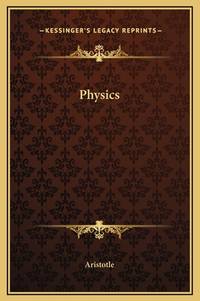
Stock photo: cover may vary

Physics Hardback - 2010

by Aristotle

Add to wish list
  • Used
  • Good
  • Hardback
Used - Good

Description

hardcover. Good. Access codes and supplements are not guaranteed with used items. May be an ex-library book.
Ask the seller a question Add to wish list
A$103.68
Free Delivery within USA
Standard delivery: 7 to 14 days
More delivery options
Dropship order
Ships from Bonita (California, United States)

Details

  • Title Physics
  • Author Aristotle
  • Binding Hardback
  • Condition Used - Good
  • Pages 188
  • Volumes 1
  • Language ENG
  • Publisher Kessinger Publishing
  • Publication date 2010-09-10
  • Bookseller's Inventory # 1169280382.G
  • ISBN 9781169280380 / 1169280382
  • Weight 1.2 lbs (0.54 kg)
  • Dimensions 10 x 7 x 0.5 in (25.40 x 17.78 x 1.27 cm)
  • Themes
    • Cultural Region: Eastern Europe
    • Topical: Ecology
  • Category Philosophy
  • Dewey Decimal Code 508.946
  • Quantity available 1

About Bonita California, United States

Biblio member since 2020

Terms of Sale: 30 day return guarantee, with full refund including original shipping costs for up to 30 days after delivery if an item arrives misdescribed or damaged.

Browse books from Bonita

Reader reviews for Physics

From the publisher

""Physics"" is a comprehensive work by Aristotle, one of the most influential philosophers and scientists of ancient Greece. In this book, Aristotle explores the fundamental principles that govern the natural world, including the concepts of motion, space, time, and causality. He also examines the properties of matter and the different types of motion, such as natural motion, violent motion, and circular motion. Aristotle's approach to physics is deeply rooted in his philosophy, which emphasizes the importance of observation and empirical evidence. He believed that the best way to understand the natural world was to carefully observe it and draw conclusions based on those observations. Throughout the book, Aristotle engages in a dialogue with other philosophers and scientists of his time, as well as with his own students. He presents a number of different theories and hypotheses, and evaluates them based on their logical consistency and their ability to explain observed phenomena. ""Physics"" is a foundational work in the history of science, and it has influenced the development of physics and other natural sciences for centuries. It remains a valuable resource for anyone interested in the history of science, philosophy, or physics.Again, does it follow that Being, if one, is motionless? Why should it not move, the whole of it within itself, as parts of it do which are unities, e.g. this water? Again, why is qualitative change impossible? But, further, Being cannot be one in form, though it may be in what it is made of. (Even some of the physicists hold it to be one in the latter way, though not in the former.) Man obviously differs from horse in form, and contraries from each other.This scarce antiquarian book is a facsimile reprint of the old original and may contain some imperfections such as library marks and notations. Because we believe this work is culturally important, we have made it available as part of our commitment for protecting, preserving, and promoting the world's literature in affordable, high quality, modern editions, that are true to their original work.
tracking-