
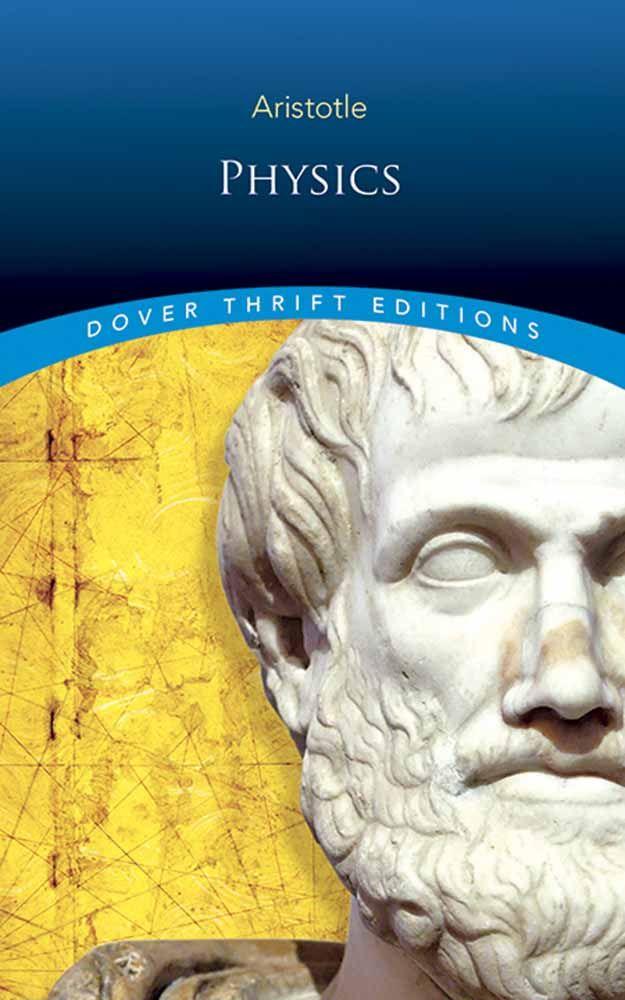
Stock photo: cover may vary
Physics Paperback - 2017
by Aristotle,
- Used
A$10.17
A$5.86
Delivery within USA
Standard delivery: 2 to 14 days
More delivery options
Standard delivery: 2 to 14 days
Ships from GreatBookPrices (Maryland, United States)
Details
- Title Physics
- Author Aristotle,
- Binding Paperback
- Edition Paperback
- Condition New
- Pages 272
- Volumes 1
- Language ENG
- Publisher Dover Publications
- Publication date 2017-03
- Illustrated Yes
- Features Bibliography, Illustrated, Index
- Bookseller's Inventory # 29016715
- ISBN 9780486813516 / 0486813517
- Weight 0.4 lbs (0.18 kg)
- Dimensions 8 x 5 x 0.6 in (20.32 x 12.70 x 1.52 cm)
-
Themes
- Chronological Period: Ancient (To 499 A.D.)
- Category Philosophy
- Library of Congress subjects Physics, Science, Ancient
- Library of Congress Catalogue Number 2017012027
- Dewey Decimal Code 530
- Quantity available 3
About GreatBookPrices Maryland, United States
Biblio member since 2024
Since 1991, we have worked every day to serve our customers with state-of-the-art technology and world class service. We are dedicated to providing customers around the world with the widest selection of books, DVDs, and CDs at the absolute lowest price.
Reader reviews for Physics
Write a review for this book
Important Terms and Guidelines
- Please focus on the book’s content and context. Also, add any personal comments as to how you enjoyed the book. Substantiate your likes and dislikes. You may make comparisons to other books.
- Reviews must be at least 140 characters in length.
- Please do not reveal critical plot elements.
- This is not a help line. Contact customer support if you need help.
Your review must not include:
- Obscenities, discriminatory language, or other insulting language not suitable for public domain
- Advertisements, “spam” content, or references to other products, offers or websites.
- Email addresses, URLs, phone numbers, physical addresses or other contact information.
- Overly critical comments about other reviews or reviewers
- Time-sensitive material (i.e. promotional tours, seminars, lectures, etc.)
- Availability, price, or alternative ordering/shipping information
From the publisher
From the rear cover
Written in the fourth century BCE by Greek philosopher and scientist Aristotle, Physics set out to define the principles and causes of change, movement, and motion. For 2,000 years―until discoveries by Galileo, Newton, and other scientists―this treatise was the primary source for explanations of falling rocks, rising flames, the circulation of air, and other physical phenomena.
Modern readers are required to bring a keen sense of criticism to these writings. Although Aristotle incorporated some degree of experience and observation in his thinking, the root of his reasoning lies in the philosophical approach. The brilliance of the philosopher's mind and his articulate manner of expression, together with the fact that he was among the first to undertake an intellectually rigorous investigation of nature's basic properties, contribute to the historic value of this book. It remains a foundational work of modern science and philosophy and a key to understanding the work of subsequent theorists and scholars.
www.doverpublications.com

