
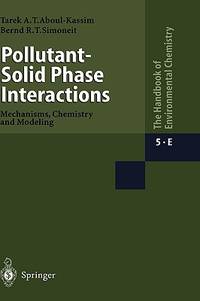
Stock photo: cover may vary
POLLUTANT-SOLID PHASE INTERACTIONS (HANDBOOK OF ENVIRONMENTAL CHEMISTRY) Hardback - 2001
by TAREK A. KASSIM, BERND R.T. SIMONEIT ,
- New
- Hardback
- first
A$177.12
A$29.04
Delivery to USA
Standard delivery: 7 to 12 days
More delivery options
Standard delivery: 7 to 12 days
Details
- Title POLLUTANT-SOLID PHASE INTERACTIONS (HANDBOOK OF ENVIRONMENTAL CHEMISTRY)
- Author TAREK A. KASSIM, BERND R.T. SIMONEIT ,
- Binding Hardback
- Edition 1st
- Condition New
- Pages 430
- Volumes 1
- Language ENG
- Publisher Springer
- Publication date 2001
- Bookseller's Inventory # AME_9783540416500
- ISBN 9783540416500 / 3540416501
- Weight 1.78 lbs (0.81 kg)
- Dimensions 9.21 x 6.14 x 1 in (23.39 x 15.60 x 2.54 cm)
-
Themes
- Topical: Ecology
- Category Medical / Nursing
- Library of Congress Catalogue Number 90009690
- Dewey Decimal Code 333.7
- Quantity available 1
About DELHI BOOK STORE Delhi, India
Biblio member since 2007
Our prime concern is to make books available with its extensive choices of titles on all subjects for medicine, engineers, technocrats, corporates, scientists, academics, students, scholars and many more at attractive price range.
Reader reviews for POLLUTANT-SOLID PHASE INTERACTIONS (HANDBOOK OF ENVIRONMENTAL CHEMISTRY)
Write a review for this book
Important Terms and Guidelines
- Please focus on the book’s content and context. Also, add any personal comments as to how you enjoyed the book. Substantiate your likes and dislikes. You may make comparisons to other books.
- Reviews must be at least 140 characters in length.
- Please do not reveal critical plot elements.
- This is not a help line. Contact customer support if you need help.
Your review must not include:
- Obscenities, discriminatory language, or other insulting language not suitable for public domain
- Advertisements, “spam” content, or references to other products, offers or websites.
- Email addresses, URLs, phone numbers, physical addresses or other contact information.
- Overly critical comments about other reviews or reviewers
- Time-sensitive material (i.e. promotional tours, seminars, lectures, etc.)
- Availability, price, or alternative ordering/shipping information
From the publisher
From the rear cover
Growth in the numbers of organic chemicals during recent decades has been extraordinary. Most are complex compounds that are released directly and/or indirectly to the surrounding environment. A view is emerging in relation to environmental protection and hazardous substance management that (1) some organic chemicals and/or organic leachates from solid waste materials and contaminated sediment/soil sites are of such extreme environmental concern that all use should be highly controlled including isolation for disposal; and (2) most hazardous substances are of sufficient social value that their continual use, production and disposal are justified. For these chemicals their types, sources, fate, behavior, effects and remediation at solid aqueous phase interfaces must be fully assessed and understood. This assessment and understanding are essential for society to accept risks of adverse ecological or human health effects.

