
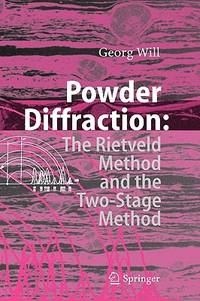
Stock photo: cover may vary
Powder Diffraction: The Rietveld Method and the Two Stage Method to Determine and Refine Crystal Structures from Powder Diffraction Data Hardback - 2005 - 2006th Edition
by Will, Georg
- Used
A$141.74
A$17.49
Delivery to USA
Standard delivery: 14 to 21 days
More delivery options
Standard delivery: 14 to 21 days
Ships from Phatpocket Limited (Essex, United Kingdom)
Details
- Title Powder Diffraction: The Rietveld Method and the Two Stage Method to Determine and Refine Crystal Structures from Powder Diffraction Data
- Author Will, Georg
- Binding Hardback
- Edition number 2006th
- Edition 2006
- Condition Used - Good
- Pages 224
- Volumes 1
- Language ENG
- Publisher Springer, Secaucus, New Jersey, U.S.A.
- Publication date 2005-11-17
- Bookseller's Inventory # Z1-V-013-02908
- ISBN 9783540279853 / 3540279857
- Weight 1.1 lbs (0.50 kg)
- Dimensions 9.3 x 6.5 x 0.9 in (23.62 x 16.51 x 2.29 cm)
- Category Science
- Library of Congress Catalogue Number 2005931757
- Dewey Decimal Code 548.83
About Phatpocket Limited Essex, United Kingdom
Biblio member since 2006
Phatpocket Limited is a world class secondhand bookstore located in the Hertfordshire countryside in the United Kingdom. We specialize in textbooks across an enormous variety of subjects. We aim to provide a low cost source of high quality textbooks to the academic community. We also have a sizable collection of rare and collectible books.
We are dedicated to providing our customers with the highest standard of customer service in the bookselling business.
Books are usually shipped in 48 hours or less. All of our books have a 14 day no hassle money back guarantee unless stated otherwise in the book's description. Item must be returned in the exact same condition that it was received. Through our work with The Rainbow Centre and other Charity Partners, we have already given hundreds of young people in Sri Lanka and Africa the vital chance to get an education.
Reader reviews for Powder Diffraction: The Rietveld Method and the Two Stage Method to Determine and Refine Crystal Structures from Powder Diffraction Data
Write a review for this book
Important Terms and Guidelines
- Please focus on the book’s content and context. Also, add any personal comments as to how you enjoyed the book. Substantiate your likes and dislikes. You may make comparisons to other books.
- Reviews must be at least 140 characters in length.
- Please do not reveal critical plot elements.
- This is not a help line. Contact customer support if you need help.
Your review must not include:
- Obscenities, discriminatory language, or other insulting language not suitable for public domain
- Advertisements, “spam” content, or references to other products, offers or websites.
- Email addresses, URLs, phone numbers, physical addresses or other contact information.
- Overly critical comments about other reviews or reviewers
- Time-sensitive material (i.e. promotional tours, seminars, lectures, etc.)
- Availability, price, or alternative ordering/shipping information

