BIBLIO is the largest independent book marketplace in the world, with over 100 million books.

Skip to content

A Practical Guide to Hybrid Natural Language Processing

A Practical Guide to Hybrid Natural Language Processing

A Practical Guide to Hybrid Natural Language Processing
Stock photo: cover may vary

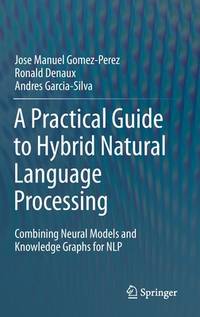
A Practical Guide to Hybrid Natural Language Processing Hardback - 2020

by Gomez-Perez

Add to wish list
  • Used
  • Good
  • Hardback
Used - Good

Description

hardcover. Good. Access codes and supplements are not guaranteed with used items. May be an ex-library book.
Ask the seller a question Add to wish list
A$192.74
Free Delivery within USA
Standard delivery: 7 to 14 days
More delivery options
Dropship order
Ships from Bonita (California, United States)

Details

  • Title A Practical Guide to Hybrid Natural Language Processing
  • Author Gomez-Perez
  • Binding Hardback
  • Condition Used - Good
  • Pages 268
  • Volumes 1
  • Language ENG
  • Publisher Springer
  • Publication date 2020-06-17
  • Illustrated Yes
  • Features Illustrated
  • Bookseller's Inventory # 3030448290.G
  • ISBN 9783030448295 / 3030448290
  • Weight 1.3 lbs (0.59 kg)
  • Dimensions 9.21 x 6.14 x 0.69 in (23.39 x 15.60 x 1.75 cm)
  • Category Computers - General Information
  • Quantity available 1

About Bonita California, United States

Biblio member since 2020

Terms of Sale: 30 day return guarantee, with full refund including original shipping costs for up to 30 days after delivery if an item arrives misdescribed or damaged.

Browse books from Bonita

Reader reviews for A Practical Guide to Hybrid Natural Language Processing

From the publisher

This book provides readers with a practical guide to the principles of hybrid approaches to natural language processing (NLP) involving a combination of neural methods and knowledge graphs. To this end, it first introduces the main building blocks and then describes how they can be integrated to support the effective implementation of real-world NLP applications. To illustrate the ideas described, the book also includes a comprehensive set of experiments and exercises involving different algorithms over a selection of domains and corpora in various NLP tasks.

Throughout, the authors show how to leverage complementary representations stemming from the analysis of unstructured text corpora as well as the entities and relations described explicitly in a knowledge graph, how to integrate such representations, and how to use the resulting features to effectively solve NLP tasks in a range of domains. In addition, the book offers access to executable code with examples, exercises and real-world applications in key domains, like disinformation analysis and machine reading comprehension of scientific literature. All the examples and exercises proposed in the book are available as executable Jupyter notebooks in a GitHub repository. They are all ready to be run on Google Colaboratory or, if preferred, in a local environment.

A valuable resource for anyone interested in the interplay between neural and knowledge-based approaches to NLP, this book is a useful guide for readers with a background in structured knowledge representations as well as those whose main approach to AI is fundamentally based on logic. Further, it will appeal to those whose main background is in the areas of machine and deep learning who are looking for ways to leverage structured knowledge bases to optimize results along the NLP downstream.


From the rear cover

This book provides readers with a practical guide to the principles of hybrid approaches to natural language processing (NLP) involving a combination of neural methods and knowledge graphs. To this end, it first introduces the main building blocks and then describes how they can be integrated to support the effective implementation of real-world NLP applications. To illustrate the ideas described, the book also includes a comprehensive set of experiments and exercises involving different algorithms over a selection of domains and corpora in various NLP tasks.

Throughout, the authors show how to leverage complementary representations stemming from the analysis of unstructured text corpora as well as the entities and relations described explicitly in a knowledge graph, how to integrate such representations, and how to use the resulting features to effectively solve NLP tasks in a range of domains. In addition, the book offers access to executable code with examples, exercises and real-world applications in key domains, like disinformation analysis and machine reading comprehension of scientific literature. All the examples and exercises proposed in the book are available as executable Jupyter notebooks in a GitHub repository. They are all ready to be run on Google Colaboratory or, if preferred, in a local environment.

A valuable resource for anyone interested in the interplay between neural and knowledge-based approaches to NLP, this book is a useful guide for readers with a background in structured knowledge representations as well as those whose main approach to AI is fundamentally based on logic. Further, it will appeal to those whose main background is in the areas of machine and deep learning who are looking for ways to leverage structured knowledge bases to optimize results along the NLP downstream.

About the author

Jose Manuel Gomez-Perez leads the Cogito Research Lab at Expert System in Madrid, Spain, where he focuses on the combination of neural and knowledge-based approaches to enable reading comprehension in machines. His work lies at the intersection of several areas of artificial intelligence, including natural language processing, knowledge graphs and deep learning. He also consults for organizations like the European Space Agency and is the co-founder of ROHub.org, a platform for the intelligent management of scientific information. A former Marie Curie fellow, Jos Manuel holds a Ph.D. in Computer Science and Artificial Intelligence from Universidad Politcnica de Madrid. He regularly publishes in top scientific conferences and journals and his views have appeared in magazines like Nature and Scientific American, as well as newspapers like El Pas.

Ronald Denaux is a senior researcher scientist at Expert System. Ronald obtained his MSc in Computer Science from the Technical University Eindhoven, The Netherlands. After a couple of years working in industry as a software developer for a large IT company in The Netherlands, Ronald decided to go back to academia. He obtained a Ph.D., again in Computer Science, from the University of Leeds, UK. Ronald's research interests have revolved around making semantic web technologies more usable for end users, which has required research into the areas of ontology authoring and reasoning, natural language interfaces, dialogue systems, intelligent user interfaces and user modelling.

Andres Garcia-Silva is a senior research scientist at Expert System, where he works on a variety of fields related to knowledge management and artificial intelligence including semantic technologies, natural language processing, information extraction and retrieval, and machine learning. Andrs holds a Ph.D. and a Master degree in Artificial Intelligence from Universidad Politcnica de Madrid. He has worked as a visiting researcher at the University of Southampton, the Free University of Berlin, and the University of Southern California. Andrs regularly publishes and reviews papers for conferences and workshops in the semantic web research community.

tracking-