
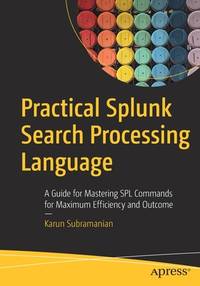
Stock photo: cover may vary
Practical Splunk Search Processing Language: A Guide for Mastering SPL Commands for Maximum Efficiency and Outcome Paperback - 2020
by Karun Subramanian
- Used
A$55.78
A$5.77
Delivery within USA
Standard delivery: 5 to 9 days
More delivery options
Standard delivery: 5 to 9 days
Ships from Wonder Book (Maryland, United States)
Details
- Title Practical Splunk Search Processing Language: A Guide for Mastering SPL Commands for Maximum Efficiency and Outcome
- Author Karun Subramanian
- Binding Paperback
- Condition Used - Very good
- Pages 268
- Volumes 1
- Language ENG
- Publisher Apress
- Publication date 2020-11-24
- Illustrated Yes
- Features Illustrated
- Bookseller's Inventory # G05J-00033
- ISBN 9781484262757 / 1484262751
- Weight 1.12 lbs (0.51 kg)
- Dimensions 10 x 7 x 0.61 in (25.40 x 17.78 x 1.55 cm)
- Category Business / Economics / Finance
About Wonder Book Maryland, United States
Biblio member since 2003


With 3 stores less than 1 hour outside the DC/Metropolitan area (1 in Gaithersburg, 1 in Frederick and 1 in Hagerstown, MD), we have the largest selection of books in the tri-state area. Wonder Book and Video has been in business since 1980 and online since 1997. We have over 1 Million books for sale on our website and another 1 Million books for sale in our 3 locations. We have a very active online inventory and as such, we can receive multiple orders for the same item. We fill those orders on a first come first serve basis, but will refund promptly any items that are out of stock. Since 1980 it has always been about the books. ALL kinds of books from 95 cent children\'s paperbacks to five figure rare and collectibles. A merging of the old and new is where we started, and it is where we are today. Our retail stores have always been places where a reader can rush in looking for a title needed for a term paper that is due the next day, or where bibliophiles can get lost \"in the stacks\" for as long as they wish. In 2002 USAToday recognized us as \"1 of 10 Great Old Bookstores\", and we have been featured in numerous other newspaper and TV stories including Washington Post and CSpan.
RETURNS are cheerfully accepted up to 30 days. We ship out within 1-2 business days and U.S. Standard Shipments usually arrive within 6-9 business days, Priority 3-6.
Reader reviews for Practical Splunk Search Processing Language: A Guide for Mastering SPL Commands for Maximum Efficiency and Outcome
Write a review for this book
Important Terms and Guidelines
- Please focus on the book’s content and context. Also, add any personal comments as to how you enjoyed the book. Substantiate your likes and dislikes. You may make comparisons to other books.
- Reviews must be at least 140 characters in length.
- Please do not reveal critical plot elements.
- This is not a help line. Contact customer support if you need help.
Your review must not include:
- Obscenities, discriminatory language, or other insulting language not suitable for public domain
- Advertisements, “spam” content, or references to other products, offers or websites.
- Email addresses, URLs, phone numbers, physical addresses or other contact information.
- Overly critical comments about other reviews or reviewers
- Time-sensitive material (i.e. promotional tours, seminars, lectures, etc.)
- Availability, price, or alternative ordering/shipping information
From the publisher
From the rear cover
Use this practical guide to the Splunk operational data intelligence platform to search, visualize, and analyze petabyte-scale, unstructured machine data. Get to the heart of the platform and use the Search Processing Language (SPL) tool to query the platform to find the answers you need.
With more than 140 commands, SPL gives you the power to ask any question of machine data. However, many users (both newbies and experienced users) find the language difficult to grasp and complex. This book takes you through the basics of SPL using plenty of hands-on examples and emphasizes the most impactful SPL commands (such as eval, stats, and timechart). You will understand the most efficient ways to query Splunk (such as learning the drawbacks of subsearches and join, and why it makes sense to use tstats). You will be introduced to lesser-known commands that can be very useful, such as using the command rex to extract fields and erex to generate regular expressions automatically.
In addition, you will learn how to create basic visualizations (such as charts and tables) and use prescriptive guidance on search optimization. For those ready to take it to the next level, the author introduces advanced commands such as predict, kmeans, and cluster.
What You Will Learn- Use real-world scenarios (such as analyzing a web access log) to search, group, correlate, and create reports using SPL commands
- Enhance your search results using lookups and create new lookup tables using SPL commands
- Extract fields from your search results
- Compare data from multiple time frames in one chart (such as comparing your current day application performance to the average of the past 30 days)
- Analyze the performance of your search using Job Inspector and identify execution costs ofvarious components of your search
Karun Subramanian is an IT operations expert and a Splunk certified architect. He is committed to helping IT organizations implement world-class observability by making use of machine-generated data. His IT career has spanned more than two decades, ranging from systems administrator to software engineer to IT director. Possessing deep expertise of the Splunk platform, he has assisted teams to solve complex problems in the area of DevOps, security, and business analytics. He has worked in engineering roles for firms including Wells Fargo Bank, Express Scripts, Federal Reserve Bank, and Optum.

