BIBLIO is the largest independent book marketplace in the world, with over 100 million books.

Skip to content

Practice Informed Research Methods for Social Workers

Practice Informed Research Methods for Social Workers

Practice Informed Research Methods for Social Workers
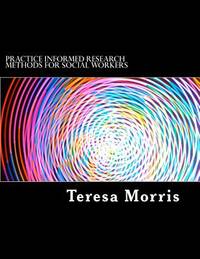
Stock photo: cover may vary

Practice Informed Research Methods for Social Workers Paperback - 2014

by Morris, Teresa

Add to wish list
  • Used
  • Good
  • Paperback
Used - Good

Description

paperback. Good. Access codes and supplements are not guaranteed with used items. May be an ex-library book.
Ask the seller a question Add to wish list
A$71.17
Free Delivery within USA
Standard delivery: 7 to 14 days
More delivery options
Dropship order
Ships from Bonita (California, United States)

Details

  • Title Practice Informed Research Methods for Social Workers
  • Author Morris, Teresa
  • Binding Paperback
  • Condition Used - Good
  • Pages 358
  • Volumes 1
  • Language ENG
  • Publisher Teresa Morris
  • Publication date 2014-11-21
  • Bookseller's Inventory # 0692210512.G
  • ISBN 9780692210512 / 0692210512
  • Weight 1.83 lbs (0.83 kg)
  • Dimensions 11.02 x 8.5 x 0.74 in (27.99 x 21.59 x 1.88 cm)
  • Category Sociology
  • Quantity available 1

About Bonita California, United States

Biblio member since 2020

Terms of Sale: 30 day return guarantee, with full refund including original shipping costs for up to 30 days after delivery if an item arrives misdescribed or damaged.

Browse books from Bonita

Reader reviews for Practice Informed Research Methods for Social Workers

From the publisher

This book describes and discusses research methods for four alternative paradigms. These methodologies are organized according to the stages of a generalist model of social work practice. In my first book on Social Work Research Methods (Morris, 2006) I introduced the idea that social workers can carry out research in a more liberated fashion than is usually outlined in most research methods text books. I gave a philosophical, theoretical, historical and practical foundation for implementing research from four alternative perspectives: positivism, post positivism, critical theory, and constructivism. As well as introducing these paradigms, I integrated research methodologies with social work practice by translating the steps of the generalist, social work, practice model (engagement, assessment, planning, implementation, evaluation, termination and follow up) into the research process (research focus, design, data collection, data analysis, data interpretation, and communication and dissemination of findings). I divided that book into four parts according to each paradigm with a fifth part that addressed cross cutting issues such as ethics, diversity, politics, and technology. This book updates and reorganizes these ideas and methods so that the flow of the discussion more closely parallels the flow of the research process. Instead of being organized according to the paradigms, it is organized according to the stages of the research process. Also, to assist with instruction on this new organization, there are additional resources that contain power point slides, full texts of example student studies using these approaches, test questions, and other supplementary materials. These can be accessed by contacting me at tmorris@csusb.edu I have made these changes because, after using my first book for a few years, I realized that starting with positivism and ending with constructivism has left students who are keen to learn about critical theory and constructivism "cooling their heels" for half of the course. Now, when I integrate the four paradigms throughout the course, I offer a continual comparison of those approaches as we learn about each stage of generalist research methods. Having tried this with drafts of this book, I can honestly say that classroom discussion has become more lively....and demanding.

About the author

eresa Morris is from England via Australia. She worked in England and Australia as a teacher, community worker and academic. She received her M.S.W. from the University of Hawaii and her Doctorate from UC, Berkeley. She has written two books on research methods and published refereed articles on refugees, research methods, professional education, and leadership. She is a professor Emerita at California State University, San Bernardino where she has been a member of the faculty since 1989. For 12 years she was the Director of the School of Social Work and currently she teaches research methods and directs the social work distance learning program.
tracking-