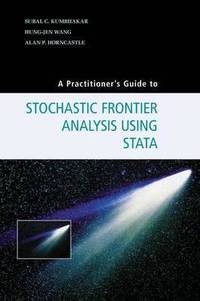
ISBN: 9781107029514
Cambridge University Press, 02 February 2015
Hardcover, 374 pages
Stochastic Frontier Analysis Using Stata provides practitioners in academia and industry with a step-by-step guide on how to conduct efficiency analysis using the stochastic frontier approach. The authors explain in detail how to estimate production, cost, and profit efficiency and introduce the basic theory of each model in an accessible way, using empirical examples that demonstrate the interpretation and application of models. This book also provides computer code, allowing users to apply the models in their own work, and incorporates the most recent stochastic frontier models developed in academic literature. Such recent developments include models of heteroscedasticity and exogenous determinants of inefficiency, scaling models, panel models with time-varying inefficiency, growth models, and panel models that separate firm effects and persistent and transient inefficiency. Immensely helpful to applied researchers, this book bridges the chasm between theory and practice, expanding the range of applications in which production frontier analysis may be implemented.
Editorial Reviews
Review
"A competent empirical application of Stochastic Frontier Analysis (SFA) requires a clear understanding of both the production economics and the econometric theory behind the specified model side by side with adequate programming skills to write the necessary software codes. Apart from a clear exposition of the economic theory behind various stochastic frontier models that represent the technology (like the Distance Functions) and/or producer behavior (like the Cost or Profit Functions) and the relevant econometric theory, the authors offer detailed instructions on how to write the commands for various models in Stata and explain how to interpret the results. This book will prove to be invaluable for every serious researcher using SFA to measure production efficiency."
Subhash C. Ray, University of Connecticut
"This book is a significant contribution to an applied introduction to stochastic frontier analysis. The authors explain clearly many of the models used in efficiency estimation, which has become a standard tool in the arsenal of applied economics. They explain clearly the models and the assumptions and provide a thorough introduction to estimating performance and efficiency for the practitioner. The many scientific fields in which efficiency and performance measurement are important will benefit immensely from the book not only because of its clarity and concreteness but also because the models are taken directly to practice using Stata, standard software used by many researchers. The combination of theory and practical application is masterfully done in this book, and practitioners in a vast number of fields will find it indispensable for their research."
Mike G. Tsionas, Athens University of Economics and Business
Book Description
This book provides practitioners with a step-by-step guide on how to conduct efficiency analysis using the stochastic frontier approach.
About the Author
Subal C. Kumbhakar is a distinguished research professor at the State University of New York, Binghamton. He specializes in productivity and efficiency analysis, with particular emphasis on the theory and application of stochastic frontier (SF) models. He has developed numerous SF models for both cross-sectional and panel models in a single-equation set-up, as well as in a set-up with simultaneous equations. He is co-editor of Empirical Economics and guest editor of special issues of the Journal of Econometrics, Empirical Economics, the Journal of Productivity Analysis, and the Indian Economic Review. He is associate editor and editorial board member of Technological Forecasting and Social Change: An International Journal, the Journal of Productivity Analysis, the International Journal of Business and Economics, and Macroeconomics and Finance in Emerging Market Economies. He is also the co-author of Stochastic Frontier Analysis (Cambridge, 2000).
Hung-Jen Wang is Professor of Economics at the National Taiwan University. His research interests include stochastic frontier analysis and empirical macroeconomics. He has published research papers in the Journal of Econometrics, the Journal of Business and Economic Statistics, Econometric Review, Economic Inquiry, the Journal of Productivity Analysis, and Economics Letters. He was a co-editor of Pacific Economic Review and is currently associate editor of Empirical Economics and the Journal of Productivity Analysis.
Alan P. Horncastle has been a professional economist for more than twenty years and leads Oxera's work on performance assessment. He has provided efficiency advice for companies and regulatory authorities in the energy, transport, water, financial services, and communications sectors across Europe for business planning, transactions, regulatory reviews, Competition Commission cases, and court hearings. He has published papers in the Journal of the Operational Research Society, the Journal of Regulatory Economics, the Competition Law Journal, and Utilities Policy and has contributed chapters to Liberalization of the Postal and Delivery Sector and Emerging Issues in Competition, Collusion and Regulation of Network Industries.