BIBLIO is the largest independent book marketplace in the world, with over 100 million books.

Skip to content

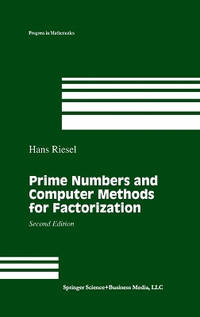
Prime Numbers and Computer Methods for Factorization

Prime Numbers and Computer Methods for Factorization

Prime Numbers and Computer Methods for Factorization Hardback - 1994

by Hans Riesel

Add to wish list
  • New
  • Hardback
New

Description

Hardback. New. Includes important advances in computational prime number theory and in factorization. This book treats four fundamental problems: the number of primes below a given limit, the approximate number of primes, the recognition of primes, and the factorization of large numbers. It is suitable for mathematicians and students of applied number theory.
Ask the seller a question Add to wish list
A$181.63
A$19.22 Delivery to USA
Standard delivery: 14 to 21 days
More delivery options
Ships from The Saint Bookstore (Merseyside, United Kingdom)

Details

  • Title Prime Numbers and Computer Methods for Factorization
  • Author Hans Riesel
  • Binding Hardback
  • Edition 2nd
  • Condition New
  • Pages 484
  • Volumes 1
  • Language ENG
  • Publisher Birkhauser Boston, Boston
  • Publication date 1994-10-01
  • Illustrated Yes
  • Features Bibliography, Illustrated, Index
  • Bookseller's Inventory # A9780817637439
  • ISBN 9780817637439 / 0817637435
  • Weight 1.8 lbs (0.82 kg)
  • Dimensions 9.58 x 6.46 x 1.12 in (24.33 x 16.41 x 2.84 cm)
  • Category Mathematics
  • Library of Congress subjects Numbers, Prime - Data processing, Factorization (Mathematics) - Data processing
  • Library of Congress Catalogue Number 94027688
  • Dewey Decimal Code 512.72
  • Quantity available 10

About The Saint Bookstore Merseyside, United Kingdom

Biblio member since 2018

The Saint Bookstore specialises in hard to find titles & also offers delivery worldwide for reasonable rates.

Terms of Sale: Refunds or Returns: A full refund of the price paid will be given if returned within 30 days in undamaged condition. If the product is faulty, we may send a replacement.

Browse books from The Saint Bookstore

Reader reviews for Prime Numbers and Computer Methods for Factorization

From the publisher

1. The Number of Primes Below a Given Limit.- What Is a Prime Number?.- The Fundamental Theorem of Arithmetic.- Which Numbers Are Primes? The Sieve of Eratosthenes.- General Remarks Concerning Computer Programs.- A Sieve Program.- Compact Prime Tables.- Hexadecimal Compact Prime Tables.- Difference Between Consecutive Primes.- The Number of Primes Below x.- Meissel's Formula.- Evaluation of Pk(x, a).- Lehmer's Formula.- Computations.- A Computation Using Meissel's Formula.- A Computation Using Lehmer's Formula.- A Computer Program Using Lehmer's Formula.- Mapes' Method.- Deduction of Formulas.- A Worked Example.- Mapes' Algorithm.- Programming Mapes' Algorithm.- Recent Developments.- Results.- Computational Complexity.- Comparison Between the Methods Discussed.- 2. The Primes Viewed at Large.- No Polynomial Can Produce Only Primes.- Formulas Yielding All Primes.- The Distribution of Primes Viewed at Large. Euclid's Theorem.- The Formulas of Gauss and Legendre for ?(x). The Prime Number Theorem.- The Chebyshev Function ?(x).- The Riemann Zeta-function.- The Zeros of the Zeta-function.- Conversion From f(x) Back to ?(x).- The Riemann Prime Number Formula.- The Sign of li x ? ?(x).- The Influence of the Complex Zeros of ?(s) on ?(x).- The Remainder Term in the Prime Number Theorem.- Effective Inequalities for ?(x), pn, and ?(x).- The Number of Primes in Arithmetic Progressions.- 3. Subtleties in the Distribution of Primes.- The Distribution of Primes in Short Intervals.- Twins and Some Other Constellations of Primes.- Admissible Constellations of Primes.- The Hardy-Littlewood Constants.- The Prime k-Tuples Conjecture.- Theoretical Evidence in Favour of the Prime k-Tuples Conjecture.- Numerical Evidence in Favour of the Prime k-Tuples Conjecture.- The Second Hardy-Littlewood Conjecture.- The Midpoint Sieve.- Modification of the Midpoint Sieve.- Construction of Superdense Admissible Constellations.- Some Dense Clusters of Primes.- The Distribution of Primes Between the Two Series 4n + 1 and 4n + 3.- Graph of the Function ?4,3(x) ? ?4,1(x).- The Negative Regions.- The Negative Blocks.- Large Gaps Between Consecutive Primes.- The Cramr Conjecture.- 4. The Recognition of Primes.- Tests of Primality and of Compositeness.- Factorization Methods as Tests of Compositeness.- Fermat's Theorem as Compositeness Test.- Fermat's Theorem as Primality Test.- Pseudoprimes and Probable Primes.- A Computer Program for Fermat's Test.- The Labor Involved in a Fermat Test.- Carmichael Numbers.- Euler Pseudoprimes.- Strong Pseudoprimes and a Primality Test.- A Computer Program for Strong Pseudoprime Tests.- Counts of Pseudoprimes and Carmichael Numbers.- Rigorous Primality Proofs.- Lehmer's Converse of Fermat's Theorem.- Formal Proof of Theorem 4.3.- Ad Hoc Search for a Primitive Root.- The Use of Several Bases.- Fermat Numbers and Pepin's Theorem.- Cofactors of Fermat Numbers.- Generalized Fermat Numbers.- A Relaxed Converse of Fermat's Theorem.- Proth's Theorem.- Tests of Compositeness for Numbers of the form N = h - 2n k.- An Alternative Approach.- Certificates of Primality.- Primality Tests of Lucasian Type.- Lucas Sequences.- The Fibonacci Numbers.- Large Subscripts.- An Alternative Deduction.- Divisibility Properties of the Numbers Un.- Primality Proofs by Aid of Lucas Sequences.- Lucas Tests for Mersenne Numbers.- A Relaxation of Theorem 4.8.- Pocklington's Theorem.- Lehmer-Pocklington's Theorem.- Pocklington-Type Theorems for Lucas Sequences.- Primality Tests for Integers of the form N = h - 2n ? 1, when 3?h.- Primality Tests for N = h - 2n ? 1, when 3?h.- The Combined N ? 1 and N + 1 Test.- Lucas Pseudoprimes.- Modern Primality Proofs.- The Jacobi Sum Primality Test.- Three Lemmas.- Lenstra's Theorem.- The Sets P and Q.- Running Time for the APRCL Test.- Elliptic Curve Primality Proving, ECPP.- The Goldwasser-Kilian Test.- Atkin's Test.- 5. Classical Methods of Factorization.- When Do We Attempt Factorization?.- Tri

From the rear cover

In the modern age of almost universal computer usage, practically every individual in a technologically developed society has routine access to the most up-to-date cryptographic technology that exists, the so-called RSA public-key cryptosystem. A major component of this system is the factorization of large numbers into their primes. Thus an ancient number-theory concept now plays a crucial role in communication among millions of people who may have little or no knowledge of even elementary mathematics.Hans Riesel 's highly successful first edition of this book has now been enlarged and updated with the goal of satisfying the needs of researchers, students, practitioners of cryptography, and non-scientific readers with a mathematical inclination. It includes important advances in computational prime number theory and in factorization as well as re-computed and enlarged tables, accompanied by new tables reflecting current research by both the author and his coworkers and by independent researchers.The book treats four fundamental problems: the number of primes below a given limit, the approximate number of primes, the recognition of primes and the factorization of large numbers. The author provides explicit algorithms and computer programs, and has attempted to discuss as many of the classically important results as possible, as well as the most recent discoveries. The programs include are written in PASCAL to allow readers to translate the programs into the language of their own computers.The independent structure of each chapter of the book makes it highly readable for a wide variety of mathematicians, students of applied number theory, and others interested in both study and research in number theory and cryptography.
tracking-