
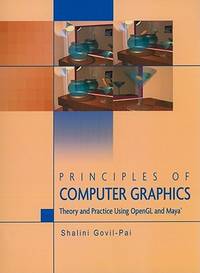
Stock photo: cover may vary
Principles of Computer Graphics: Theory and Practice Using Opengl and Maya« Paperback - 2010
by Shalini Govil-Pai
- New
- Paperback
A$132.88
A$29.24
Delivery to USA
Standard delivery: 7 to 14 days
More delivery options
Standard delivery: 7 to 14 days
Ships from Revaluation Books (Devon, United Kingdom)
Details
- Title Principles of Computer Graphics: Theory and Practice Using Opengl and Maya«
- Author Shalini Govil-Pai
- Binding Paperback
- Edition Softcover reprin
- Condition New
- Pages 296
- Volumes 1
- Language ENG
- Publisher Springer US
- Publication date 2010
- Features Bibliography, Table of Contents
- Bookseller's Inventory # x-1441947183
- ISBN 9781441947185 / 1441947183
- Weight 1.36 lbs (0.62 kg)
- Dimensions 9.8 x 7.4 x 0.9 in (24.89 x 18.80 x 2.29 cm)
- Category Computers - Other Applications
- Dewey Decimal Code 006.6
- Quantity available 2
About Revaluation Books Devon, United Kingdom
Biblio member since 2020
General bookseller of both fiction and non-fiction.
Reader reviews for Principles of Computer Graphics: Theory and Practice Using Opengl and Maya«
Write a review for this book
Important Terms and Guidelines
- Please focus on the book’s content and context. Also, add any personal comments as to how you enjoyed the book. Substantiate your likes and dislikes. You may make comparisons to other books.
- Reviews must be at least 140 characters in length.
- Please do not reveal critical plot elements.
- This is not a help line. Contact customer support if you need help.
Your review must not include:
- Obscenities, discriminatory language, or other insulting language not suitable for public domain
- Advertisements, “spam” content, or references to other products, offers or websites.
- Email addresses, URLs, phone numbers, physical addresses or other contact information.
- Overly critical comments about other reviews or reviewers
- Time-sensitive material (i.e. promotional tours, seminars, lectures, etc.)
- Availability, price, or alternative ordering/shipping information
From the publisher
From the rear cover
Computer graphics continues to evolve at a breakneck pace, fueled by modern uses in health, biotechnology, business, and entertainment (feature films and the gaming industry). It is important for those in the business to have a solid grounding in--and holistic view of--the fundamentals of this exciting discipline.
Providing an integrated balance of underlying theory and real-life practicality, Principles of Computer Graphics is a uniquely comprehensive introduction to the concepts, core principles, and methodologies employed in the graphics endeavor. Concepts are defined and explained in an easy-to-understand manner, and the reader learns progressively-- from basic algorithmic components to elaborate and stunning visual displays. The text uses C (a standard programming language) and OpenGL (a standard graphics library) to teach illustratively, and it introduces the powerful 3D capability of Maya. Readers need only a basic education in math and programming.
Topics and Features:
-Provides a full introduction to computer graphics concepts, principles, methods, and applications
-Concentrates on core principles, thereby allowing readers to readily utilize any graphics API upon completion
-Reinforces its theme with heavy use of examples, exercises, and figures and images
-Discusses the processes, tricks, and techniques used at professional production houses
-Uses a step-by-step, teach-by-example approach, whereby readers end up creating their own game and movie (much like real graphics production houses)
-Supplies a full treatment of all key elements of graphics study and the results and products derived from it
This all-encompassing and well-organized textbook/reference is ideally suited to both students and professionals interested in developing or honing their skills in computer graphics. Its clarity of approach and wealth of examples andlearning aids will also be helpful for vocational training courses or self study, and will empower readers to further study of graphics.
Shalini Govil-Pai has used her imaging and animation expertise to develop virtual reality games and military training simulators. She was technical director on the films, Toy Story and A Bug's Life, and is a co-author of Learning Computer Graphics.

