BIBLIO is the largest independent book marketplace in the world, with over 100 million books.

Skip to content

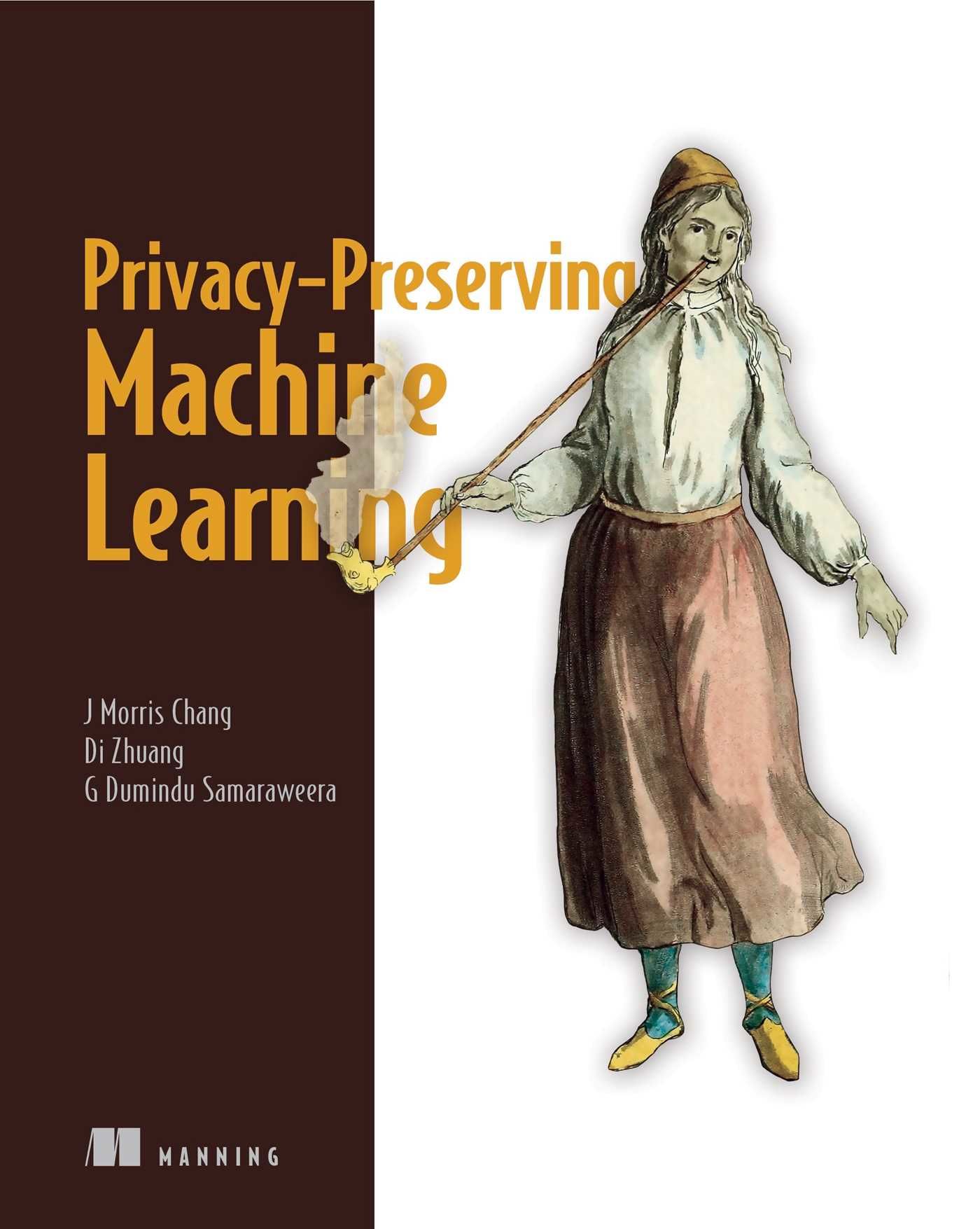
Privacy-Preserving Machine Learning

Privacy-Preserving Machine Learning

Privacy-Preserving Machine Learning
Stock photo: cover may vary

Privacy-Preserving Machine Learning Papeback -

by J. Morris Chang; Di Zhuang; G. Dumindu Samaraweera

Add to wish list
  • New
New

Description

Manning Publications Company , . Papeback. New.
Ask the seller a question Add to wish list
A$111.47
A$5.82 Delivery within USA
Standard delivery: 9 to 14 days
More delivery options
Ships from Cold Books (New York, United States)

Details

  • Title Privacy-Preserving Machine Learning
  • Author J. Morris Chang; Di Zhuang; G. Dumindu Samaraweera
  • Binding Papeback
  • Condition New
  • Pages 336
  • Volumes 1
  • Language ENG
  • Publisher Manning Publications Company
  • Publication date
  • Bookseller's Inventory # 6386708715
  • ISBN 9781617298042 / 1617298042
  • Weight 1.27 lbs (0.58 kg)
  • Dimensions 9.27 x 7.43 x 0.65 in (23.55 x 18.87 x 1.65 cm)
  • Category Computers - General Information
  • Quantity available 4

About Cold Books New York, United States

Biblio member since 2012

Terms of Sale: 30 day return guarantee, with full refund including shipping costs for up to 30 days after delivery if an item arrives misdescribed or damaged.

Browse books from Cold Books

Reader reviews for Privacy-Preserving Machine Learning

From the publisher

Keep sensitive user data safe and secure without sacrificing the performance and accuracy of your machine learning models.

In Privacy Preserving Machine Learning, you will learn:

  • Privacy considerations in machine learning
  • Differential privacy techniques for machine learning
  • Privacy-preserving synthetic data generation
  • Privacy-enhancing technologies for data mining and database applications
  • Compressive privacy for machine learning

Privacy-Preserving Machine Learning is a comprehensive guide to avoiding data breaches in your machine learning projects. You'll get to grips with modern privacy-enhancing techniques such as differential privacy, compressive privacy, and synthetic data generation. Based on years of DARPA-funded cybersecurity research, ML engineers of all skill levels will benefit from incorporating these privacy-preserving practices into their model development. By the time you're done reading, you'll be able to create machine learning systems that preserve user privacy without sacrificing data quality and model performance.

Purchase of the print book includes a free eBook in PDF, Kindle, and ePub formats from Manning Publications.

About the Technology

Machine learning applications need massive amounts of data. It's up to you to keep the sensitive information in those data sets private and secure. Privacy preservation happens at every point in the ML process, from data collection and ingestion to model development and deployment. This practical book teaches you the skills you'll need to secure your data pipelines end to end.

About the Book

Privacy-Preserving Machine Learning explores privacy preservation techniques through real-world use cases in facial recognition, cloud data storage, and more. You'll learn about practical implementations you can deploy now, future privacy challenges, and how to adapt existing technologies to your needs. Your new skills build towards a complete security data platform project you'll develop in the final chapter.

What's Inside

  • Differential and compressive privacy techniques
  • Privacy for frequency or mean estimation, naive Bayes classifier, and deep learning
  • Privacy-preserving synthetic data generation
  • Enhanced privacy for data mining and database applications

About the Reader

For machine learning engineers and developers. Examples in Python and Java.

About the Author

J. Morris Chang is a professor at the University of South Florida. His research projects have been funded by DARPA and the DoD. Di Zhuang is a security engineer at Snap Inc. Dumindu Samaraweera is an assistant research professor at the University of South Florida. The technical editor for this book, Wilko Henecka, is a senior software engineer at Ambiata where he builds privacy-preserving software.

Table of Contents

PART 1 - BASICS OF PRIVACY-PRESERVING MACHINE LEARNING WITH DIFFERENTIAL PRIVACY
1 Privacy considerations in machine learning
2 Differential privacy for machine learning
3 Advanced concepts of differential privacy for machine learning
PART 2 - LOCAL DIFFERENTIAL PRIVACY AND SYNTHETIC DATA GENERATION
4 Local differential privacy for machine learning
5 Advanced LDP mechanisms for machine learning
6 Privacy-preserving synthetic data generation
PART 3 - BUILDING PRIVACY-ASSURED MACHINE LEARNING APPLICATIONS
7 Privacy-preserving data mining techniques
8 Privacy-preserving data management and operations
9 Compressive privacy for machine learning
10 Putting it all together: Designing a privacy-enhanced platform (DataHub)

From the rear cover

Privacy Preserving Machine Learning is a practical guide to keeping ML data anonymous and secure. You'll learn the core principles behind different privacy preservation technologies, and how to put theory into practice for your own machine learning.Complex privacy-enhancing technologies are demystified through real-world use cases for facial recognition, cloud datastorage, and more. Alongside skills for technical implementation, you'll learn about current and future machine learning privacy challenges and how to adapt technologies to your specific needs. By the time you're done, you'll be able tocreate machine learning systems that preserve user privacy without sacrificing data quality and model performance.

About the author

J. Morris Chang is a professor in the Department of Electrical Engineering of University of South Florida, Tampa, USA. He received his PhD from North Carolina State University. Since 2012, his research projects on cybersecurity and machine learning have been funded by DARPA and agencies under DoD. He has led a DARPA project under the Brandeis Program, focusing on privacy-preserving computation over the internet for three years.

Di Zhuang received his BSc degree in computer science and information security from Nankai University, Tianjin, China. He is currently a PhD candidate in the Department of Electrical Engineering of University of South Florida, Tampa, USA. He conducted privacy-preserving machine learning research under the DARPA Brandeis Program from 2015 to 2018.

G. Dumindu Samaraweera received his BSc degree in computer systems and networking from Curtin University, Australia, and a MSc in enterprise application development degree from Sheffield Hallam University, UK. He is currently reading for his PhD in electrical engineering at University of South Florida, Tampa.

tracking-