
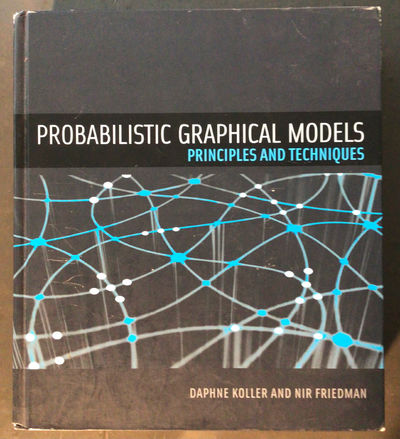
Click to view full size.

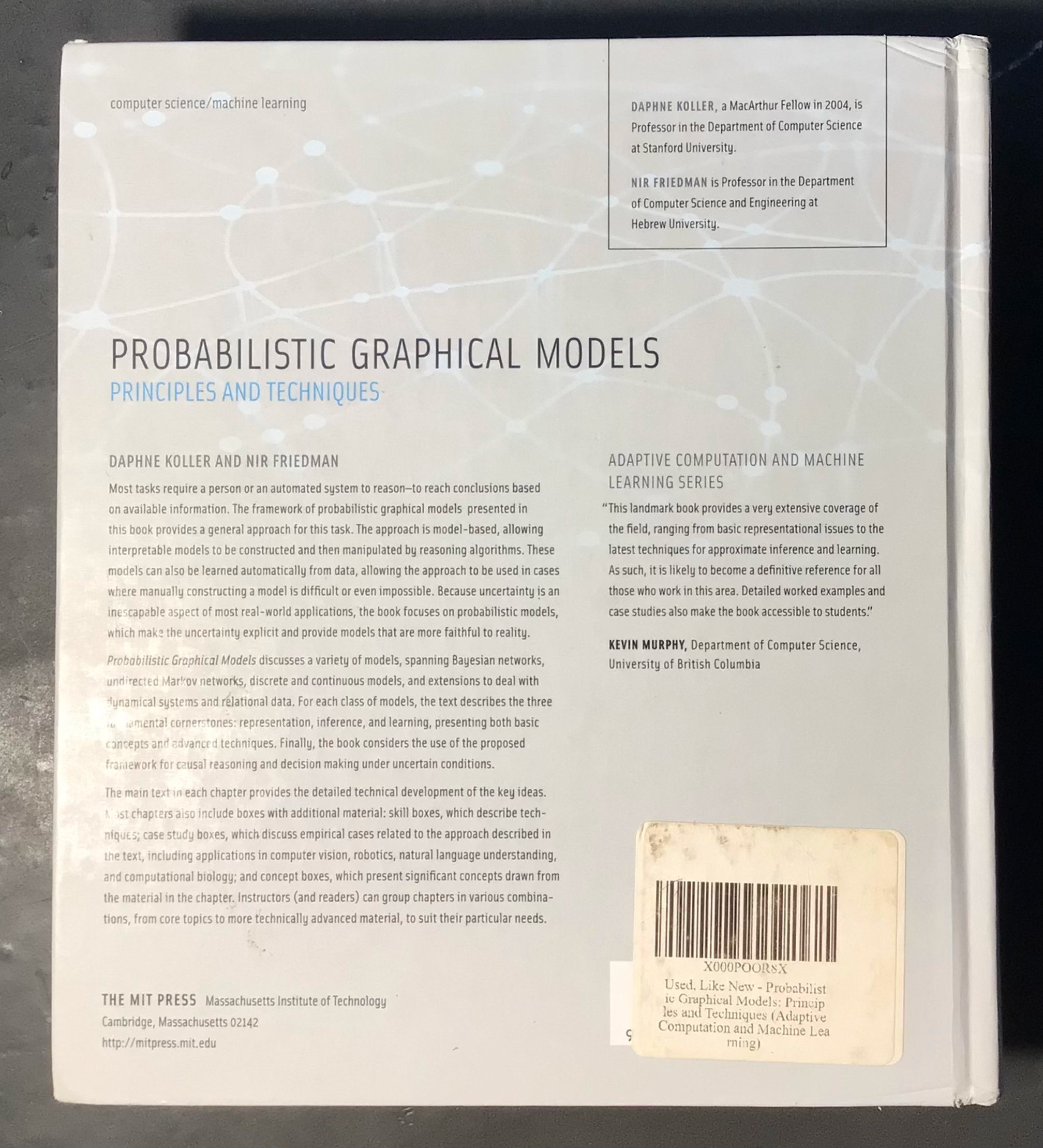

Probabilistic Graphical Models: Principles and Techniques (Adaptive Computation and Machine Learning series) Hardback - 2009
by Daphne; Friedman, Nir Koller
- Used
- Good
- Hardback
A$69.37
A$4.34
Delivery within USA
Standard delivery: 2 to 8 days
More delivery options
Standard delivery: 2 to 8 days
Ships from D. A. Dahlbom (Tennessee, United States)
Details
- Title Probabilistic Graphical Models: Principles and Techniques (Adaptive Computation and Machine Learning series)
- Author Daphne; Friedman, Nir Koller
- Binding Hardback
- Edition [ Edition: first
- Condition Used - Good
- Pages 1270
- Volumes 1
- Language ENG
- Publisher The Mit Press, Cambridge, Ma, U.s.a.
- Publication date 2009-07
- Illustrated Yes
- Features Bibliography, Illustrated, Index, Table of Contents
- Bookseller's Inventory # 60
- ISBN 9780262013192 / 0262013193
- Weight 4.65 lbs (2.11 kg)
- Dimensions 9.22 x 8.18 x 2.05 in (23.42 x 20.78 x 5.21 cm)
- Age range 18 to UP years
- Grade levels 13 - UP
- Category Mathematics
- Library of Congress subjects Bayesian statistical decision theory -, Graphical modeling (Statistics)
- Library of Congress Catalogue Number 2009008615
- Dewey Decimal Code 519.542
- Quantity available 1
About D. A. Dahlbom Tennessee, United States
Specialising in: Acoustics, Electrical Engineering, Literature, Math, Metalworking, Music, Neuroscience
Biblio member since 2022
Smaller seller specializing math, acoustics, electrical engineering, music and some literature. Please feel free to ask questions about individual items.
Reader reviews for Probabilistic Graphical Models: Principles and Techniques (Adaptive Computation and Machine Learning series)
Review summary
Readers broadly view this as an authoritative, exhaustive treatment of probabilistic graphical models, best approached as a reference or alongside a course. Many also judge it punishingly dense and math-heavy, with unconventional notation, sparse examples, and uneven organization, making it ill-suited to beginners compared with gentler alternatives.
Readers say this book is:
comprehensiverigorousdensechallengingauthoritativeinsightfulnot beginner-friendlydryreference-worthyoverwhelmingWrite a review for this book
Important Terms and Guidelines
- Please focus on the book’s content and context. Also, add any personal comments as to how you enjoyed the book. Substantiate your likes and dislikes. You may make comparisons to other books.
- Reviews must be at least 140 characters in length.
- Please do not reveal critical plot elements.
- This is not a help line. Contact customer support if you need help.
Your review must not include:
- Obscenities, discriminatory language, or other insulting language not suitable for public domain
- Advertisements, “spam” content, or references to other products, offers or websites.
- Email addresses, URLs, phone numbers, physical addresses or other contact information.
- Overly critical comments about other reviews or reviewers
- Time-sensitive material (i.e. promotional tours, seminars, lectures, etc.)
- Availability, price, or alternative ordering/shipping information

