
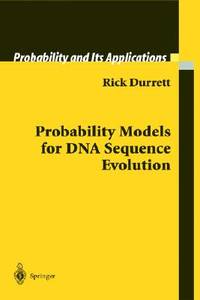
Stock photo: cover may vary
Probability Models for DNA Sequence Evolution (Probability and Its Applications) Hardback - 2002
by Durrett, Rick
- Used
- very good
- Hardback
- first
A$78.83
A$21.50
Delivery to USA
Standard delivery: 7 to 14 days
More delivery options
Standard delivery: 7 to 14 days
Ships from Quickhatch Books (Ontario, Canada)
Details
- Title Probability Models for DNA Sequence Evolution (Probability and Its Applications)
- Author Durrett, Rick
- Binding Hardback
- Edition 1st Edition
- Condition Used - Very good
- Pages 240
- Volumes 1
- Language ENG
- Publisher Springer, New York
- Publication date 2002
- Illustrated Yes
- Bookseller's Inventory # 011721
- ISBN 9780387954356 / 038795435X
- Weight 1.06 lbs (0.48 kg)
- Dimensions 9.14 x 6.82 x 0.64 in (23.22 x 17.32 x 1.63 cm)
- Category Science
- Library of Congress subjects Evolutionary genetics - Statistical methods, Nucleotide sequence - Statistical methods
- Library of Congress Catalogue Number 2002016001
- Dewey Decimal Code 572.838
- Bookseller catalogues Science and Medicine; Mathematics
About Quickhatch Books Ontario, Canada
Specialising in: Arctic, Canadiana, Foreign Language, Nature, Nautical, Scholarly And Academic, Science, Travel
Biblio member since 2007
In our 17th year of sharing Canadiana, natural and social sciences, travel, scholarly works and other interesting primarily non-fiction in English, French, and other languages of the world.
Items shipped promptly worldwide. Additional postage may apply to some international destinations or for oversize or overweight items. Postage reduced from standard rates on lightweight books and ephemera. Full refund of purchase price if not satisfied.
Reader reviews for Probability Models for DNA Sequence Evolution (Probability and Its Applications)
Write a review for this book
Important Terms and Guidelines
- Please focus on the book’s content and context. Also, add any personal comments as to how you enjoyed the book. Substantiate your likes and dislikes. You may make comparisons to other books.
- Reviews must be at least 140 characters in length.
- Please do not reveal critical plot elements.
- This is not a help line. Contact customer support if you need help.
Your review must not include:
- Obscenities, discriminatory language, or other insulting language not suitable for public domain
- Advertisements, “spam” content, or references to other products, offers or websites.
- Email addresses, URLs, phone numbers, physical addresses or other contact information.
- Overly critical comments about other reviews or reviewers
- Time-sensitive material (i.e. promotional tours, seminars, lectures, etc.)
- Availability, price, or alternative ordering/shipping information
From the publisher
First line
Before we can discuss modeling the evolution of DNA sequences, the reader needs a basic knowledge of the object being modeled.

