
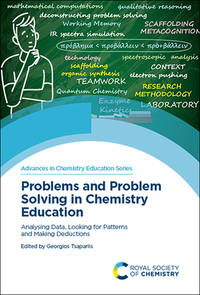
Stock photo: cover may vary
Problems and Problem Solving in Chemistry Education: Analysing Data, Looking for Patterns and Making Deductions Hardback - 2021
by Tsaparlis, Georgios (Editor)
- New
- Hardback
A$259.07
A$28.96
Delivery to USA
Standard delivery: 7 to 14 days
More delivery options
Standard delivery: 7 to 14 days
Ships from Revaluation Books (Devon, United Kingdom)
Details
- Title Problems and Problem Solving in Chemistry Education: Analysing Data, Looking for Patterns and Making Deductions
- Author Tsaparlis, Georgios (Editor)
- Binding Hardback
- Condition New
- Pages 502
- Volumes 1
- Language ENG
- Publisher Royal Society of Chemistry
- Publication date 2021
- Bookseller's Inventory # 2-183916218X
- ISBN 9781839162183 / 183916218X
- Weight 1.85 lbs (0.84 kg)
- Dimensions 9.37 x 6.54 x 1.26 in (23.80 x 16.61 x 3.20 cm)
- Category Education / Teaching
- Quantity available 1
About Revaluation Books Devon, United Kingdom
Biblio member since 2020
General bookseller of both fiction and non-fiction.
Reader reviews for Problems and Problem Solving in Chemistry Education: Analysing Data, Looking for Patterns and Making Deductions
Write a review for this book
Important Terms and Guidelines
- Please focus on the book’s content and context. Also, add any personal comments as to how you enjoyed the book. Substantiate your likes and dislikes. You may make comparisons to other books.
- Reviews must be at least 140 characters in length.
- Please do not reveal critical plot elements.
- This is not a help line. Contact customer support if you need help.
Your review must not include:
- Obscenities, discriminatory language, or other insulting language not suitable for public domain
- Advertisements, “spam” content, or references to other products, offers or websites.
- Email addresses, URLs, phone numbers, physical addresses or other contact information.
- Overly critical comments about other reviews or reviewers
- Time-sensitive material (i.e. promotional tours, seminars, lectures, etc.)
- Availability, price, or alternative ordering/shipping information
From the publisher
From the rear cover
Problem solving is central to the teaching and learning of chemistry at secondary, tertiary and post-tertiary levels of education, opening to students and professional chemists alike a whole new world for analysing data, looking for patterns and making deductions. As an important higher-order thinking skill, problem solving also constitutes a major research field in science education. Relevant education research is an ongoing process, with recent developments occurring not only in the area of quantitative/computational problems, but also in qualitative problem solving.
The following situations are considered, some general, others with a focus on specific areas of chemistry: quantitative problems, qualitative reasoning, metacognition and resource activation, deconstructing the problem-solving process, an overview of the working memory hypothesis, reasoning with the electron-pushing formalism, scaffolding synthesis skills, spectroscopy for structural characterization in organic chemistry, enzyme kinetics, problem solving in the academic chemistry laboratory, chemistry problem-solving in context, team-based/active learning, technology for molecular representations, IR spectra simulation, and computational quantum chemistry tools. The book concludes with methodological and epistemological issues in problem solving research and other perspectives in problem solving in chemistry.
With a foreword by George Bodner.

