
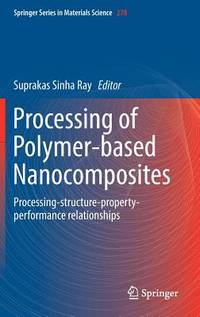
Stock photo: cover may vary
Processing of Polymer-based Nanocomposites.: Processing-structure-property-performance relationships. Hardback - 2018
by Sinha Ray, Suprakas (Ed.)
- Used
- Hardback
A$98.86
A$32.95
Delivery to USA
Standard delivery: 7 to 21 days
More delivery options
Standard delivery: 7 to 21 days
Ships from Lange & Springer Antiquariat (Germany)
Details
- Title Processing of Polymer-based Nanocomposites.
- Author Sinha Ray, Suprakas (Ed.)
- Binding Hardback
- Pages XV, 232 p
- Volumes 1
- Language ENG
- Publisher Springer
- Publication date 2018
- Illustrated Yes
- Features Illustrated
- Bookseller's Inventory # 34823AB
- ISBN 9783319977911 / 3319977911
- Weight 1.16 lbs (0.53 kg)
- Dimensions 9.21 x 6.14 x 0.63 in (23.39 x 15.60 x 1.60 cm)
- Category Science
- Dewey Decimal Code 541.225
About Lange & Springer Antiquariat Germany
Specialising in: Astrology, Chemistry, Engineering, Humanities, Mathematics, Medicine, Natural Science, Old and rare scientific books
Biblio member since 2025
Lange & Springer Antiquariat (est. 1816) is a long-established scientific antiquarian bookstore based in Berlin. We specialize in rare and scholarly books spanning the sciences, medicine, mathematics, engineering, and the humanities — from historically significant early works to modern academic literature. Our curated selection includes antiquarian treasures as well as contemporary academic titles for researchers, collectors, and institutions worldwide.
Reader reviews for Processing of Polymer-based Nanocomposites.
Write a review for this book
Important Terms and Guidelines
- Please focus on the book’s content and context. Also, add any personal comments as to how you enjoyed the book. Substantiate your likes and dislikes. You may make comparisons to other books.
- Reviews must be at least 140 characters in length.
- Please do not reveal critical plot elements.
- This is not a help line. Contact customer support if you need help.
Your review must not include:
- Obscenities, discriminatory language, or other insulting language not suitable for public domain
- Advertisements, “spam” content, or references to other products, offers or websites.
- Email addresses, URLs, phone numbers, physical addresses or other contact information.
- Overly critical comments about other reviews or reviewers
- Time-sensitive material (i.e. promotional tours, seminars, lectures, etc.)
- Availability, price, or alternative ordering/shipping information
From the publisher
From the rear cover
Processing of polymer nanocomposites usually requires special attention since the resultant structure--micro- and nano-level, is directly influenced by among other factors, polymer/nano-additive chemistry and the processing strategy. This book consolidates knowledge, from fundamental to product development, on polymer nanocomposites processing with special emphasis on the processing-structure-property-performance relationships in a wide range of polymer nanocomposites. Furthermore, this book focuses on emerging processing technologies such as electrospinning, which has very exciting applications ranging from medical to filtration. Additionally, the important role played by the nanoparticles in polymer blends structures has been illustrated in the current book, with special focus on fundamental aspects and properties of nanoparticles migration and interface crossing in immiscible polymer blend nanocomposites.
This book focuses heavily on the processingtechnologies and strategies and extensively addresses the processing-structure-property-performance relationships in a wide range of polymer nanocomposites, such as commodity polymers (chapter 1), engineering polymers (chapter 2), elastomers (chapter 3), thermosets (chapter 4), biopolymers (chapter 5), polymer blends (chapter 6), and electrospun polymer (chapter 7). The important role played by nanoparticles in polymer blends structures in particular is illustrated.The book is useful to undergraduate and postgraduate students (polymer engineering, materials science & engineering, chemical & process engineering), as well as research & development personnel, engineers, and material scientists.
This book focuses heavily on the processingtechnologies and strategies and extensively addresses the processing-structure-property-performance relationships in a wide range of polymer nanocomposites, such as commodity polymers (chapter 1), engineering polymers (chapter 2), elastomers (chapter 3), thermosets (chapter 4), biopolymers (chapter 5), polymer blends (chapter 6), and electrospun polymer (chapter 7). The important role played by nanoparticles in polymer blends structures in particular is illustrated.The book is useful to undergraduate and postgraduate students (polymer engineering, materials science & engineering, chemical & process engineering), as well as research & development personnel, engineers, and material scientists.

