
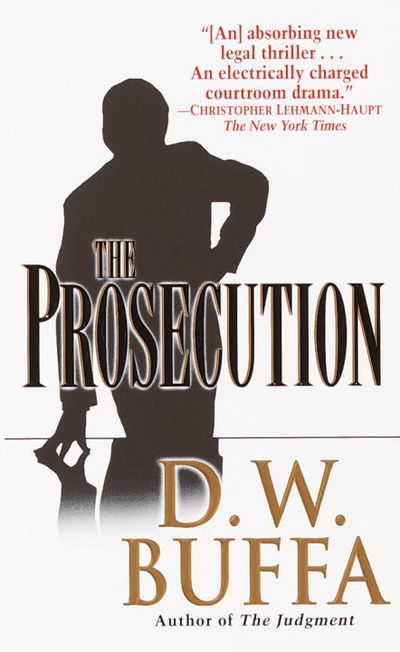
Stock photo: cover may vary
The Prosecution Mass market paperbound - 2001
by Buffa, D.W
- Used
- Acceptable
- first
Description
Ballantine Books. First Thus. Acceptable. The item might be beaten up but readable. May contain markings or highlighting, as well as stains, bent corners, or any other major defect, but the text is not obscured in any way.
A$7.29
Free Delivery within USA
Standard delivery: 7 to 14 days
More delivery options
Standard delivery: 7 to 14 days
Ships from BooksRun (Pennsylvania, United States)
Details
- Title The Prosecution
- Author Buffa, D.W
- Binding Mass Market Paperbound
- Edition First Thus
- Condition Used - Acceptable
- Pages 336
- Volumes 1
- Language ENG
- Publisher Ballantine Books, New York, NY, U.S.A.
- Publication date October 30, 2001
- Bookseller's Inventory # 0449006905-7-1
- ISBN 9780449006900 / 0449006905
- Weight 0.35 lbs (0.16 kg)
- Dimensions 6.83 x 4.07 x 0.91 in (17.35 x 10.34 x 2.31 cm)
- Category Fiction - Espionage / Thriller
- Dewey Decimal Code FIC
- Quantity available 1
About BooksRun Pennsylvania, United States
Specialising in: Textbooks
Biblio member since 2016
BooksRun - best place to buy, sell or rent cheap textbooks
Terms of Sale:
30 days return guarantee. 10% restocking fee applies to discretionary returns
Reader reviews for The Prosecution
Write a review for this book
Important Terms and Guidelines
- Please focus on the book’s content and context. Also, add any personal comments as to how you enjoyed the book. Substantiate your likes and dislikes. You may make comparisons to other books.
- Reviews must be at least 140 characters in length.
- Please do not reveal critical plot elements.
- This is not a help line. Contact customer support if you need help.
Your review must not include:
- Obscenities, discriminatory language, or other insulting language not suitable for public domain
- Advertisements, “spam” content, or references to other products, offers or websites.
- Email addresses, URLs, phone numbers, physical addresses or other contact information.
- Overly critical comments about other reviews or reviewers
- Time-sensitive material (i.e. promotional tours, seminars, lectures, etc.)
- Availability, price, or alternative ordering/shipping information
From the publisher
D. W. Buffa completed a Ph.D. in political science at the University of Chicago. He later moved to Oregon, where for ten years he worked as a defense attorney. The author of the bestselling The Defense, he now lives in Walnut Creek, California.
Excerpt
Lying always came easier to me than telling the truth. When I was a small boy, I climbed onto the kitchen counter to get to the cookie jar and knocked my mother's favorite crystal bowl over the edge. Watching it shatter into pieces on the floor, I knew in my heart that if anyone ever found out I was as good as dead. Carefully, I gathered up the shards of glass and tried to hide them behind some pots and pans in the cupboard. Holding one of the largest pieces in his hand, my father asked me that evening if I knew anything about it. I did what anyone would have done: I denied it.
He did not seem to believe me. Sitting in his chair, he put his hand on my shoulder and started telling me about George Washington and the cherry tree. I knew then I was finished. That story was everywhere. You couldn't run away from it. Every father told it to his son, and every schoolteacher told it to her class. You might go all the way through grade school without knowing anything about American history, but you knew young George had ruined it for the rest of us when he made his famous confession, "Father, I cannot tell a lie."
I stood there and stared down at the laces on my shoes. There was no way out of it, but I still could not bring myself to lift my eyes and say those words. The best I could do was nod my head and hope that this excruciating silent admission would be the only punishment I had to endure. It was not clear to me even then whether the lesson was never lie or never get caught.
I have not always told the truth in my life, but I never lied in a court of law, and I spent years defending murderers and rapists and thieves. I did not need to lie; the law itself allowed me to make certain that people who should have been punished were set free. I had wanted to be a lawyer who never lost a case because every client was innocent; instead I became a lawyer whose only concern was preventing anyone from ever proving that my client was guilty.
I had no qualms of conscience, no late-night regrets, about what I did or how I did it. I was a criminal defense attorney, sworn to put on the best defense I could for my client. When one trial ended, another began, and I never thought twice about what might happen because someone guilty had been acquitted; not until, as part of an exquisite scheme of revenge, the only truly innocent man I ever knew was charged with murder, and I was betrayed by the only woman I ever loved.
Leopold Rifkin was the most honorable and decent man I have ever known. The senior circuit judge, he had done everything he could to help when I was just starting out, a graduate of the Harvard Law School who did not know the first thing about trying a case in court. From the very beginning, I was drawn to the power of his mind. Learned in ways I could only imagine, he studied the classics in the original languages and owned the largest private library I had ever seen. After I had become known as a lawyer who seldom lost, he worried that I won too often and wondered if I understood the price I might one day have to pay.
The day he warned me about finally came, and the price was higher than even Leopold Rifkin could have foreseen. I suppose there is a certain irony in the fact that the first time I cared more about the defendant than I did about myself was the first time I thought I might lose. Unwilling to take that chance, I defended him for a crime he did not commit by committing one of my own. I told a witness to lie, and, as a result, Leopold Rifkin walked out of court a free man. A few days later, he took his own life, and the day of the funeral, Alexandra, the woman I wanted to marry, walked out of mine.
It had been more than a year since a jury found Leopold Rifkin not guilty of a murder he had not committed and for which he should never have been prosecuted, more than a year since I abandoned the practice of law. In that time I never returned to the courthouse. There were too many memories, too many things I did not want to think about. If Horace Woolner had not asked me, I might never have come at all.
The court reporter gazed ahead as his fingers pressed the silent keys of his machine. At the counsel table an assistant district attorney looked glumly at the floor, his hands shoved into the pockets of his dark blue suit. The only spectator, I sat on a wooden bench in the back, remembering the last time I had been here, waiting to hear the verdict of the jury in a case in which I had convinced a witness to lie.
Now Horace Woolner was on the bench, presiding over a simple sentencing. Determined to let everyone know what he thought, the prisoner raised his shackled wrists and extended the middle finger of each hand in a gesture of double defiance. A few feet away, a deputy sheriff moved forward. Woolner raised his hand and shook his head. The deputy stopped and backed away.
Resting his arm on the bench, his huge shoulders hunched forward, Woolner narrowed his eyes, measuring the young man on whom he had just passed sentence.
"That will be six months for contempt of court," he said finally. "To run consecutive to the twenty-four-month sentence you were just given on the burglary charge."
His lawyer tried in vain to stop him. Screaming an obscenity, the prisoner thrust his two raised fingers into the air again, his blue eyes fierce with rage. The deputy grabbed him by the shoulder and threw him down into the empty chair as the lawyer looked on in open-eyed astonishment.
"You knew what the sentence would be before you were brought in. You filled out a plea petition," Horace said, waving an eight-page document stapled at the corner. "This is your second felony conviction. You knew exactly where you stood, exactly what the sentencing guidelines call for. We went through this petition." He indicated the document. "You said you understood it. You said you had reviewed it with your lawyer. There were no surprises, Mr. Merriweather. Despite that, you have to put on this little show of yours to demonstrate how tough you are. Is that the game we're playing here?"
Straining under the hand that held him down in the chair, the prisoner retreated into a scowling silence.
"I can give you another six months for contempt, if you'd like," Horace said. His deep voice seemed to come from everywhere at once. "And then you can give me the finger again, and we can keep doing this, over and over."
The deputy was holding the prisoner down as hard as he could. Merriweather had the lean, well-muscled look that prisoners his age often have. Tension rippled down the tendons of his neck.
"Let him go," Woolner ordered, as he got to his feet.
You could see the surprise register on Merriweather's face as Woolner moved around the bench and came toward the table. It was one thing to challenge a heavyset black man with graying hair and a judicial robe flowing over his rounded shoulders. It was something else to watch the distance close between yourself and a thick-necked man you just realized had to be at least six foot two and well over two hundred fifty pounds, a black man coming right at you with cold-eyed confidence.
"What . . . ?" he asked, his eyes darting from the judge to the deputy and back again to the judge.
Standing directly in front of him, Woolner laid a huge hand on the prisoner's shoulder and gazed into his eyes.
"I wish I didn't have to do this," he said, in a quiet, unhurried voice, "but I have to. So why don't we both handle it like men?"
The tension seemed to drain out of the prisoner. With Woolner's hand still on him, his shoulders slumped forward and, lowering his eyes, he slowly nodded his head.
"Let's go back to the beginning," Woolner said, resuming his place on the bench.
Standing next to his lawyer, Merriweather looked smaller and younger than he had before.
"In accordance with the guidelines, I sentenced you to twenty-four months in the care and custody of the state department of corrections," Woolner went on, in a calm, firm voice. "Is there any comment you would like to make about that sentence?"
Merriweather stood there, blinking.
"Is there any comment you wish to make, Mr. Merriweather?" the judge repeated.
This time Merriweather understood. "No, sir," he said politely, shaking his head for emphasis.
"Very good. In that case, the six-month sentence formerly imposed for contempt of court is withdrawn." As the deputy started to lead the prisoner away, Woolner added, "One more thing, Mr. Merriweather. This is your second felony conviction. Don't let there be a third. You understand my meaning?"
The prisoner was taken out of the courtroom, and the lawyers began to gather up their papers.
"Welcome back to the criminal courts, Mr. Antonelli," Woolner called out in a clear, jovial voice, from his place on the bench.
Both attorneys stopped what they were doing and looked up.
"That's right, gentlemen, Joseph Antonelli really does exist."
He led me into chambers, where I sat down in front of his desk and watched him remove the black robe and hang it on a rack next to the door.
"Alma is going to kill me," he said, examining a hole in his pants. "I just got this suit last week," he explained, as he slid into the chair behind the desk. "She's just going to kill me. I got to stop doing this," he mumbled to himself.
The words had barely left his mouth when he began to laugh, a deep, rumbling noise.
"When that kid gave me the finger, I got so mad I started to grind my fountain pen into my leg. Damn good thing it isn't real!"
"You didn't look mad. You looked like you were in complete control the whole time."
It was almost instinctive, the way he deflected praise.
" 'Judge beats twenty-two-year-old defendant to death with bare hands' isn't the best headline to get when you have to run for reelection, is it?"
"You saved him from himself, and no one is ever going to read about that," I replied.
He dismissed it. "He's just an angry kid. Can't really blame him, either. Both his parents were drug dealers. Start out like that, not much chance you're going to do all that well, is there?"
His voice had become so quiet I could hear his breath underneath the words he spoke. He leaned back in the chair and let his gaze drift across the book-lined walls of the room. The venetian blinds on the room's only window were open, and gray light cast a dreary pallor over the desk and our thoughts.
"I didn't know you had taken Leopold's courtroom, not until I walked in here this morning."
Horace was staring out the window. "I didn't want to," he said finally, turning back to me. "It didn't seem quite right. Besides, I liked the one I had. It was bigger, and I was used to it. But then, after Leopold died"--he hesitated, tactfully avoiding any reference to suicide--"I didn't like the idea of some other judge having it, either." He shook his head with disdain. "They were all so willing to believe he must have been guilty, even though he was acquitted."
His head jerked back. "Strange, isn't it? We're the only two people who know what really happened, and you inherited his house and I ended up with his courtroom. . . .
"You look different, Joe," he said presently. "More relaxed." He changed his mind. "No, that's not it. More concentrated." Beaming, he exclaimed, "That's it, isn't it? It's that damn library. You're starting to get like Leopold. It's that same look, something behind the eyes."
"The only change, Horace, is that I'm not carrying a couple dozen cases around in my head, trying to remember what I'm supposed to be doing an hour from now."
Leaning forward, a shrewd glint in his eye, he got right to the point. "Leopold never did what you're doing. He didn't lock himself up behind those iron gates and spend all his time in his library. He came down here every day, five days a week, year in, year out, and did his work. He came down here every morning because he knew he had certain obligations to the rest of us. You have obligations too. You're a hell of a lawyer," he said firmly, "and it's time you got back to doing it."
"We've been through this before, Horace. I'm not coming back. I can't."
Folding his arms across his chest, he moved his hand along the side of his face, down to the chin. In the silence, he looked at me. "There's something else I want to talk to you about," he said finally. "Do you remember the murder of Marshall Goodwin's wife?"
Marshall Goodwin was the chief deputy district attorney. His wife had been viciously murdered, and the case had never been solved. I had forgotten most of the details, but what I remembered was bad enough.
"She was killed in a hotel room somewhere. Her throat was slashed."
"That's right. Do you know Goodwin?" Horace asked. He closed his long thick fingers into a fist and then opened them, over and over again, like some ritual exercise.
"I tried a couple of cases against him. He was good."
"I hired him," Horace remarked, as he watched his hands at work. "Probably the best deputy I had. Always prepared. He usually won, too," he added, as he looked up. "Except when he had to go against you."
I missed the courtroom, but it was so far removed from the way I now lived that it was like being told how good you had been at something in high school. It no longer mattered. It was not even viable as a form of nostalgia.
Picking up a ballpoint pen, Horace began to tap it on the desk in a slow rhythm. "His wife's name was Nancy," he said, with a solemn expression. "As nice a person as you'd ever want to meet. She worked for an electronics firm. She was in Corvallis for a conference when she died, one of the few times she ever spent the night away from home."
He did not seem to believe me. Sitting in his chair, he put his hand on my shoulder and started telling me about George Washington and the cherry tree. I knew then I was finished. That story was everywhere. You couldn't run away from it. Every father told it to his son, and every schoolteacher told it to her class. You might go all the way through grade school without knowing anything about American history, but you knew young George had ruined it for the rest of us when he made his famous confession, "Father, I cannot tell a lie."
I stood there and stared down at the laces on my shoes. There was no way out of it, but I still could not bring myself to lift my eyes and say those words. The best I could do was nod my head and hope that this excruciating silent admission would be the only punishment I had to endure. It was not clear to me even then whether the lesson was never lie or never get caught.
I have not always told the truth in my life, but I never lied in a court of law, and I spent years defending murderers and rapists and thieves. I did not need to lie; the law itself allowed me to make certain that people who should have been punished were set free. I had wanted to be a lawyer who never lost a case because every client was innocent; instead I became a lawyer whose only concern was preventing anyone from ever proving that my client was guilty.
I had no qualms of conscience, no late-night regrets, about what I did or how I did it. I was a criminal defense attorney, sworn to put on the best defense I could for my client. When one trial ended, another began, and I never thought twice about what might happen because someone guilty had been acquitted; not until, as part of an exquisite scheme of revenge, the only truly innocent man I ever knew was charged with murder, and I was betrayed by the only woman I ever loved.
Leopold Rifkin was the most honorable and decent man I have ever known. The senior circuit judge, he had done everything he could to help when I was just starting out, a graduate of the Harvard Law School who did not know the first thing about trying a case in court. From the very beginning, I was drawn to the power of his mind. Learned in ways I could only imagine, he studied the classics in the original languages and owned the largest private library I had ever seen. After I had become known as a lawyer who seldom lost, he worried that I won too often and wondered if I understood the price I might one day have to pay.
The day he warned me about finally came, and the price was higher than even Leopold Rifkin could have foreseen. I suppose there is a certain irony in the fact that the first time I cared more about the defendant than I did about myself was the first time I thought I might lose. Unwilling to take that chance, I defended him for a crime he did not commit by committing one of my own. I told a witness to lie, and, as a result, Leopold Rifkin walked out of court a free man. A few days later, he took his own life, and the day of the funeral, Alexandra, the woman I wanted to marry, walked out of mine.
It had been more than a year since a jury found Leopold Rifkin not guilty of a murder he had not committed and for which he should never have been prosecuted, more than a year since I abandoned the practice of law. In that time I never returned to the courthouse. There were too many memories, too many things I did not want to think about. If Horace Woolner had not asked me, I might never have come at all.
The court reporter gazed ahead as his fingers pressed the silent keys of his machine. At the counsel table an assistant district attorney looked glumly at the floor, his hands shoved into the pockets of his dark blue suit. The only spectator, I sat on a wooden bench in the back, remembering the last time I had been here, waiting to hear the verdict of the jury in a case in which I had convinced a witness to lie.
Now Horace Woolner was on the bench, presiding over a simple sentencing. Determined to let everyone know what he thought, the prisoner raised his shackled wrists and extended the middle finger of each hand in a gesture of double defiance. A few feet away, a deputy sheriff moved forward. Woolner raised his hand and shook his head. The deputy stopped and backed away.
Resting his arm on the bench, his huge shoulders hunched forward, Woolner narrowed his eyes, measuring the young man on whom he had just passed sentence.
"That will be six months for contempt of court," he said finally. "To run consecutive to the twenty-four-month sentence you were just given on the burglary charge."
His lawyer tried in vain to stop him. Screaming an obscenity, the prisoner thrust his two raised fingers into the air again, his blue eyes fierce with rage. The deputy grabbed him by the shoulder and threw him down into the empty chair as the lawyer looked on in open-eyed astonishment.
"You knew what the sentence would be before you were brought in. You filled out a plea petition," Horace said, waving an eight-page document stapled at the corner. "This is your second felony conviction. You knew exactly where you stood, exactly what the sentencing guidelines call for. We went through this petition." He indicated the document. "You said you understood it. You said you had reviewed it with your lawyer. There were no surprises, Mr. Merriweather. Despite that, you have to put on this little show of yours to demonstrate how tough you are. Is that the game we're playing here?"
Straining under the hand that held him down in the chair, the prisoner retreated into a scowling silence.
"I can give you another six months for contempt, if you'd like," Horace said. His deep voice seemed to come from everywhere at once. "And then you can give me the finger again, and we can keep doing this, over and over."
The deputy was holding the prisoner down as hard as he could. Merriweather had the lean, well-muscled look that prisoners his age often have. Tension rippled down the tendons of his neck.
"Let him go," Woolner ordered, as he got to his feet.
You could see the surprise register on Merriweather's face as Woolner moved around the bench and came toward the table. It was one thing to challenge a heavyset black man with graying hair and a judicial robe flowing over his rounded shoulders. It was something else to watch the distance close between yourself and a thick-necked man you just realized had to be at least six foot two and well over two hundred fifty pounds, a black man coming right at you with cold-eyed confidence.
"What . . . ?" he asked, his eyes darting from the judge to the deputy and back again to the judge.
Standing directly in front of him, Woolner laid a huge hand on the prisoner's shoulder and gazed into his eyes.
"I wish I didn't have to do this," he said, in a quiet, unhurried voice, "but I have to. So why don't we both handle it like men?"
The tension seemed to drain out of the prisoner. With Woolner's hand still on him, his shoulders slumped forward and, lowering his eyes, he slowly nodded his head.
"Let's go back to the beginning," Woolner said, resuming his place on the bench.
Standing next to his lawyer, Merriweather looked smaller and younger than he had before.
"In accordance with the guidelines, I sentenced you to twenty-four months in the care and custody of the state department of corrections," Woolner went on, in a calm, firm voice. "Is there any comment you would like to make about that sentence?"
Merriweather stood there, blinking.
"Is there any comment you wish to make, Mr. Merriweather?" the judge repeated.
This time Merriweather understood. "No, sir," he said politely, shaking his head for emphasis.
"Very good. In that case, the six-month sentence formerly imposed for contempt of court is withdrawn." As the deputy started to lead the prisoner away, Woolner added, "One more thing, Mr. Merriweather. This is your second felony conviction. Don't let there be a third. You understand my meaning?"
The prisoner was taken out of the courtroom, and the lawyers began to gather up their papers.
"Welcome back to the criminal courts, Mr. Antonelli," Woolner called out in a clear, jovial voice, from his place on the bench.
Both attorneys stopped what they were doing and looked up.
"That's right, gentlemen, Joseph Antonelli really does exist."
He led me into chambers, where I sat down in front of his desk and watched him remove the black robe and hang it on a rack next to the door.
"Alma is going to kill me," he said, examining a hole in his pants. "I just got this suit last week," he explained, as he slid into the chair behind the desk. "She's just going to kill me. I got to stop doing this," he mumbled to himself.
The words had barely left his mouth when he began to laugh, a deep, rumbling noise.
"When that kid gave me the finger, I got so mad I started to grind my fountain pen into my leg. Damn good thing it isn't real!"
"You didn't look mad. You looked like you were in complete control the whole time."
It was almost instinctive, the way he deflected praise.
" 'Judge beats twenty-two-year-old defendant to death with bare hands' isn't the best headline to get when you have to run for reelection, is it?"
"You saved him from himself, and no one is ever going to read about that," I replied.
He dismissed it. "He's just an angry kid. Can't really blame him, either. Both his parents were drug dealers. Start out like that, not much chance you're going to do all that well, is there?"
His voice had become so quiet I could hear his breath underneath the words he spoke. He leaned back in the chair and let his gaze drift across the book-lined walls of the room. The venetian blinds on the room's only window were open, and gray light cast a dreary pallor over the desk and our thoughts.
"I didn't know you had taken Leopold's courtroom, not until I walked in here this morning."
Horace was staring out the window. "I didn't want to," he said finally, turning back to me. "It didn't seem quite right. Besides, I liked the one I had. It was bigger, and I was used to it. But then, after Leopold died"--he hesitated, tactfully avoiding any reference to suicide--"I didn't like the idea of some other judge having it, either." He shook his head with disdain. "They were all so willing to believe he must have been guilty, even though he was acquitted."
His head jerked back. "Strange, isn't it? We're the only two people who know what really happened, and you inherited his house and I ended up with his courtroom. . . .
"You look different, Joe," he said presently. "More relaxed." He changed his mind. "No, that's not it. More concentrated." Beaming, he exclaimed, "That's it, isn't it? It's that damn library. You're starting to get like Leopold. It's that same look, something behind the eyes."
"The only change, Horace, is that I'm not carrying a couple dozen cases around in my head, trying to remember what I'm supposed to be doing an hour from now."
Leaning forward, a shrewd glint in his eye, he got right to the point. "Leopold never did what you're doing. He didn't lock himself up behind those iron gates and spend all his time in his library. He came down here every day, five days a week, year in, year out, and did his work. He came down here every morning because he knew he had certain obligations to the rest of us. You have obligations too. You're a hell of a lawyer," he said firmly, "and it's time you got back to doing it."
"We've been through this before, Horace. I'm not coming back. I can't."
Folding his arms across his chest, he moved his hand along the side of his face, down to the chin. In the silence, he looked at me. "There's something else I want to talk to you about," he said finally. "Do you remember the murder of Marshall Goodwin's wife?"
Marshall Goodwin was the chief deputy district attorney. His wife had been viciously murdered, and the case had never been solved. I had forgotten most of the details, but what I remembered was bad enough.
"She was killed in a hotel room somewhere. Her throat was slashed."
"That's right. Do you know Goodwin?" Horace asked. He closed his long thick fingers into a fist and then opened them, over and over again, like some ritual exercise.
"I tried a couple of cases against him. He was good."
"I hired him," Horace remarked, as he watched his hands at work. "Probably the best deputy I had. Always prepared. He usually won, too," he added, as he looked up. "Except when he had to go against you."
I missed the courtroom, but it was so far removed from the way I now lived that it was like being told how good you had been at something in high school. It no longer mattered. It was not even viable as a form of nostalgia.
Picking up a ballpoint pen, Horace began to tap it on the desk in a slow rhythm. "His wife's name was Nancy," he said, with a solemn expression. "As nice a person as you'd ever want to meet. She worked for an electronics firm. She was in Corvallis for a conference when she died, one of the few times she ever spent the night away from home."
Media reviews
“Buffa’s spare observation, crackling dialogue, and shadowy circle of criminals, lawyers, and lovers keep you riveted.”
–Entertainment Weekly
“EXPLOSIVE . . . D. W. BUFFA IS ONE OF A KIND.”
–San Jose Mercury News
–Entertainment Weekly
“EXPLOSIVE . . . D. W. BUFFA IS ONE OF A KIND.”
–San Jose Mercury News
Customers who bought The Prosecution also bought…
Book Conditions Explained
Biblio’s Book Conditions
-
As NewThe book is pristine and free of any defects, in the same condition as when it was first newly published.
-
Fine (F)A book in fine condition exhibits no flaws. A fine condition book closely approaches As New condition, but may lack the crispness of an uncirculated, unopened volume.
-
Near Fine (NrFine or NF)Almost perfect, but not quite fine. Any defect outside of shelf-wear should be noted.
-
Very Good (VG)A used book that does show some small signs of wear - but no tears - on either binding or paper. Very good items should not have writing or highlighting.
-
Good (G or Gd.)The average used and worn book that has all pages or leaves present. ‘Good’ items often include writing and highlighting and may be ex-library. Any defects should be noted. The oft-repeated aphorism in the book collecting world is “good isn’t very good.”
-
FairIt is best to assume that a “fair” book is in rough shape but still readable.
-
Poor (P)A book with significant wear and faults. A poor condition book can still make a good reading copy but is generally not collectible unless the item is very scarce. Any missing pages must be specifically noted.

