BIBLIO is the largest independent book marketplace in the world, with over 100 million books.

Skip to content

PSP(sm): a Self-Improvement Process for Software Engineers

PSP(sm): a Self-Improvement Process for Software Engineers

PSP(sm): a Self-Improvement Process for Software Engineers
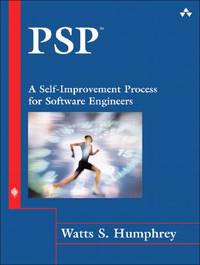
Stock photo: cover may vary

PSP(sm): a Self-Improvement Process for Software Engineers Hardback - 2005

by Watts S. Humphrey

Add to wish list
  • Used
Used - Good

Description

Addison Wesley Professional. Used - Good. Pages intact with minimal writing/highlighting. The binding may be loose and creased. Dust jackets/supplements are not included. Stock photo provided. Product includes identifying sticker. Better World Books: Buy Books. Do Good.
Ask the seller a question Add to wish list
A$10.22
A$10.14 Delivery to USA
Standard delivery: 5 to 21 days
More delivery options
Ships from Better World Books Ltd (Fife, United Kingdom)

Details

  • Title PSP(sm): a Self-Improvement Process for Software Engineers
  • Author Watts S. Humphrey
  • Binding Hardback
  • Edition F Fourth Printin
  • Condition Used - Good
  • Pages 368
  • Volumes 1
  • Language ENG
  • Publisher Addison Wesley Professional, Upper Saddle River, NJ
  • Publication date March 3, 2005
  • Illustrated Yes
  • Bookseller's Inventory # 6001556-6
  • ISBN 9780321305497 / 0321305493
  • Weight 1.4 lbs (0.64 kg)
  • Dimensions 9.4 x 6.5 x 0.9 in (23.88 x 16.51 x 2.29 cm)
  • Category Computers - Languages / Programming
  • Library of Congress subjects Software engineering, Computer software - Management
  • Library of Congress Catalogue Number 2004030348
  • Dewey Decimal Code 005.1
  • Quantity available 1

About Better World Books Ltd Fife, United Kingdom

Biblio member since 2009

Better World Books is a for-profit, socially conscious business and a global online bookseller that collects and sells new and used books online, matching each purchase with a book donation. Each sale generates funds for literacy and education initiatives in the U.S., the U.K., and around the world. Since its launch in 2003, Better World Books has raised over $35 million for libraries and literacy, donated over 38 million books, and reused or recycled more than 475 million books.

Terms of Sale: Better World Books ("BWB") values your satisfaction and offers you returns within thirty (30) days after the estimated delivery date on most items. All returned items must be in the original condition; used items should include the SKU sticker located on the spine or back of the product. If you have an incomplete, incorrect, or damaged shipment, please contact our Customer Care team via Biblio's contact seller options before proceeding with the return. Please keep in mind that because we deal mostly in used books, any extra components, such as CDs, DVDs, figurines, or access codes are not included.

Browse books from Better World Books Ltd

Reader reviews for PSP(sm): a Self-Improvement Process for Software Engineers

From the publisher

Most software-development groups have embarrassing records: By some accounts, more than half of all software projects are significantly late and over budget, and nearly a quarter of them are cancelled without ever being completed. Although developers recognize that unrealistic schedules, inadequate resources, and unstable requirements are often to blame for such failures, few know how to solve these problems. Fortunately, the Personal Software Process (PSP) provides a clear and proven solution. Comprising precise methods developed over many years by Watts S. Humphrey and the Software Engineering Institute (SEI), the PSP has successfully transformed work practices in a wide range of organizations and has already produced some striking results.

This book describes the PSP and is the definitive guide and reference for its latest iteration. PSP training focuses on the skills required by individual software engineers to improve their personal performance. Once learned and effectively applied, PSP-trained engineers are qualified to participate on a team using the Team Software Process (TSP), the methods for which are described in the final chapter of the book. The goal for both PSP and TSP is to give developers exactly what they need to deliver quality products on predictable schedules.

PSPSM A Self-Improvement Process for Software Engineers presents a disciplined process for software engineers and anyone else involved in software development. This process includes defect management, comprehensive planning, and precise project tracking and reporting.

The book first scales down industrial software practices to fit the needs of the module-sized program development, then walks readers through a progressive sequence of practices that provide a sound foundation for large-scale software development. By doing the exercises in the book, and using the PSP methods described here to plan, evaluate, manage, and control the quality of your own work, you will be well prepared to apply those methods on ever larger and more critical projects.

Drawing on the author's extensive experience helping organizations to achieve their development goals, and with the PSP benefits well illustrated, the book presents the process in carefully crafted steps. The first chapter describes overall principles and strategies. The next two explain how to follow a defined process, as well as how to gather and use the data required to manage a programming job. Several chapters then cover estimating and planning, followed by quality management and design. The last two chapters show how to put the PSP to work, and how to use it on a team project. A variety of support materials for the book, as described in the Preface, are available on the Web.

If you or your organization are looking for a way to improve your project success rate, the PSP could well be your answer.

About the author

Known as "the father of software quality," Watts S. Humphrey is the author of numerous influential books on the software-development process and software process improvement. Humphrey is a fellow of the Software Engineering Institute (SEI) at Carnegie Mellon University, where he founded the Software Process Program and provided the vision and early leadership for the original Capability Maturity Model (CMM). He also is the creator of the Personal Software Process (PSP) and Team Software Process (TSP). Recently, he was awarded the National Medal of Technology--the highest honor given by the president of the United States to America's leading innovators.

tracking-