
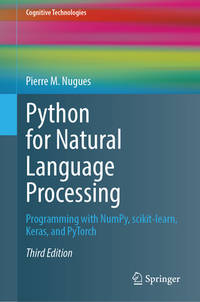
Stock photo: cover may vary
Python for Natural Language Processing: Programming with NumPy, scikit-learn, Keras, and PyTorch (Cognitive Technologies) Hardback - 2024
by Pierre M. Nugues
- Used
A$105.15
A$5.79
Delivery within USA
Standard delivery: 2 to 14 days
More delivery options
Standard delivery: 2 to 14 days
Ships from GreatBookPrices (Maryland, United States)
Details
- Title Python for Natural Language Processing: Programming with NumPy, scikit-learn, Keras, and PyTorch (Cognitive Technologies)
- Author Pierre M. Nugues
- Binding Hardback
- Condition New
- Pages 520
- Volumes 1
- Language ENG
- Publisher Springer
- Publication date 2024-07-10
- Illustrated Yes
- Features Illustrated
- Bookseller's Inventory # 47819965
- ISBN 9783031575488 / 3031575482
- Weight 2.07 lbs (0.94 kg)
- Dimensions 9.21 x 6.14 x 1.19 in (23.39 x 15.60 x 3.02 cm)
- Category Computers - Other Applications
- Quantity available 5
About GreatBookPrices Maryland, United States
Biblio member since 2024
Since 1991, we have worked every day to serve our customers with state-of-the-art technology and world class service. We are dedicated to providing customers around the world with the widest selection of books, DVDs, and CDs at the absolute lowest price.
Reader reviews for Python for Natural Language Processing: Programming with NumPy, scikit-learn, Keras, and PyTorch (Cognitive Technologies)
Write a review for this book
Important Terms and Guidelines
- Please focus on the book’s content and context. Also, add any personal comments as to how you enjoyed the book. Substantiate your likes and dislikes. You may make comparisons to other books.
- Reviews must be at least 140 characters in length.
- Please do not reveal critical plot elements.
- This is not a help line. Contact customer support if you need help.
Your review must not include:
- Obscenities, discriminatory language, or other insulting language not suitable for public domain
- Advertisements, “spam” content, or references to other products, offers or websites.
- Email addresses, URLs, phone numbers, physical addresses or other contact information.
- Overly critical comments about other reviews or reviewers
- Time-sensitive material (i.e. promotional tours, seminars, lectures, etc.)
- Availability, price, or alternative ordering/shipping information
From the publisher
From the rear cover
Since the last edition of this book (2014), progress has been astonishing in all areas of Natural Language Processing, with recent achievements in Text Generation that spurred a media interest going beyond the traditional academic circles. Text Processing has meanwhile become a mainstream industrial tool that is used, to various extents, by countless companies. As such, a revision of this book was deemed necessary to catch up with the recent breakthroughs, and the author discusses models and architectures that have been instrumental in the recent progress of Natural Language Processing.
As in the first two editions, the intention is to expose the reader to the theories used in Natural Language Processing, and to programming examples that are essential for a deep understanding of the concepts. Although present in the previous two editions, Machine Learning is now even more pregnant, having replaced many of the earlier techniques to process text. Many new techniques build on the availability of text.
Using Python notebooks, the reader will be able to load small corpora, format text, apply the models through executing pieces of code, gradually discover the theoretical parts by possibly modifying the code or the parameters, and traverse theories and concrete problems through a constant interaction between the user and the machine. The data sizes and hardware requirements are kept to a reasonable minimum so that a user can see instantly, or at least quickly, the results of most experiments on most machines.
The book does not assume a deep knowledge of Python, and an introduction to this language aimed at Text Processing is given in Ch. 2, which will enable the reader to touch all the programming concepts, including NumPy arrays and PyTorch tensors as fundamental structures to represent and process numerical data in Python, or Keras for training Neural Networks to classify texts. Covering topics like Word Segmentation and Part-of-Speech and Sequence Annotation, the textbook also gives an in-depth overview of Transformers (for instance, BERT), Self-Attention and Sequence-to-Sequence Architectures.

