
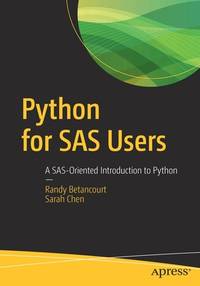
Stock photo: cover may vary
Python for SAS Users: A SAS-Oriented Introduction to Python Paperback - 2019
by Betancourt, Randy
- Used
- Paperback
- first
A$79.32
Free Delivery within USA
Standard delivery: 5 to 10 days
More delivery options
Standard delivery: 5 to 10 days
Dropship order
Ships from Ergodebooks (Texas, United States)
Details
- Title Python for SAS Users: A SAS-Oriented Introduction to Python
- Author Betancourt, Randy
- Binding Paperback
- Edition 1st ed
- Condition Used: Good
- Pages 434
- Volumes 1
- Language ENG
- Publisher Apress
- Publication date 2019-09-06
- Illustrated Yes
- Features Illustrated
- Bookseller's Inventory # SONG1484250001
- ISBN 9781484250006 / 1484250001
- Weight 1.72 lbs (0.78 kg)
- Dimensions 10 x 7 x 0.92 in (25.40 x 17.78 x 2.34 cm)
- Size 7.01x1.02x10.00
- Category Computers - Languages / Programming
- Dewey Decimal Code 005.133
- Quantity available 1
About Ergodebooks Texas, United States
Biblio member since 2005
Our goal is to provide best customer service and good condition books for the lowest possible price. We are always honest about condition of book. We list book only by ISBN # and hence exact book is guaranteed.
We have 30 day return policy.
Reader reviews for Python for SAS Users: A SAS-Oriented Introduction to Python
Write a review for this book
Important Terms and Guidelines
- Please focus on the book’s content and context. Also, add any personal comments as to how you enjoyed the book. Substantiate your likes and dislikes. You may make comparisons to other books.
- Reviews must be at least 140 characters in length.
- Please do not reveal critical plot elements.
- This is not a help line. Contact customer support if you need help.
Your review must not include:
- Obscenities, discriminatory language, or other insulting language not suitable for public domain
- Advertisements, “spam” content, or references to other products, offers or websites.
- Email addresses, URLs, phone numbers, physical addresses or other contact information.
- Overly critical comments about other reviews or reviewers
- Time-sensitive material (i.e. promotional tours, seminars, lectures, etc.)
- Availability, price, or alternative ordering/shipping information
From the publisher
From the rear cover
Business users familiar with Base SAS programming can now learn Python by example. You will learn via examples that map SAS programming constructs and coding patterns into their Python equivalents. Your primary focus will be on pandas and data management issues related to analysis of data.
It is estimated that there are three million or more SAS users worldwide today. As the data science landscape shifts from using SAS to open source software such as Python, many users will feel the need to update their skills. Most users are not formally trained in computer science and have likely acquired their skills programming SAS as part of their job.
As a result, the current documentation and plethora of books and websites for learning Python are technical and not geared for most SAS users. Python for SAS Users provides the most comprehensive set of examples currently available. It contains over 200 Python scripts and approximately 75 SAS programs that are analogs tothe Python scripts. The first chapters are more Python-centric, while the remaining chapters illustrate SAS and corresponding Python examples to solve common data analysis tasks such as reading multiple input sources, missing value detection, imputation, merging/combining data, and producing output. This book is an indispensable guide for integrating SAS and Python workflows.What You'll Learn:
- Quickly master Python for data analysis without using a trial-and-error approach
- Understand the similarities and differences between Base SAS and Python
- Better determine which language to use, depending on your needs
- Obtain quick results

