BIBLIO is the largest independent book marketplace in the world, with over 100 million books.

Skip to content

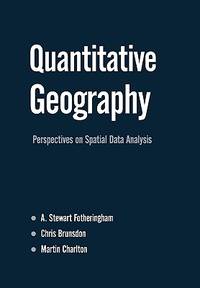
Quantitative Geography : Perspectives on Spatial Data Analysis

Quantitative Geography : Perspectives on Spatial Data Analysis

Quantitative Geography : Perspectives on Spatial Data Analysis
Stock photo: cover may vary

Quantitative Geography : Perspectives on Spatial Data Analysis Paperback - 2000

by Brunsdon, Chris, Fotheringham, A. Stewart, Charlton, Martin

Add to wish list
  • Used
Used - Good

Description

SAGE Publications, Limited. Used - Good. Former library copy. Pages intact with minimal writing/highlighting. The binding may be loose and creased. Dust jackets/supplements are not included. Includes library markings. Stock photo provided. Product includes identifying sticker. Better World Books: Buy Books. Do Good.
Ask the seller a question Add to wish list
A$10.12
A$10.12 Delivery to USA
Standard delivery: 5 to 21 days
More delivery options
Ships from Better World Books Ltd (Fife, United Kingdom)

Details

  • Title Quantitative Geography : Perspectives on Spatial Data Analysis
  • Author Brunsdon, Chris, Fotheringham, A. Stewart, Charlton, Martin
  • Binding Paperback
  • Edition [ Edition: first
  • Condition Used - Good
  • Pages 288
  • Volumes 1
  • Language ENG
  • Publisher SAGE Publications, Limited, London
  • Publication date 2000-05-02
  • Bookseller's Inventory # GRP35206166
  • ISBN 9780761959489 / 0761959483
  • Weight 1.08 lbs (0.49 kg)
  • Dimensions 9.64 x 6.74 x 0.64 in (24.49 x 17.12 x 1.63 cm)
  • Category Science
  • Library of Congress subjects Geographic information systems, Geography - Statistical methods
  • Library of Congress Catalogue Number 00698468
  • Dewey Decimal Code 910.02
  • Quantity available 1

About Better World Books Ltd Fife, United Kingdom

Biblio member since 2009

Better World Books is a for-profit, socially conscious business and a global online bookseller that collects and sells new and used books online, matching each purchase with a book donation. Each sale generates funds for literacy and education initiatives in the U.S., the U.K., and around the world. Since its launch in 2003, Better World Books has raised over $35 million for libraries and literacy, donated over 38 million books, and reused or recycled more than 475 million books.

Terms of Sale: Better World Books ("BWB") values your satisfaction and offers you returns within thirty (30) days after the estimated delivery date on most items. All returned items must be in the original condition; used items should include the SKU sticker located on the spine or back of the product. If you have an incomplete, incorrect, or damaged shipment, please contact our Customer Care team via Biblio's contact seller options before proceeding with the return. Please keep in mind that because we deal mostly in used books, any extra components, such as CDs, DVDs, figurines, or access codes are not included.

Browse books from Better World Books Ltd

Reader reviews for Quantitative Geography : Perspectives on Spatial Data Analysis

From the publisher

Quantitative Geography is a lucid and comprehensive overview of the use of quantitative methods in spatial data analysis. It focuses on the philosophy informing spatial analysis and demonstrates the significant differences between modern quantitative methods and the methods associated with Geography′s ′Quantitative Revolution′ in the sixties. The text integrates a discussion of the application of quantitative methods with practical examples, and explains the philosophy of the new quantitative methodologies. Comprising a discussion of specific techniques, Quantitative Geography critically examines the profound difference in the use of those techniques since the quantitative revolution.

Key issues include: spatial data; geographical information systems; visualization; local analysis; point pattern analysis; spatial regression; and statistical inference. Concluding with a review of models used in spatial theory, the text goes on to discuss the current challenges to spatial data analysis.

Written to be accessible, to communicate the diversity and excitement of recent thinking, Quantitative Geography will be required reading for students and researchers in any discipline where quantitative methods are used to analyze spatial data.

". . . this is an excellent piece of work! The book is particularly important for those who are dealing with spatial data, both geographers and researchers in other disciplines, and those who wish to appreciate newly developing techniques in spatial analysis. It would make an outstanding textbook and is an essential reference work."
- THE ANNALS OF THE ASSOCIATION OF AMERICAN GEOGRAPHERS

This is a veritable tour de force of everything that is exciting about quantitative geography and GIS. It is a timely, thorough and exciting account of the state of the art and science of spatial analysis′
- Paul Longley, University of Bristol


A highly innovative and up-to-date text. It is unique in its coverage of the many developments that have taken place in the field over the past few years. The book is one that is highly readable and stimulating for those with some background in the field, and its expositional style and many examples will make it stimulating to newcomers as well′
- Peter Rogerson, State University of New York at Buffalo

Brings the field thoroughly up to date, integrating modern methods of GIS with a comprehensive and easy-to-read overview of the most recent and powerful techniques of spatial analysis. The book will be valuable to students and researchers in any discipline that seeks to explore or explain phenomena in geographical context, and will make excellent reading for geographers, political scientists, criminologists, anthropologists, geologists, epidemiologists, ecologists, and many others. It offers a spirited challenge to critics of a scientific approach to social science, and demonstrates the value of its subject matter through abundant examples′
- Michael Goodchild, National Center for Geographic Information and Analysis, University of California, Santa Barbara

There is a view within some parts of academic geography that what used to be called "quantitative geography" is dead, having been subsumed within "geographical information systems" or else of no continuing interest. This book should correct this view. First, it shows that quantitative methods have remained an exciting area of development and, second, it shows that, if anything, they have more relevance to substantive problems of interest than they have ever had. Although not specifically about GIS, it is a book that should be read by everyone concerned with the analysis of geographical information′
- David Unwin, Birkbeck College, University of London

About the author

Stewart Fotheringham is Professor of Quantitative Geography at the University of Newcastle′. Chris Brunsdon is Lecturer in Computer Based Methods, Department of Town and Country Planning, University of Newcastle. Martin Charlton is Lecturer in Geographical Information Systems, Department of Geography, University of Newcastle.
tracking-