
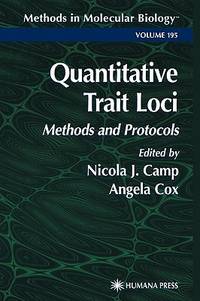
Stock photo: cover may vary
Quantitative Trait Loci Hardback -
by Nicola J. Camp (Editor); Angela Cox (Editor)
- New
- Hardback
A$110.52
A$5.78
Delivery within USA
Standard delivery: 9 to 14 days
More delivery options
Standard delivery: 9 to 14 days
Ships from Cold Books (New York, United States)
Details
- Title Quantitative Trait Loci
- Author Nicola J. Camp (Editor); Angela Cox (Editor)
- Binding Hardback
- Edition U. S. EDITION
- Condition New
- Pages 360
- Volumes 1
- Language ENG
- Publisher Humana Press , USA
- Publication date pp. 376
- Illustrated Yes
- Features Bibliography, Illustrated, Index
- Bookseller's Inventory # 6255768
- ISBN 9780896039278 / 0896039277
- Weight 1.63 lbs (0.74 kg)
- Dimensions 9.28 x 6.26 x 1.16 in (23.57 x 15.90 x 2.95 cm)
- Category Science
- Library of Congress subjects Gene mapping, Phenotype
- Library of Congress Catalogue Number 2001039828
- Dewey Decimal Code 576.507
- Quantity available 1
About Cold Books New York, United States
Reader reviews for Quantitative Trait Loci
Write a review for this book
Important Terms and Guidelines
- Please focus on the book’s content and context. Also, add any personal comments as to how you enjoyed the book. Substantiate your likes and dislikes. You may make comparisons to other books.
- Reviews must be at least 140 characters in length.
- Please do not reveal critical plot elements.
- This is not a help line. Contact customer support if you need help.
Your review must not include:
- Obscenities, discriminatory language, or other insulting language not suitable for public domain
- Advertisements, “spam” content, or references to other products, offers or websites.
- Email addresses, URLs, phone numbers, physical addresses or other contact information.
- Overly critical comments about other reviews or reviewers
- Time-sensitive material (i.e. promotional tours, seminars, lectures, etc.)
- Availability, price, or alternative ordering/shipping information
From the publisher
First line
A classical case-control study design is frequently used in genetic epidemiology to investigate the association between genotype and the presence or absence of disease.
From the rear cover
Statistical methods for the analysis of quantitative trait locus (QTL), in conjunction with genome-wide screening technologies, are today yielding exciting results in the study of human disease, experimental organisms, and agriculture. In Quantitative Trait Loci: Methods and Protocols, Drs. Nicola Camp and Angela Cox have assembled a highly experienced panel of statistical geneticists who demonstrate in a step-by-step fashion how to use this powerful methodology and associated software for the detection and fine mapping of quantitative trait loci. Writing for the nonmathematician, these experts guide the investigator from the design stage of a project onwards, providing detailed explanations of how best to proceed with each specific analysis, to find and use appropriate software, and to interpret results. Worked examples, citations to key papers, and useful variations and/or extensions to standard methods are included that ease the reader toward understanding and successful studies. Among the cutting-edge techniques presented are QTDT methods, variance components methods, and the Markov chain Monte Carlo method for joint linkage and segregation analysis.
Up-to-date and highly practical, Quantitative Trait Loci: Methods and Protocols makes available to nonmathematical investigators a step-by-step guide to the productive use today of all the latest techniques for localizing genes involved in complex quantitative traits.
Up-to-date and highly practical, Quantitative Trait Loci: Methods and Protocols makes available to nonmathematical investigators a step-by-step guide to the productive use today of all the latest techniques for localizing genes involved in complex quantitative traits.

