BIBLIO is the largest independent book marketplace in the world, with over 100 million books.

Skip to content

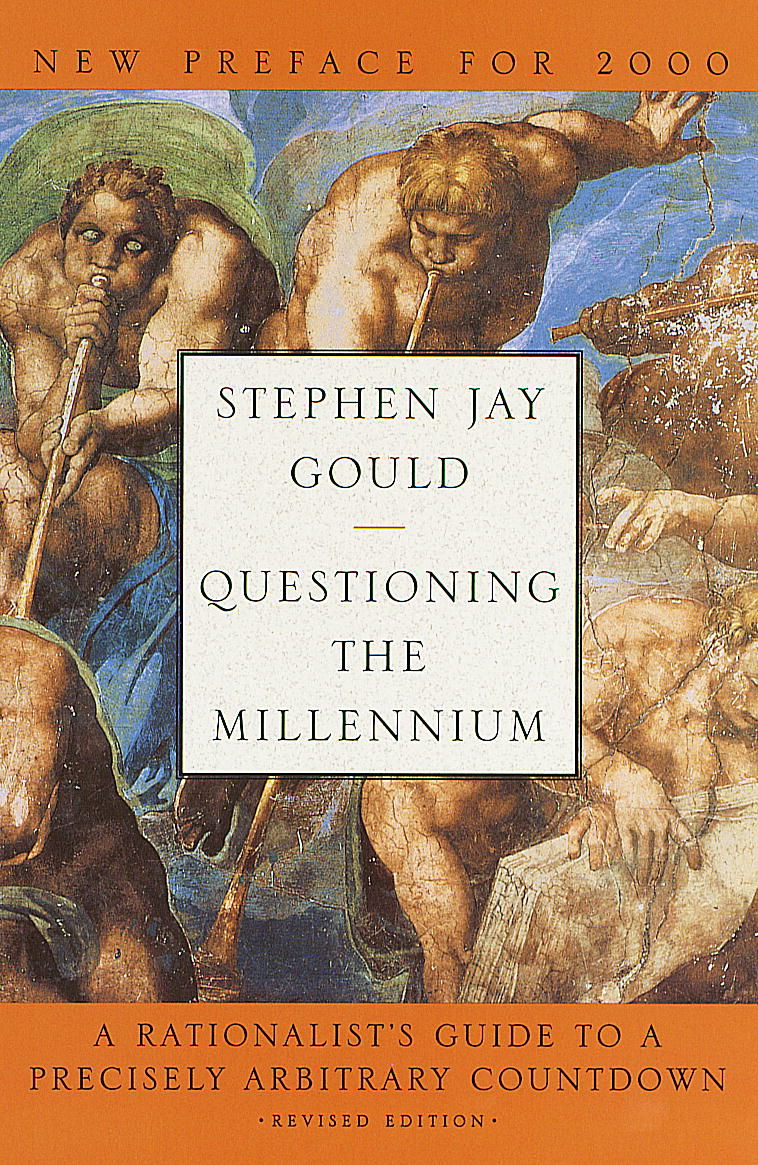
Questioning the Millennium: A Rationalist's Guide to a Precisely Arbitrary Countdown (Revised Edition)

Questioning the Millennium: A Rationalist's Guide to a Precisely Arbitrary Countdown (Revised Edition)

Questioning the Millennium: A Rationalist's Guide to a Precisely Arbitrary
Stock photo: cover may vary

Questioning the Millennium: A Rationalist's Guide to a Precisely Arbitrary Countdown (Revised Edition) Hardback - 1999

by Gould, Stephen Jay

Add to wish list
  • Used
  • very good
Used - Very good

Description

Harmony Books. Revised. Very Good. It's a well-cared-for item that has seen limited use. The item may show minor signs of wear. All the text is legible, with all pages included. It may have slight markings and/or highlighting.
Ask the seller a question Add to wish list
A$8.67
Free Delivery within USA
Standard delivery: 7 to 14 days
More delivery options
Ships from BooksRun (Pennsylvania, United States)

Details

About BooksRun Pennsylvania, United States

Specialising in: Textbooks
Biblio member since 2016

BooksRun - best place to buy, sell or rent cheap textbooks

Terms of Sale:

30 days return guarantee. 10% restocking fee applies to discretionary returns

Browse books from BooksRun

Reader reviews for Questioning the Millennium: A Rationalist's Guide to a Precisely Arbitrary Countdown (Revised Edition)

From the publisher

In this new edition of Questioning the Millennium, best-selling author Stephen Jay Gould applies his wit and erudition to one of today's most pressing subjects: the significance of the millennium.

In 1950 at age eight, prompted by an issue of Life magazine marking the century's midpoint, Stephen Jay Gould started thinking about the approaching turn of the millennium. In this beautiful inquiry into time and its milestones, he shares his interest and insights with his readers. Refreshingly reasoned and absorbing, the book asks and answers the three major questions that define the approaching calendrical event. First, what exactly is this concept of a millennium and how has its meaning shifted? How did the name for a future thousand-year reign of Jesus Christ on earth get transferred to the passage of a secular period of a thousand years in current human history? When does the new millennium really begin: January 1, 2000, or January 1, 2001? (Although seemingly trivial, the debate over this issue tells an intriguing story about the cultural history of the twentieth century.) And why must our calendars be so complex, leading to our search for arbitrary regularity, including a fascination with millennia? This revised edition begins with a new and extensive preface on a key subject not treated in the original version.

As always, Gould brings into his essays a wide range of compelling historical and scientific fact, including a brief history of millennial fevers, calendrical traditions, and idiosyncrasies from around the world; the story of a sixth-century monk whose errors in chronology plague us even today; and the heroism of a young autistic man who has developed the extraordinary ability to calculate dates deep into the past and the future.

Ranging over a wide terrain of phenomena--from the arbitrary regularities of human calendars to the unpredictability of nature, from the vagaries of pop culture to the birth of Christ--Stephen Jay Gould holds up the mirror to our millennial passions to reveal our foibles, absurdities, and uniqueness--in other words, our humanity.

First line

We inhabit a world of infinite and wondrous variety, a source of potential joy, especially if we can recapture childhood's fresh delight for "splendor in the grass" and "glory in the flower."

Excerpt

I have always and dearly loved calendrical questions because they display all our foibles in revealing miniature. Where else can we note, so vividly revealed, such an intimate combination of all the tricks that recalcitrant nature plays upon us, linked with all the fallacies of reason, and all the impediments of habit and emotion, that make the fulfillment of our urge to understand even more difficult - in other words, of both the external pitfalls to knowledge. Yet we press on regardless - and we do manage to get somewhere.

I think that I love humanity all the more - the scholar's hang-up, I suppose - when our urge to know transcends mere practical advantage. Societies that both fish and farm need to reconcile the incommensurate cycles of years and lunations. Since nature permits no clean and crisp correlation, people had to devise the cumbersome, baroque Metonic Cycle. And this achievement by several independent societies can only be called heroic.
        
I recognize this functional need to know, and I surely honor it as a driving force in human history. But when Paleolithic Og looked out of his cave and up at the heavens - and asked why the moon had phases, not because he could use the information to boost his success in gathering shellfish at the nearby shore, but because he just wanted to resolve a mystery, and because he sensed, however dimly, that something we might call recurrent order, and regard as beautiful for this reason alone, must lie behind the overt pattern - well, then calendrical questions became sublime, and so did humanity as well.
        
If we regard millennial passion in particular, and calendrical fascination in general, as driven by the pleasure of ordering and the joy of understanding, then this strange little subject - so often regarded as the province of drones or eccentrics, but surely not of grand or expansive thinkers - becomes a wonderful microcosm for everything that makes human beings so distinctive, so potentially noble, and often so actually funny. Socrates and Charlie Chaplin reached equal heights of sublimity.

Media reviews

"Gould poses three questions about the millennium in this delicious science-historical jeu d'esprit. . . . [This] may be the most enjoyable millennium book of the second millennium."                
-- Booklist

"With a humorous Everyman approach, Gould juggles a mind-boggling array of various calendrical concepts as he explains why creating a reliable calendar was one of man's greatest struggles. Whether nailing down the precise date of the birth of Christ or airing his suspicion that God is a New York Yankees fan, Gould teaches rather than preaches."                
-- Entertainment Weekly

"Gould eloquently charts . . . our stubborn, foolish, and occasionally glorious efforts, through science, religion, and philosophy, to continue to try to understand."        
-- New York Times

"In Questioning the Millennium, a collection of three witty and erudite essays . . . the noted paleontologist and science popularizer ponders the meaning of the upcoming calendar hoopla. As always, he is irreverent, idiosyncratic, and original."
-- San Francisco Examiner and Chronicle

"However out-of-left-field the subject, [Gould] still manages to charm with characteristically energetic, down-to-earth lucidity. Gently iconoclastic, always illuminating essays from the science writer whose prose can bring to life not only theories but even the fossils themselves."        
-- Kirkus Reviews

About the author

Stephen Jay Gould was one of the most influential evolutionary biologists and most acclaimed science essayists of the 20th century. He died in May 2002. He was the author of numerous books, including The Lying Stones of Marrakech and Questioning the Millennium.
tracking-