
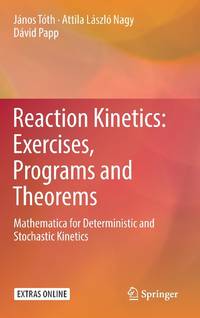
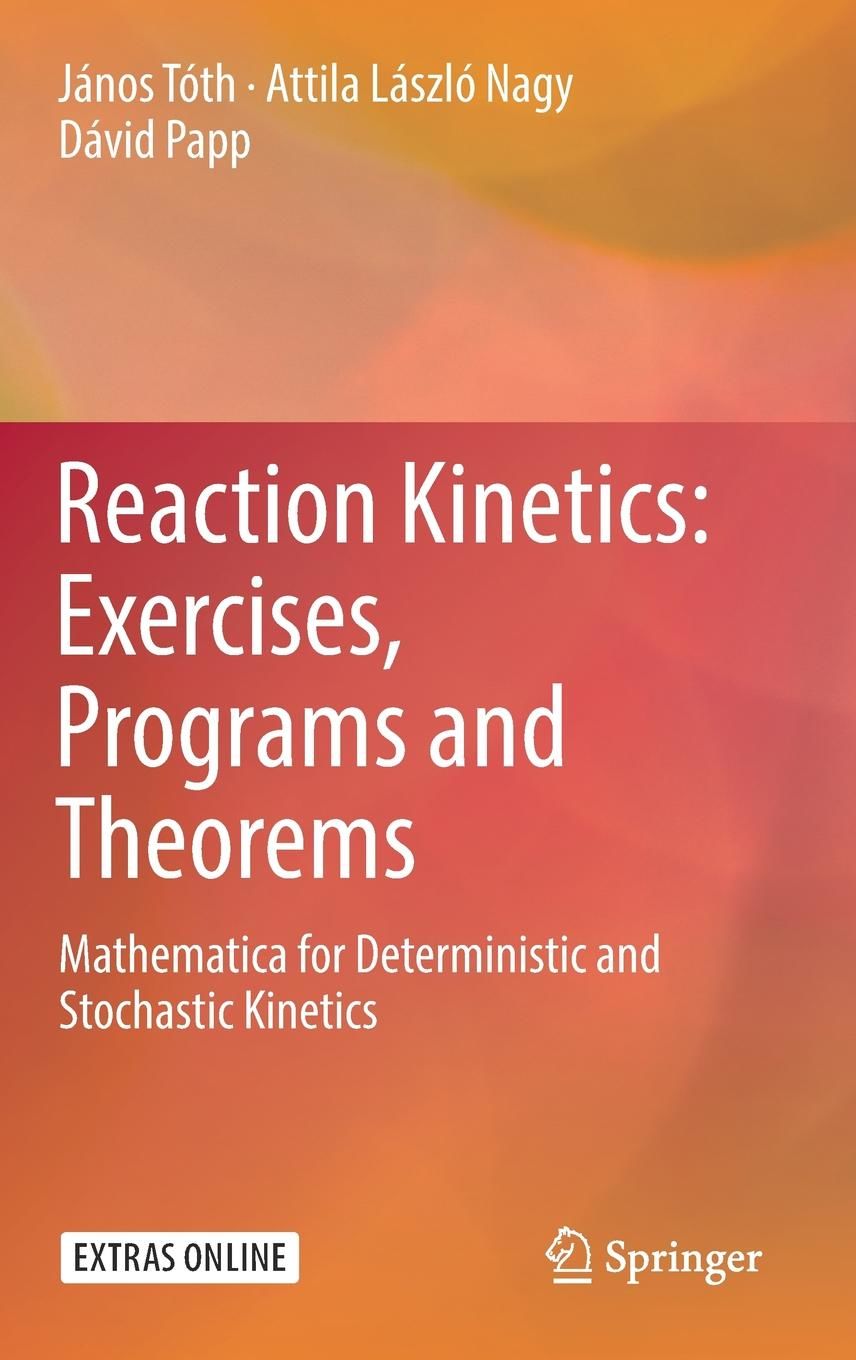
Reaction Kinetics: Exercises, Programs and Theorems : Mathematica for Deterministic and Stochastic Kinetics Hardback -
by János Tóth
- New
- Hardback
A$158.46
A$15.60
Delivery to USA
Standard delivery: 7 to 12 days
More delivery options
Standard delivery: 7 to 12 days
Ships from Ria Christie Collections (Greater London, United Kingdom)
Details
- Title Reaction Kinetics: Exercises, Programs and Theorems : Mathematica for Deterministic and Stochastic Kinetics
- Author János Tóth
- Binding Hardback
- Condition New
- Features Glossary, Illustrated
- Bookseller's Inventory # ria9781493986415_inp
- ISBN 9781493986415
- Quantity available 467
About Ria Christie Collections Greater London, United Kingdom
Biblio member since 2014
Hello We are professional online booksellers. We sell mostly new books and textbooks and we do our best to provide a competitive price. We are based in Greater London, UK. We pride ourselves by providing a good customer service throughout, shipping the items quickly and replying to customer queries promptly. Ria Christie Collections
30 day return guarantee, with full refund including original shipping costs for up to 30 days after delivery if an item arrives misdescribed or damaged.
Reader reviews for Reaction Kinetics: Exercises, Programs and Theorems : Mathematica for Deterministic and Stochastic Kinetics
Write a review for this book
Important Terms and Guidelines
- Please focus on the book’s content and context. Also, add any personal comments as to how you enjoyed the book. Substantiate your likes and dislikes. You may make comparisons to other books.
- Reviews must be at least 140 characters in length.
- Please do not reveal critical plot elements.
- This is not a help line. Contact customer support if you need help.
Your review must not include:
- Obscenities, discriminatory language, or other insulting language not suitable for public domain
- Advertisements, “spam” content, or references to other products, offers or websites.
- Email addresses, URLs, phone numbers, physical addresses or other contact information.
- Overly critical comments about other reviews or reviewers
- Time-sensitive material (i.e. promotional tours, seminars, lectures, etc.)
- Availability, price, or alternative ordering/shipping information
From the publisher
From the rear cover
Fifty years ago, a new approach to reaction kinetics began to emerge: one based on mathematical models of reaction kinetics, or formal reaction kinetics. Since then, there has been a rapid and accelerated development in both deterministic and stochastic kinetics, primarily because mathematicians studying differential equations and algebraic geometry have taken an interest in the nonlinear differential equations of kinetics, which are relatively simple, yet capable of depicting complex behavior such as oscillation, chaos, and pattern formation.The development of stochastic models was triggered by the fact that novel methods made it possible to measure molecules individually. Now it is high time to make the results of the last half-century available to a larger audience: students of chemistry, chemical engineering and biochemistry, not to mention applied mathematics. Based on recent papers, this book presents the most important concepts and results, together with a wealth of solvedexercises. The book is accompanied by the authors' Mathematica package, ReactionKinetics, which helps both students and scholars in their everyday work, and which can be downloaded from http: //extras.springer.com/ and also from the authors' websites. Further, the large set of unsolved problems provided may serve as a springboard for individual research.

