BIBLIO is the largest independent book marketplace in the world, with over 100 million books.

Skip to content

Reading Educational Research : How to Avoid Getting Statistically Snookered

Reading Educational Research : How to Avoid Getting Statistically Snookered

Reading Educational Research : How to Avoid Getting Statistically Snookered
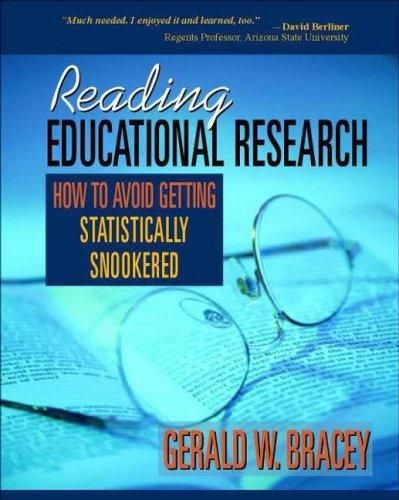
Stock photo: cover may vary

Reading Educational Research : How to Avoid Getting Statistically Snookered Paperback - 2006

by Bracey, Gerald W

Add to wish list
  • Used
Used - Very good

Description

Heinemann. Used - Very Good. Pages intact with possible writing/highlighting. Binding strong with minor wear. Dust jackets/supplements may not be included. Stock photo provided. Product includes identifying sticker. Better World Books: Buy Books. Do Good.
Ask the seller a question Add to wish list
A$10.62
Free Delivery within USA
Standard delivery: 4 to 8 days
More delivery options
Ships from Better World Books (Indiana, United States)

Details

  • Title Reading Educational Research : How to Avoid Getting Statistically Snookered
  • Author Bracey, Gerald W
  • Binding Paperback
  • Edition [ Edition: first
  • Condition Used - Very good
  • Pages 208
  • Volumes 1
  • Language ENG
  • Publisher Heinemann, Portsmouth, New Hampshire
  • Publication date 2006-02
  • Illustrated Yes
  • Features Bibliography, Illustrated, Index, Table of Contents
  • Bookseller's Inventory # 4756836-6
  • ISBN 9780325008585 / 0325008582
  • Weight 0.81 lbs (0.37 kg)
  • Dimensions 9.08 x 6.58 x 0.45 in (23.06 x 16.71 x 1.14 cm)
  • Category Education / Teaching
  • Library of Congress subjects Education - Research - United States, Educational statistics - United States
  • Library of Congress Catalogue Number 2005034445
  • Dewey Decimal Code 370.72
  • Quantity available 2

About Better World Books Indiana, United States

Biblio member since 2005

Better World Books is a for-profit, socially conscious business and a global online bookseller that collects and sells new and used books online, matching each purchase with a book donation. Each sale generates funds for literacy and education initiatives in the U.S., the UK, and around the world. Since its launch in 2003, Better World Books has raised over $35 million for libraries and literacy, donated over 38 million books, and reused or recycled more than 475 million books.

Terms of Sale: Better World Books ("BWB") values your satisfaction and offers you returns within thirty (30) days after the estimated delivery date on most items. All returned items must be in the original condition; used items should include the SKU sticker located on the spine or back of the product. If you have an incomplete, incorrect, or damaged shipment, please contact our Customer Care team via Biblio's contact seller options before proceeding with the return. Please keep in mind that because we deal mostly in used books, any extra components, such as CDs, DVDs, figurines, or access codes are not included.

Browse books from Better World Books

Reader reviews for Reading Educational Research : How to Avoid Getting Statistically Snookered

From the publisher

    Gerald Bracey's primer on statistics comes out exactly when we need it most: when school folks are being driven crazy by the bureaucrats' insistence on "data-driven" everything. But Bracey makes clear that data is rarely what it seems, and that both its producers and its users need to be much more sophisticated about what it is and isn't.
    Susan Harman, Principal, Growing Children School, California
Stats, stats, stats. It seems everything written about education today is full of stats. Stats about reading and writing competency; stats about graduation and retention rates; stats comparing U.S. students to other countries' students; stats about how many students meet state education mandates. With so many numbers in education these days, how do you discern what's data and what's dada?

With Reading Education Research, nimble-minded number cruncher and award-winning researcher Gerald Bracey takes your hand and walks you through the process of figuring out the meaning behind the figures. You don't need to be a math whiz to follow Bracey because he writes with clarity and humor, explicitly defining statistical terminology in easy-to-understand language and even offering you thirty-two specific principles for assessing the quality of research as you read it.

Reading Education Research includes four major themes that every classroom teacher will find helpful as they read research and talk about it with colleagues, parents, or administrators, including:

  • understanding data and how it is used-and misused
  • uncovering how variables are used in the construction of scientifically based research-and manipulated in politically motivated research
  • drawing conclusions about a study and deciding whether the data presented is meaningful
  • assessing the data that comes from standardized testing.
Don't be numbed by the numbers or get hung up on histograms. Before you read another piece of educational research, get Reading Education Research and let Gerald Bracey guide you to a firm understanding of the story behind the stats.

About the author

Beginning in 1984 Gerald W. Bracey wrote a monthly column for Phi Delta Kappan making research accessible to teaching practitioners. In 2003 the column received the Interpretive Scholarship Award from the American Educational Research Association. Bracey was both an independent researcher and writer and worked at both George Mason University and the High/Scope Educational Research Foundation. He earned a Ph.D. in developmental psychology from Stanford University and held positions in private firms, local school districts, universities, and state departments of education.

tracking-